Home
Class 12
PHYSICS
Each resistor in the following circuit h...

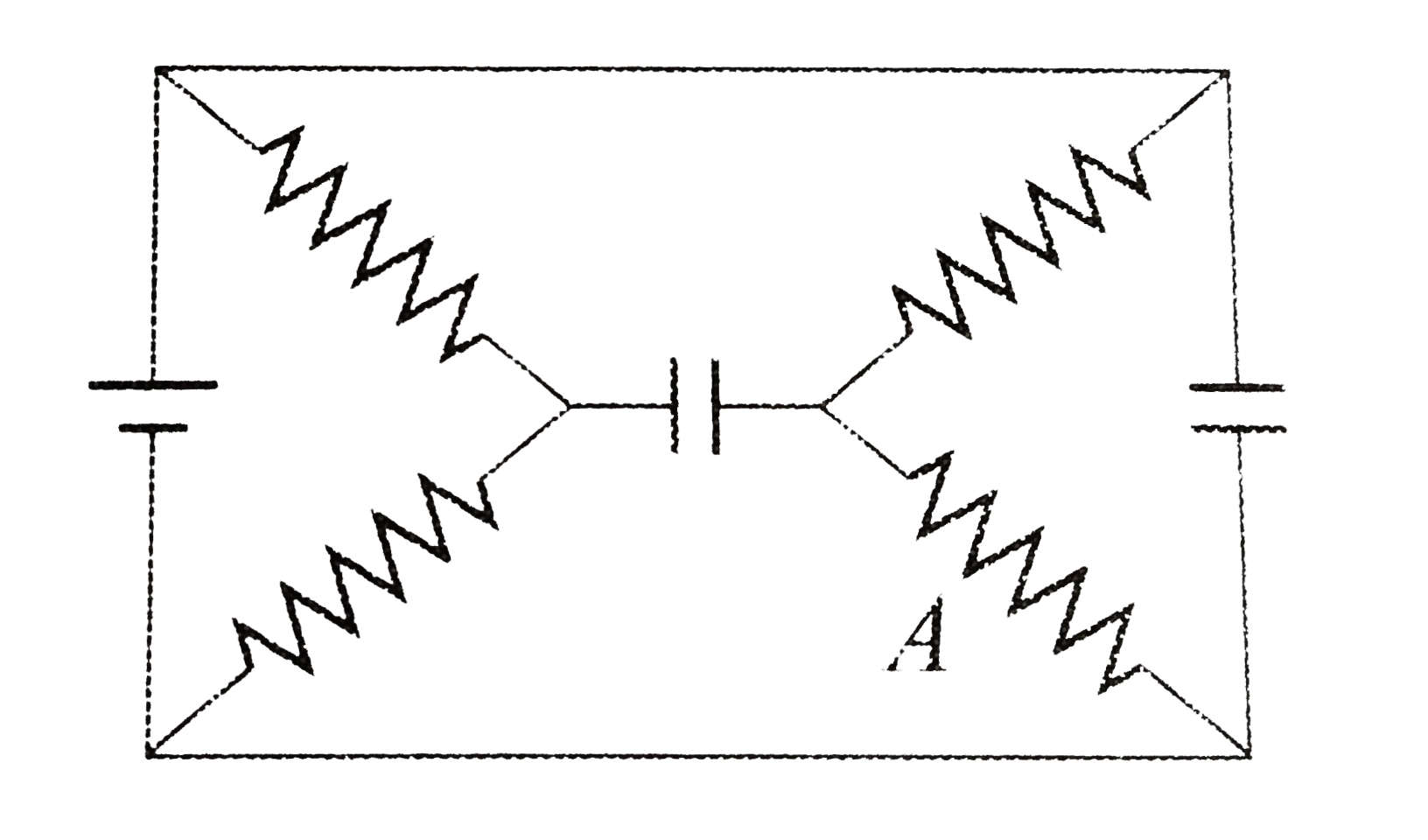
Each resistor in the following circuit has a resistance of `2 M Omega` and the capacitors have capacitances of `1muF`. The battery voltage is 3V. The voltage across the resistor A in the following circuit in steady state is

A

0 V

B

0.5 V

C

0.75 V

D

1.5 V

Text Solution

Verified by Experts

The correct Answer is:
D

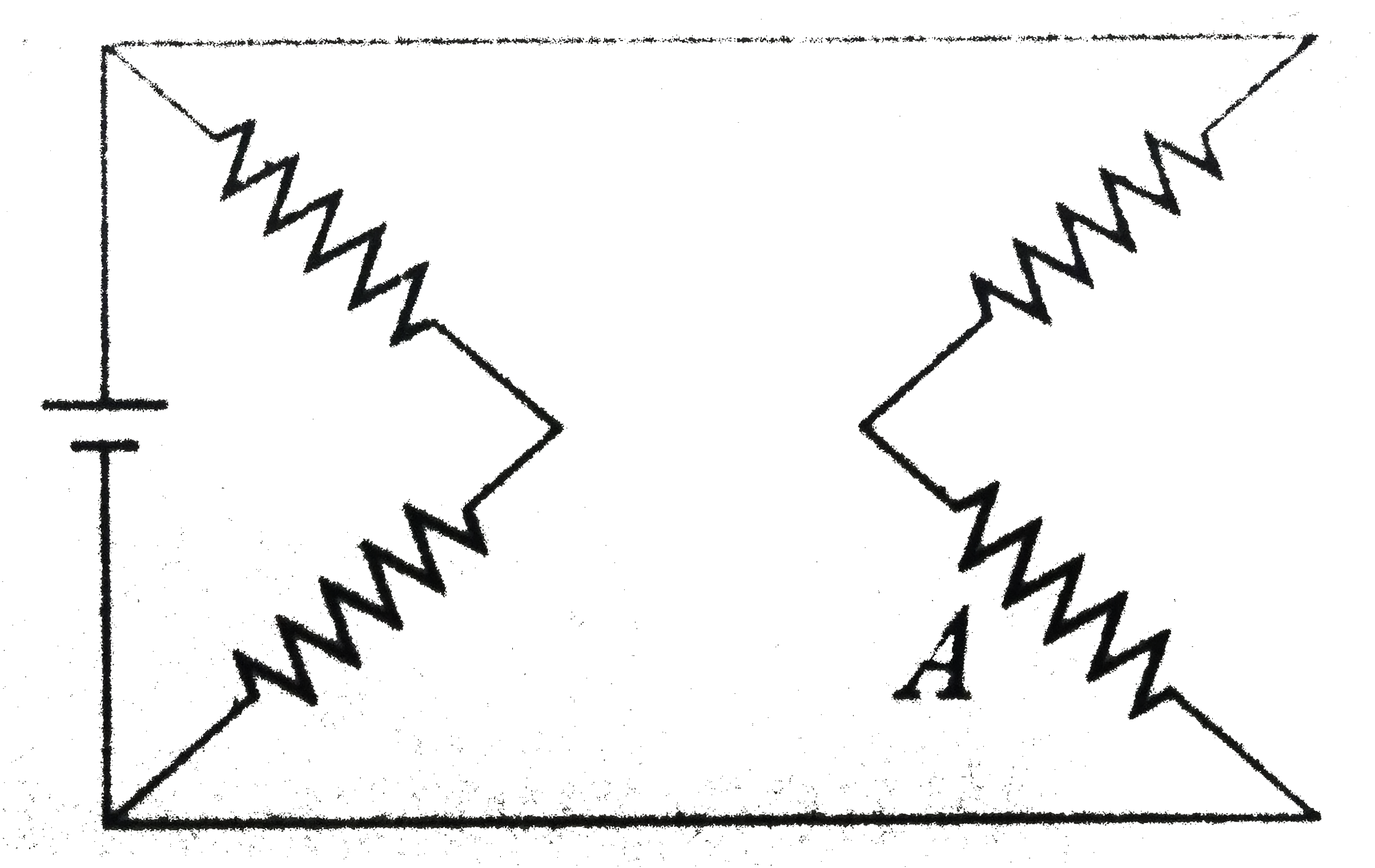
d. This is a dc circuit because the battery is the only source of voltage.
Hence, the capacitors behave like
open circuits. An equivalent circuit
is then two parallel sets of two
identical series resistors.
The voltage drop across
each parallel brabch must be the battery voltage of 3V.
Since the resistors are identical, there is an equal voltage
drop of 1.5 V across each resistor. In particular, there is a
drop of 1.5 V across resistor A.
Promotional Banner

Similar Questions

Explore conceptually related problems

A resistance of 200Omega and capacitor of 15muF are connected in series to a 220 V, 50 Hz AC source. The voltage (rms) across the resistor and capacitor is that

A circuit is shown below. If A is a capacitor, B is an ideal ammeter and C is an ideal battery of voltage V, what is the voltage across the capacitor?

The ratio of voltage across inductor/condenser to the voltage across resistor in a series resonance circuit is

An inductor is connected in series with a resistor of resistance 1000 Omega and a capacitor of capacitance 2 mu F. Potential difference of 100 V exists across the resistor . Angular frequency of source is 200 rad/s, and the same is equal to resonant frequency of the circuit find the rms voltage across inductor .

Three resistors having resistances of 1.60 Omega, 2.40 Omega and 4.80 Omega are connected in parallel to a 28.0 V battery that has negligible internal resistance. Find (a) the equivalent resistance of the combination. (b) the current in each resistor. (c) the total current through the battery. (d) the voltage across each resistor. (e) the power dissipated in each resistor. (f) which resistor dissipates the maximum power the one with the greatest resistance or the least resistance? Explain why this should be.

circuit consists of a source of EMF xi and internal resistance r, two capacitors each of capacitance C and two resistors, each of value R. The voltage across either capacitor is:

The circuit consists of two resistors (of resistance R_(1) = 20 Omega and R_(2) = 10 Omega ), a capacitor (of capacitance C =10 muF ) and two ideal cells. In the circuit shown the capacitor is in steady state and the switch S is open The charge on capacitor in steady state with switch S closed.

The circuit consists of two resistors (of resistance R_(1) = 20 Omega and R_(2) = 10 Omega ), a capacitor (of capacitance C =10 muF ) and two ideal cells. In the circuit shown the capacitor is in steady state and the switch S is open The current through the resistor R_(2) just after the switch S is closed is :

A series LCR circuit, has equal resistance capacitive reactance. What is the phase angle between voltage across generator and resistor ?

