Home
Class 12
PHYSICS
A resistance R = 12 Omega is connected a...

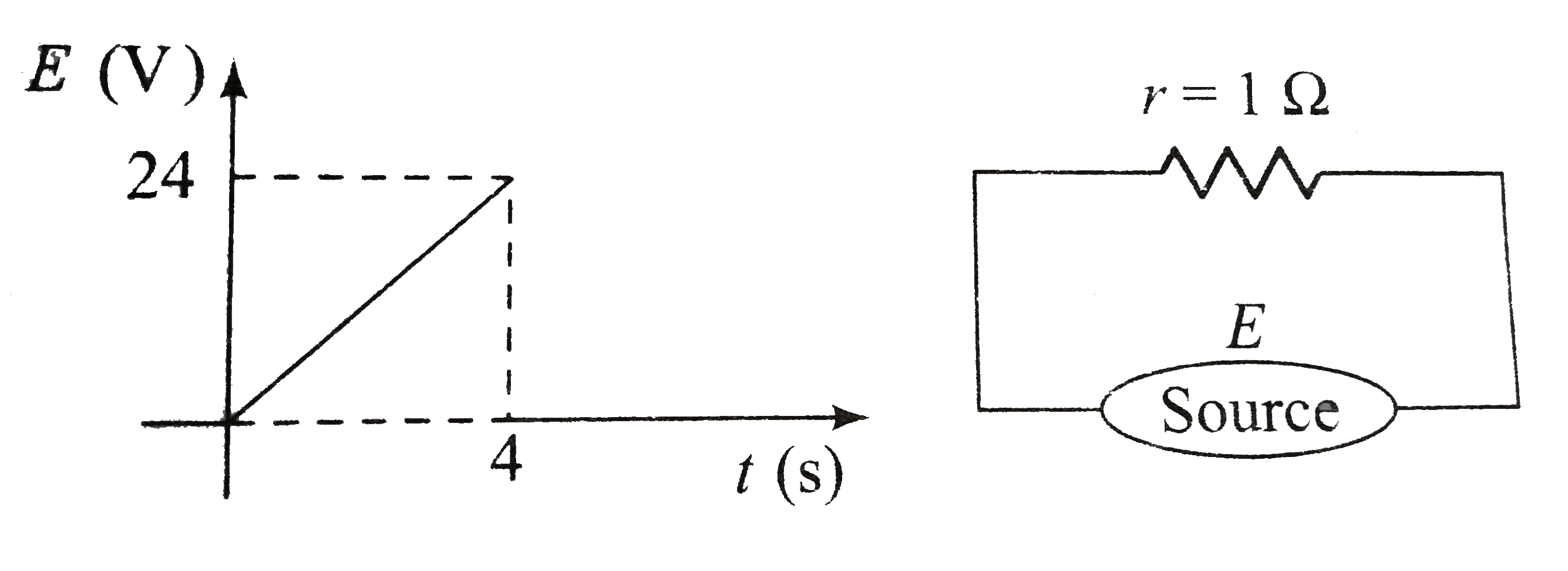
A resistance `R = 12 Omega` is connected across a source of emf as shown in the figure. Its emf changes with time as shown in the graph. What is the heat developed in the resistance in the first 4 s. ?

A

72 J

B

64 J

C

108 J

D

100 J

Text Solution

Verified by Experts

The correct Answer is:

B

b. `H = int_(0)^(4) (E^2)/R (dt) = int_(0)^(4) ((6t)^2dt)/12 = 64J`.
Promotional Banner

Similar Questions

Explore conceptually related problems

In the circuit shown in figure find the heat developed across each resistance in 2 s .

A cell E_1 of emf 6V and internal resistance 2 Omega is connected with another cell E_2 of emf 4V and internal resistance 8 Omega (as shown in the figure). The potential difference across points X and Y is :

A voltmeter has a resistance of 50 Omega is connected across a cell of e.m.f. 2V and internal resistance 10 Omega . The reading of voltmeter is

An inductor of inductance L = 400 mH and resistors of resistance R_(1) = 2Omega and R_(2) = 2Omega are connected to a battery of emf 12 V as shown in the figure. The internal resistance of the battery is negligible. The switch S is closed at t = 0 . The potential drop across L as a function of time is

The resistances of 20Omega are connected to a source of emf. Calculated the ratio of the heats produced in the two resistances when they are connected (i) In series and (ii) in parallel.

The resistances of 20Omega are connected to a source of emf. Calculated the ratio of the heats produced in the two resistances when they are connected (i) In series and (ii) in parallel.

An inductor of inductance L=400 mH and resistors of resistances R_1=2Omega and R_2=2Omega are connected to a battery of emf E=12 V as shown in the figure. The internal resistance of the battery is negligible. The switch S is closed at time t=0 . What is the potential dro across L s a function of time? After the steady state is reached, the switch is opened. What is the direction ad the magnitude of current throough R_1 as a function of time?
