Home
Class 12
PHYSICS
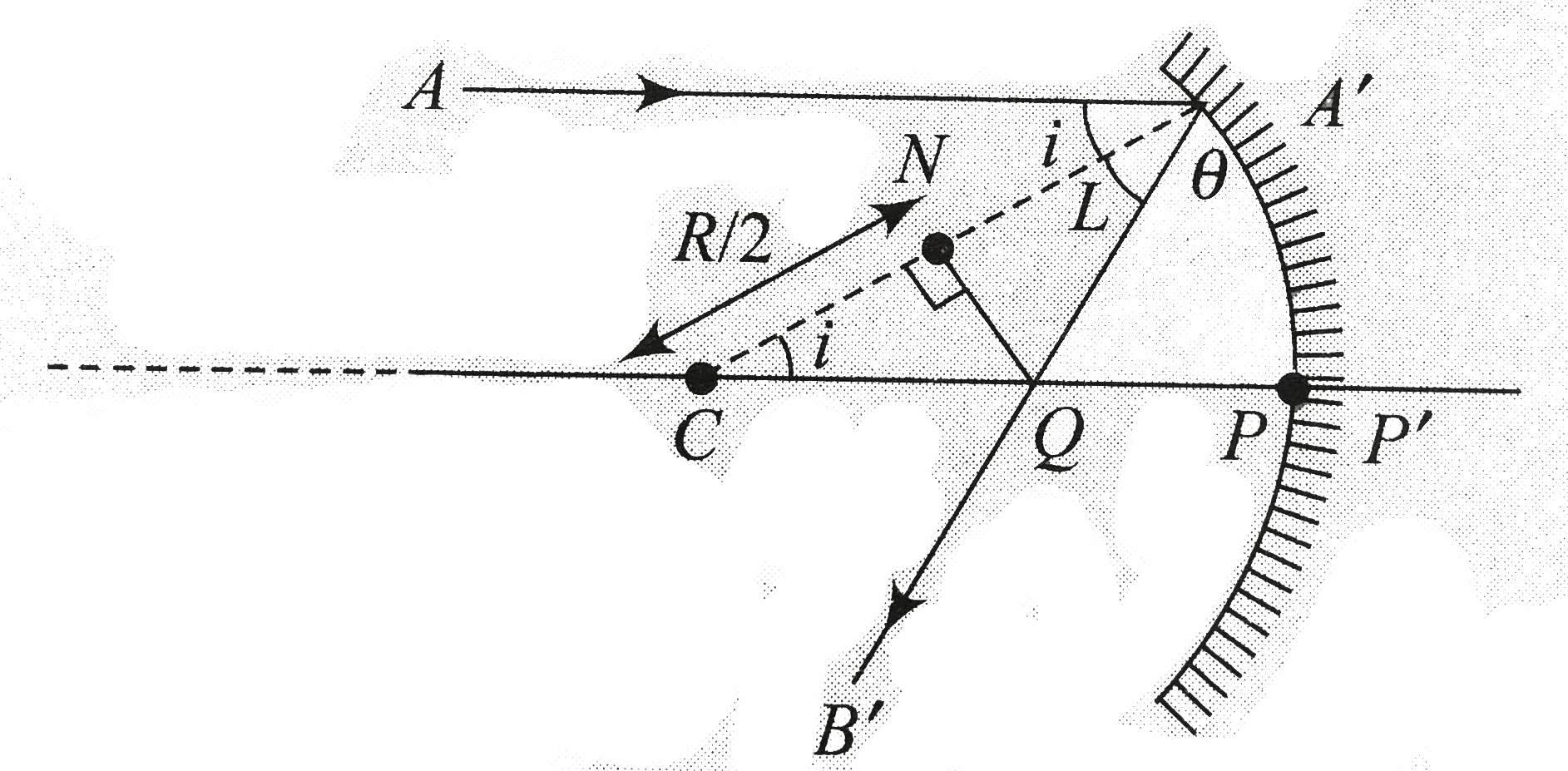
Find the distance CQ if incident light r...

Find the distance CQ if incident light ray parallel to principal axis is incident at an angle i. Also, find the distance CQ if `irarr0` .

Text Solution

Verified by Experts

In triangle CNQ, cos `i= R//2CQ rArr CQ = R//2 cos i`
As `i` increases `cos i` decreases. Hence, CQ increases.
If `i` is a small angle, `cos i~~ 1` (see Fig. (b)).
`:. CQ= R//2`
So, paraxial rays meet at a distance equal to `R//2` from center of curvature, which is call focus.
Promotional Banner

Topper's Solved these Questions

  • GEOMETRICAL OPTICS

    CENGAGE PHYSICS|Exercise Solved Examples|15 Videos
  • GEOMETRICAL OPTICS

    CENGAGE PHYSICS|Exercise Exercise1.1|14 Videos
  • FRICTION

    CENGAGE PHYSICS|Exercise QUESTION BANK|1 Videos
  • GRAVITATION

    CENGAGE PHYSICS|Exercise Question Bank|39 Videos

Similar Questions

Explore conceptually related problems

Radius of curvature of concave mirror is R and a light ray is incident on it parallel to principal axis at a height h above the principal axis. Calculate distance of the point from pole of mirror where reflected ray intersects with principal axis.

Monochromatic light rays parallel to the principal axis (the x axis) are incident on a convex lens of focal length f. If the lens oscillates such that it tilts up to a small angle theta on either side of the y axis, then find the distance between the exterme positions of the image. Take sec theta ~~ 1 + (theta^(2))/(2) for small theta .

A ray of light is incident on a concave mirror . It is parallel to the principal axis and its height from principal axis is equal to the focal length of the mirror. The ratio of the distance of point B to the distance of the focus from the centre of curvature is (AB is the reflected ray)

A parallel beam of monochromatic light of frequency v is incident on a surface. Intensity of the beam is I and area of the surface is A. Find the force exerted by the light beam on the surface for following cases– (i) the surface is perfectly absorbing and the light beam is incident normally on it. (ii) the surface is perfectly reflecting and the light beam is incident normally. (iii) the surface is perfectly absorbing and the light beam is incident at an angle of incidence theta . (iv) the surface is perfectly reflecting and the light beam is incident at an angle of incidence theta .
