Home
Class 12
PHYSICS
A spider is on the surface of a glass sp...

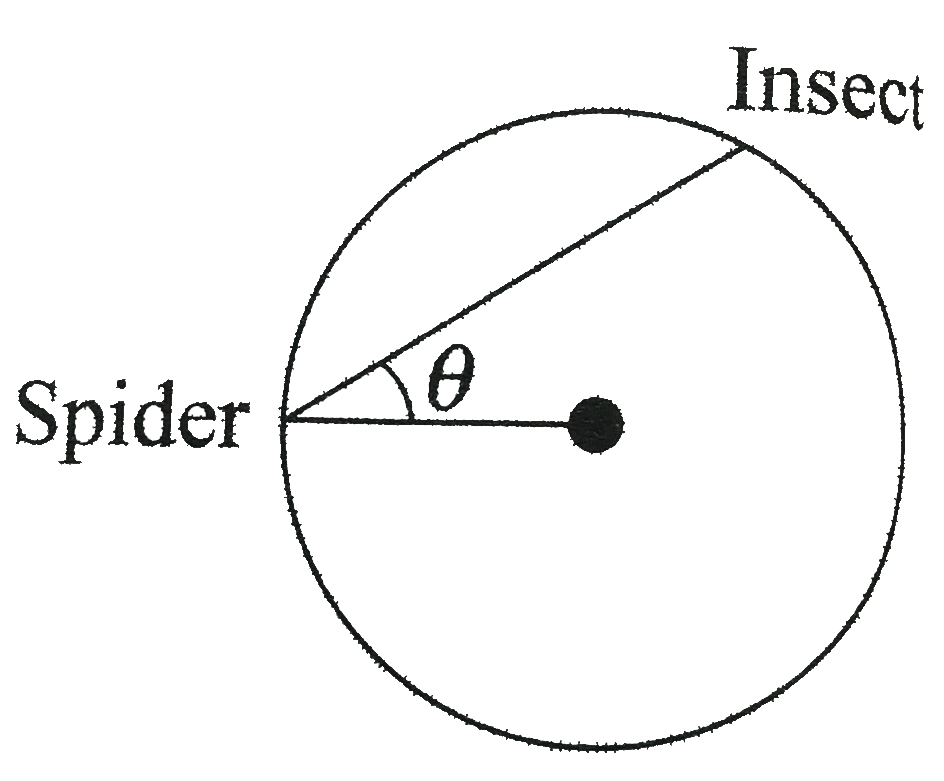
A spider is on the surface of a glass sphere with a refractive inndex of `1.5` . An insect crawls on the other side of the sphere as shown in Fig. For what maximum value of `theta` will the spider be able to still see the insect. Assume the spiders eye is in air.

Text Solution

Verified by Experts
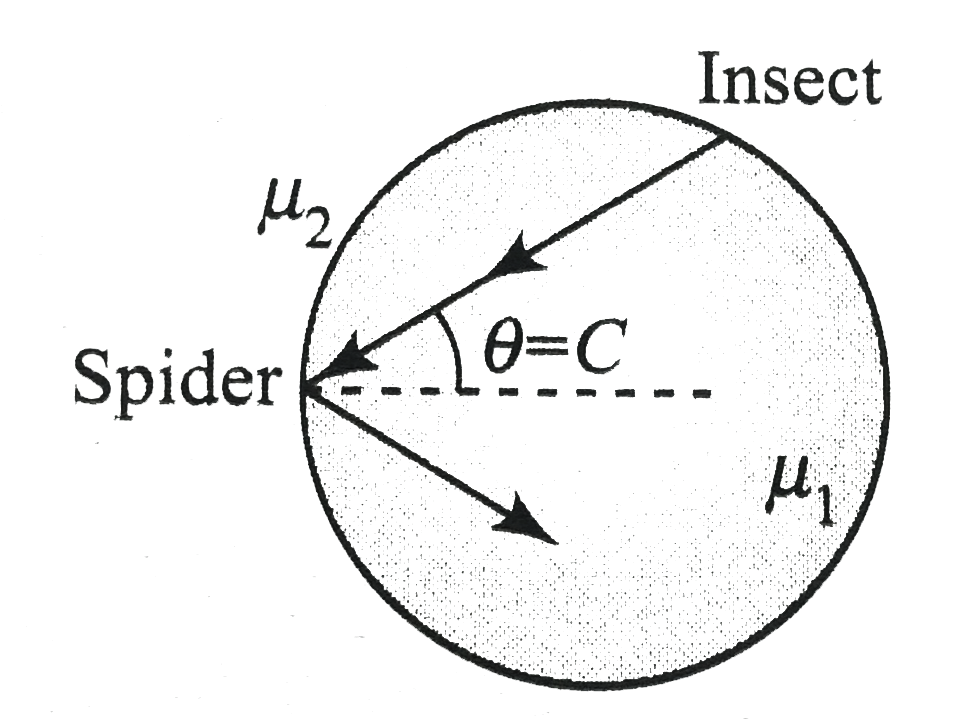
The spider will be able to see the insect if a ray of light from the insect reaches the spider's eye. If the angle of incidence of the beam is greater than the cirtical angle for the glass-air interface, the ray will be reflected within the glass sphere and will not emerge from it. Consequently, the spider will not be able to see the insect. Therefore, the angle `theta` must be greater than the critical angle for the glass- air interface. That is,
`thetagtsin^(-1)[1/(1*5)]rArrthetagtsin^(-1)(2/3)`
Promotional Banner

Topper's Solved these Questions

  • GEOMETRICAL OPTICS

    CENGAGE PHYSICS|Exercise Solved Examples|15 Videos
  • GEOMETRICAL OPTICS

    CENGAGE PHYSICS|Exercise Exercise1.1|14 Videos
  • FRICTION

    CENGAGE PHYSICS|Exercise QUESTION BANK|1 Videos
  • GRAVITATION

    CENGAGE PHYSICS|Exercise Question Bank|39 Videos

Similar Questions

Explore conceptually related problems

A spider and a fly are on the surface of a glass sphere. As the fly moves on the surface, find the maximum area on the glass sphere for the spider to be able to see it? Assume that the radius of the sphere (R) is much larger than the sizes of the spider and the fly. take the refractive index of glass mu_(g) to be equal to sqrt(2) .

A rectangular slab ABCD, of refractive index n_1 , is immersed in water of refractive index n_2(n_1 lt n_2) . A ray of light is incident at the surface AB of the slab as shown in Fig. Find the maximum value of angle of incidence alpha_(max) , such that the ray comes out only from the other surface CD.

A hollow sphere made of a transparent material of refractive index 1.5 has a small mark on its surface as shown. The mark is observed from the farther side. Find the distance of the image of mark from the centre of the sphere.

A rectengular glass slab ABCD of refractive index n_1 is immersed in water of refractive index n_2(n_1gtn_2) . A ray of light is incident at the surface AB of the slab as shown. The maximum value of the angle of incidence alpha_max such that the ray comes out only from the other surface CD is given by

A rectangular glass slab ABCD of refractive index n_(1) is immerged in water of refractive index n_(2) (n_(1) gt n_(2)) . A ray of light is incident at the surface AB of the slab as shown . The maximum value of the angle of incidence alpha_("max") , such that the ray comes out only from the other surface CD , is given by :-

There is an insect a cabin eying towards thick glass plate P_(1) , Insect sees the images of light source acrss the glass plate P_(1) outside tha chain. Cabin is made of thick glass plates of refractive index mu = (3)/(2) and thickness 3cm. Insect is eying from the middle of the cabin as shown in figure. (glass plates are partially reflective and consider only paraxial rays) At what distance (from eye of insect) will the eye see first image?

There is an insect a cabin eying towards thick glass plate P_(1) , Insect sees the images of light source acrss the glass plate P_(1) outside tha chain. Cabin is made of thick glass plates of refractive index mu = (3)/(2) and thickness 3cm. Insect is eying from the middle of the cabin as shown in figure. (glass plates are partially reflective and consider only paraxial rays) At what distance (from eye of insect) will the eye see second image ?

A hemispherical portion of the surface of a solid glass sphere (mu = 1.5) of radius r is silvered to make the inner side reflecting. An object is placed on the axis of the hemisphere at a distance 3r from the centre of the sphere. The light from the object is refracted at the unsilvered part, then reflected from the silvered part and again refracted at the unsilvered part. Locate the final image formed.

