Home
Class 12
PHYSICS
Light is incident from air on an oil lay...

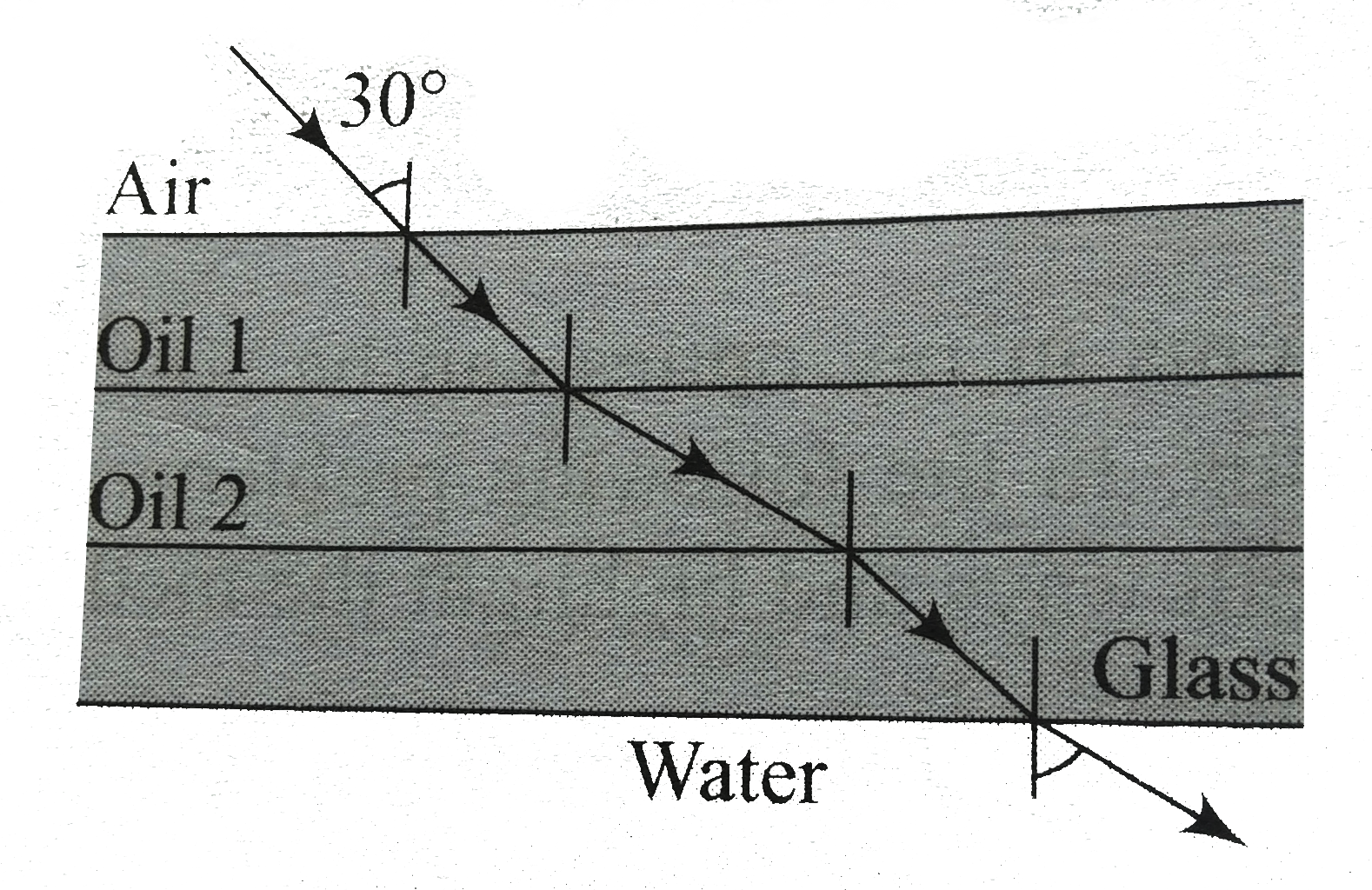
Light is incident from air on an oil layer at an incident angle of `30^(@)`. After moving through the oil 1, oil 2, and glass it enters water. If the refraction index of glass and water are `1.5` and `1.3`, respectively. Find the angle which the ray makes with the normal in water.

Text Solution

Verified by Experts

As we know that `mu`sin i = constant
`rArrmu_(air) sini_((air))=mu_(glass)sinr_((glass))`
`sini_(glass)=(mu_(air))/(mu_(glass))sini_(air)`
Again `mu_(glass) sini_(glass)=mu_(water)sinr_(water)`
From Eqs. (i) and (ii), `sin 30^@ =1.3 sin r`
`rarr sinr= (1)/(2xx1.3)=(1)/(2.6),r=sin^(-1)(1/(2.6))`
Promotional Banner

Topper's Solved these Questions

  • GEOMETRICAL OPTICS

    CENGAGE PHYSICS|Exercise Solved Examples|15 Videos
  • GEOMETRICAL OPTICS

    CENGAGE PHYSICS|Exercise Exercise1.1|14 Videos
  • FRICTION

    CENGAGE PHYSICS|Exercise QUESTION BANK|1 Videos
  • GRAVITATION

    CENGAGE PHYSICS|Exercise Question Bank|39 Videos

Similar Questions

Explore conceptually related problems

A light wave travels from glass to water. The refractive index for glass and water are 3/2 and 4/3 respectively. The value of the critical angle will be:

The refractive indices of water and glass with respect to air are 1.2 and 1.5 respectively. The refractive index of glass with respect to water is

If the refractive index of a certain glass with respect to water is 1.25 , find the refractive index of water with respect to the glass.

The ratio of velocities of light in glass to that in water is (refractive index of glass = 1.5 and refactive index of water = 1.33)

A ray of light falls on a glass slab at an incident angle of 45^(@) and refracted at angle of 30^(@) . What is the refractive index of the glass with respect to air ?

If the refractive index from air to glass is 1.5 ,and the refractive index of water is 1.33. What is the refractive index from glass into water?

A light ray is incident on a glass sphere at an angle of incidence 60^(@) as shown. Find the angles r, f^(1) , e and the total deviation after two refractions.
