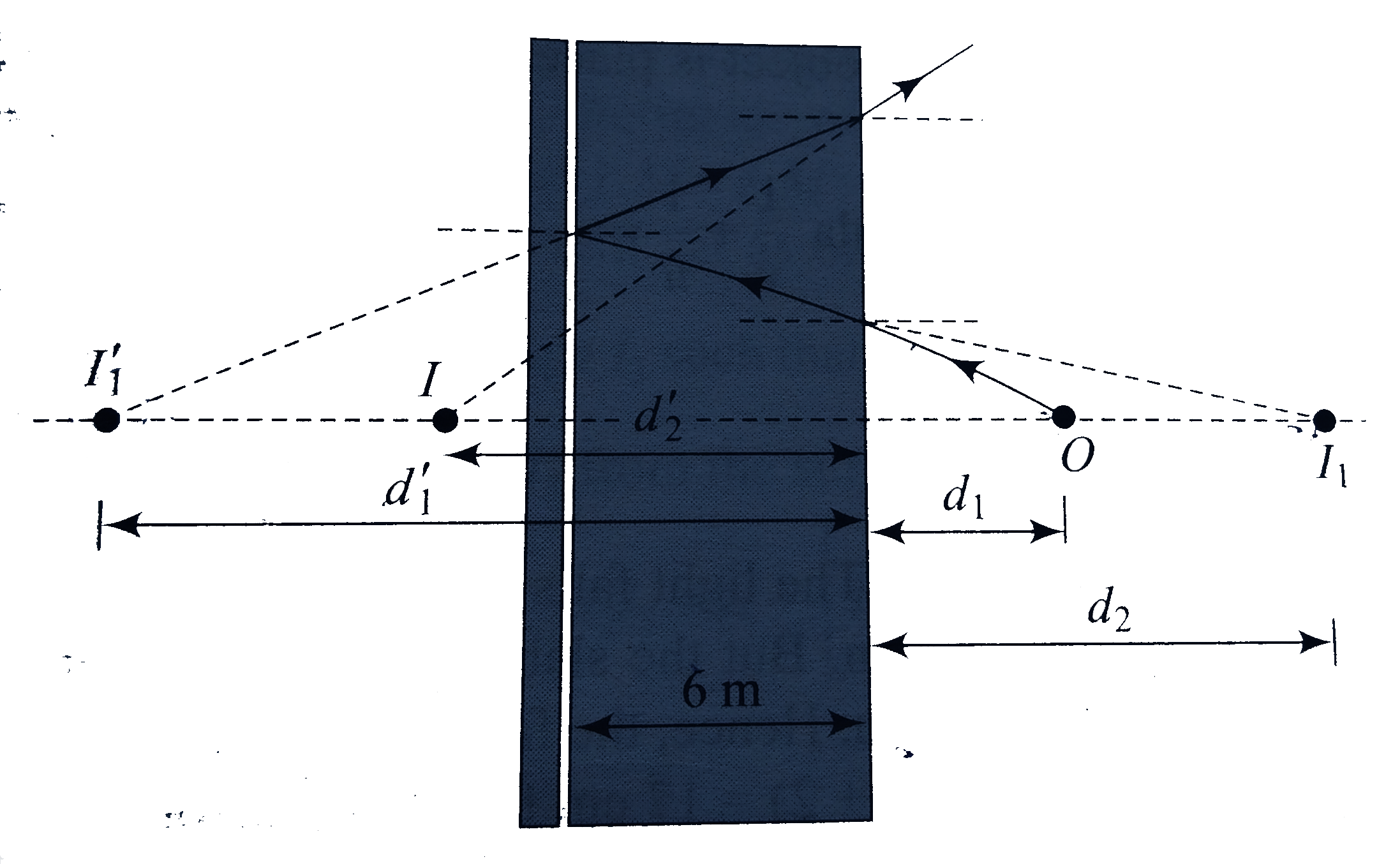
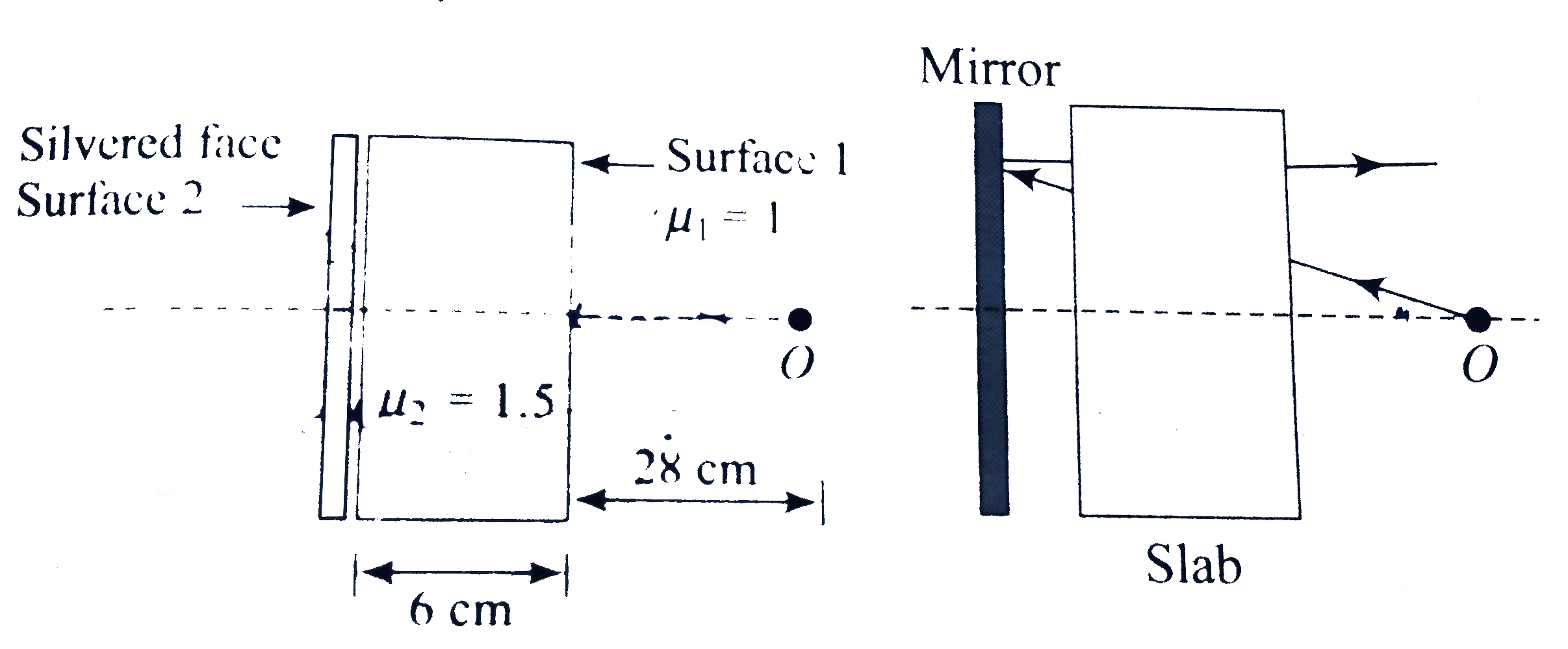
Method of interface: A ray of light from the object O undergoes refraction, reflection and then refraction.
Refraction at surface 1:
Here, `mu_(1)=1, mu_(2)=1.5`
`d_(1)=28 cm,d_(2)=?`
Since `d_(2)=(d_(1))/(n_("relative"))=(d_(1))/((1//mu)),[n_("rel")=(n_("incident"))/(n_("refracted"))=(1)/(mu)]`
`rArr d_(2) =mud_(1)=1.5xx28=42 cm`
Therefore, `d_(2) `=42 cm from the first interface. The first image `I_(1)` is formed 42 cm in front of the slab.
Reflection at surface 2:
The object for reflection at the second surface is the image from frfraction at the first.
Therefore, object distance from the mirror is `42+6=48cm`.
A s a result of reflection, the image will be formed as far behind the mirror as the object is in front of it. Therfore, the second image `I'_(1)` is formed 48cm behind the mirror.
Second refraction at surface 1,
Object distance from surface 1,
`d_(1)= 48+6=54 cm`
`d_(2)^(')= (d_(1)^('))/(n_("relative"))=(d_(1)^('))/((n_(" incident ")/n_(" refraction ")))=(54)/((1.5//1))=36cm`
So, the final image is at a distance `d_(2)=36cm` behind the first interface.
Hence, final image is formed 36cm behind surface 1 or 30 cm behind surface 2.
Method 2: Shifted of object
A ray of light from the object first encounters a glass slab, then a mirror, and finally a glass slab again.
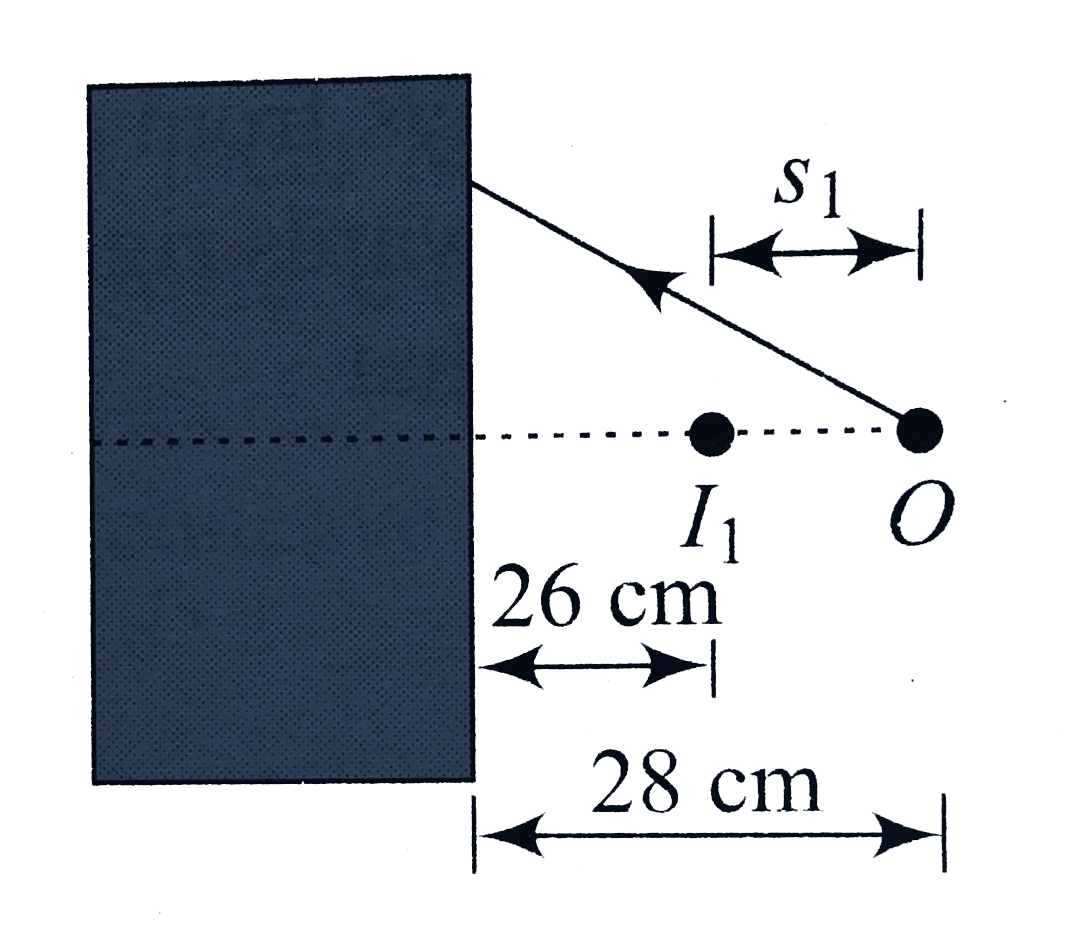
Glass slab: A slab simply shifts the object along the axis by a distance
`s_(1) =t(1-(1)/(mu))=2cm`
Direction of shift of object is towards left. Therefore, the object apears to be at `I_(1)` which is `28-2=26cm` from the slab.
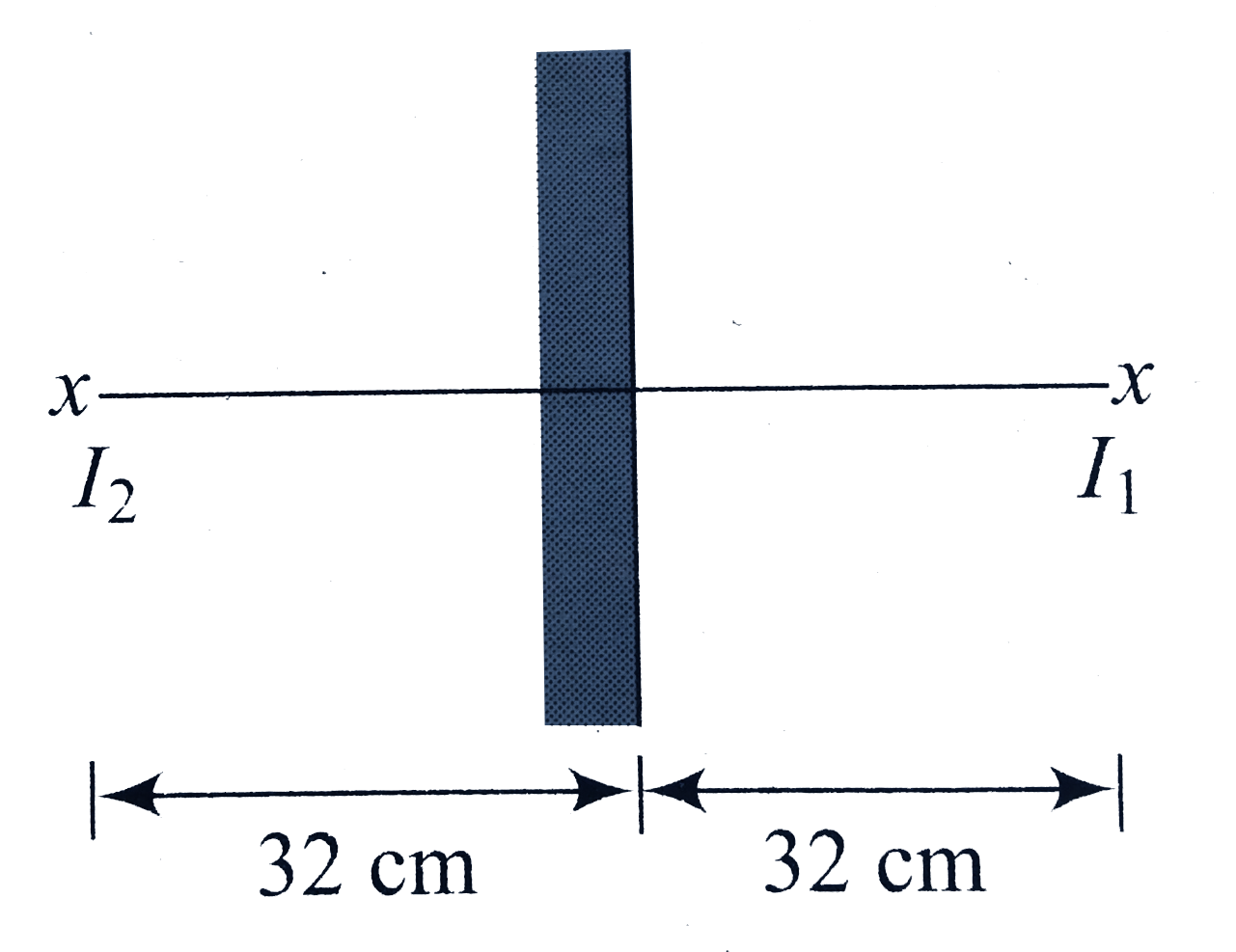
For mirror, the object for the mirror is the image `I_(1)` formed after shift due to the slab.
Therefore, objectobject distance from the mirror is `26+6=32cm`. The image will now be formed `32cm` behind the mirror. Now, reflected rays are travelling from left to right.
The ray now travels through the slab again but this time from right to left. Therefore, it is shifted again by a distance of 2cm, but towards the right. Thus, final position of the image is `32-2=30cm` behind the mirror.
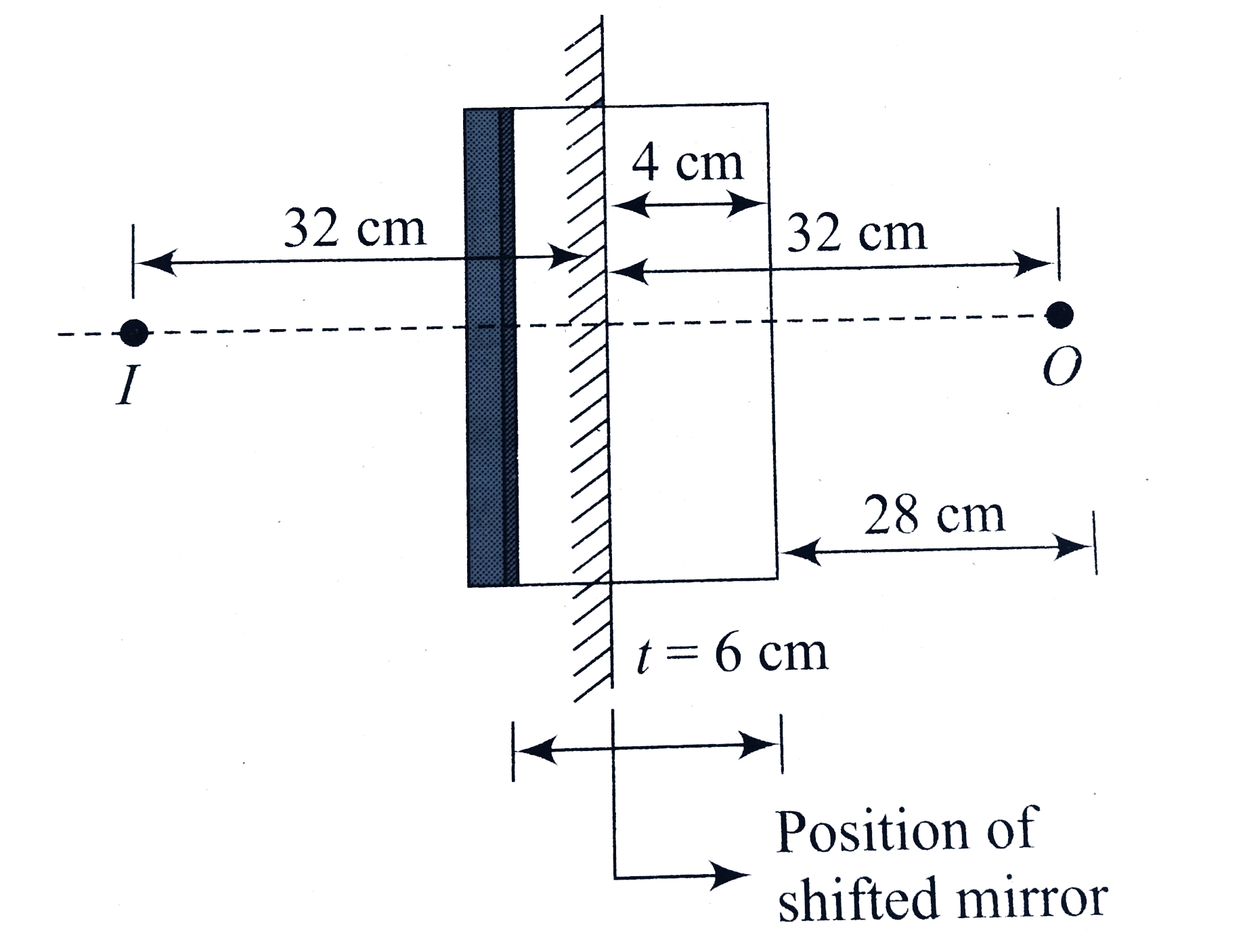
Method 3 : Shifted of mirror
By the principle of reversibility of light, we can say if light rays are coming from the mirror and passing through the slab, the mirror will shift 2m towards right for observer in front of the slab.
The position of the object from shifted mirror `=32 cm`.
So, the position of the image formed by shifted mirror will be `32 cm` behind it. Hence, the position of the image from surface 2 is 30 cm left to it and `36 cm` left of surface 1.
Let us learn the combination of the slab and mirror through some more illustrations.
,