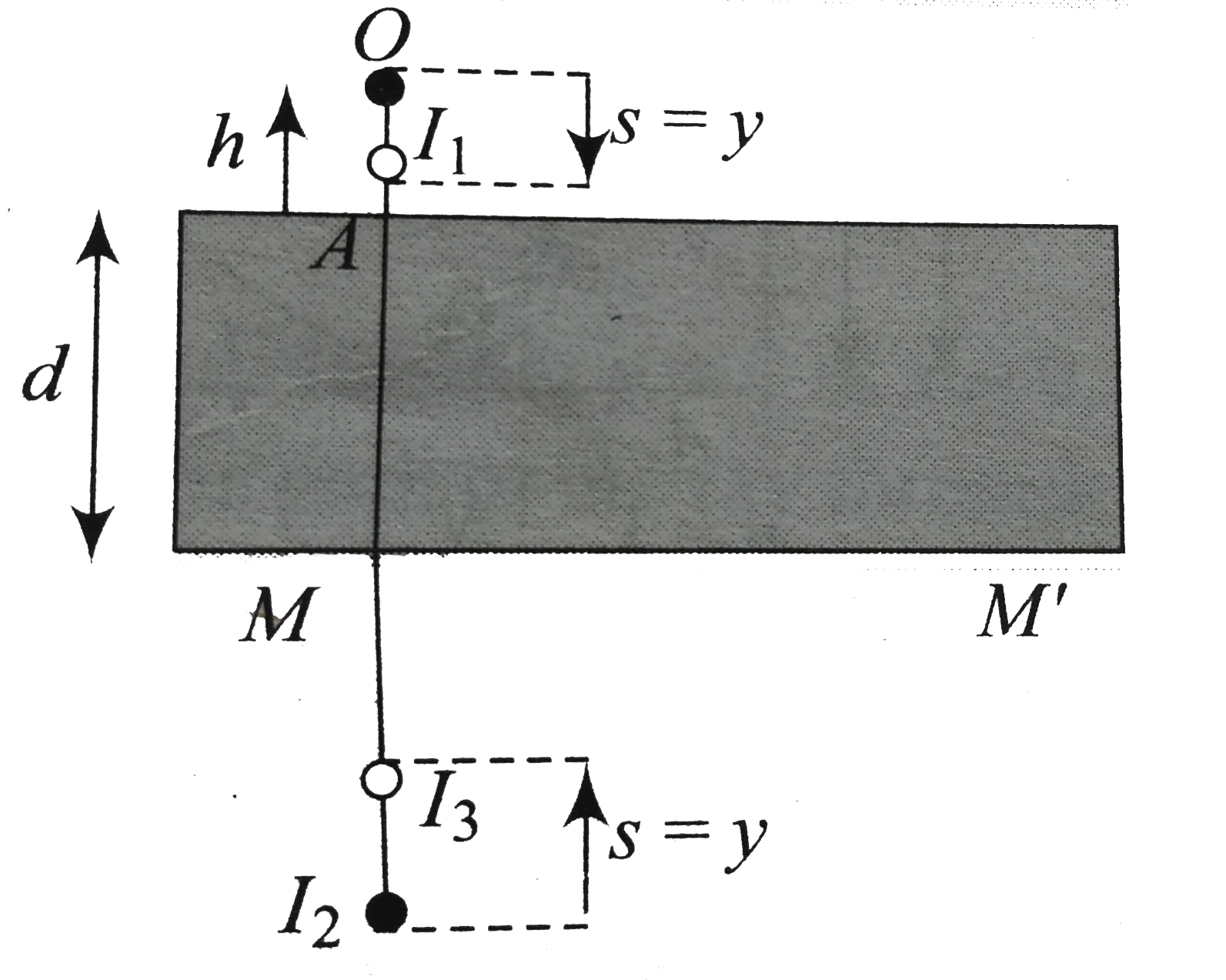
As shown in Fig. water will form the image of object O at `I_(1)` such that `OI_(1)=y=d[1-(1//mu)]`, so that the distance of image `I_(1)` from water surface will be `I_(1)A=h-y=h-d[1-(1//mu)]`. Hence, the distance of this image `I_(1)` from miror MM',
`I_(1)M=I_(1)A+AM`
`=[h-d(1-(1)/(-mu))]+d=h+[(d)/(mu)]`
Now, image `I_(1)` will act as object for mirror `MM'` . As a plane mirror forms image at same distance behind the mirror as the object is in fron of is, the image of `I_(1)` formed by the mirror `MM^(')` will be `I_(2)` such that`I_(1)M=I_(2)M=h+(d//mu)` .
Now, this image `I_(2)` will act as object for water again and water will produce image `I_(3)` such that `I_(2)I_(3)=y=d(1-(1)/(mu))` . So, the distance of image `I_(3)` from the surface of water AC will be
`AI_(3)=AM+MI_(2)=I_(2)I_(3)=d+[h+(d)/(mu)]-d[1-(1)/(mu)]`
`AI_(3)=h+2(d)/(mu)=h+(3)/(2)d`
Alternative solution:
As shown in Fig. water will form the image of bottom, i.e., mirror MM' at a depth `(d//mu)` from its surface. So, the distance of object O from virtual mirror mm' will be `h+(d//mu)`
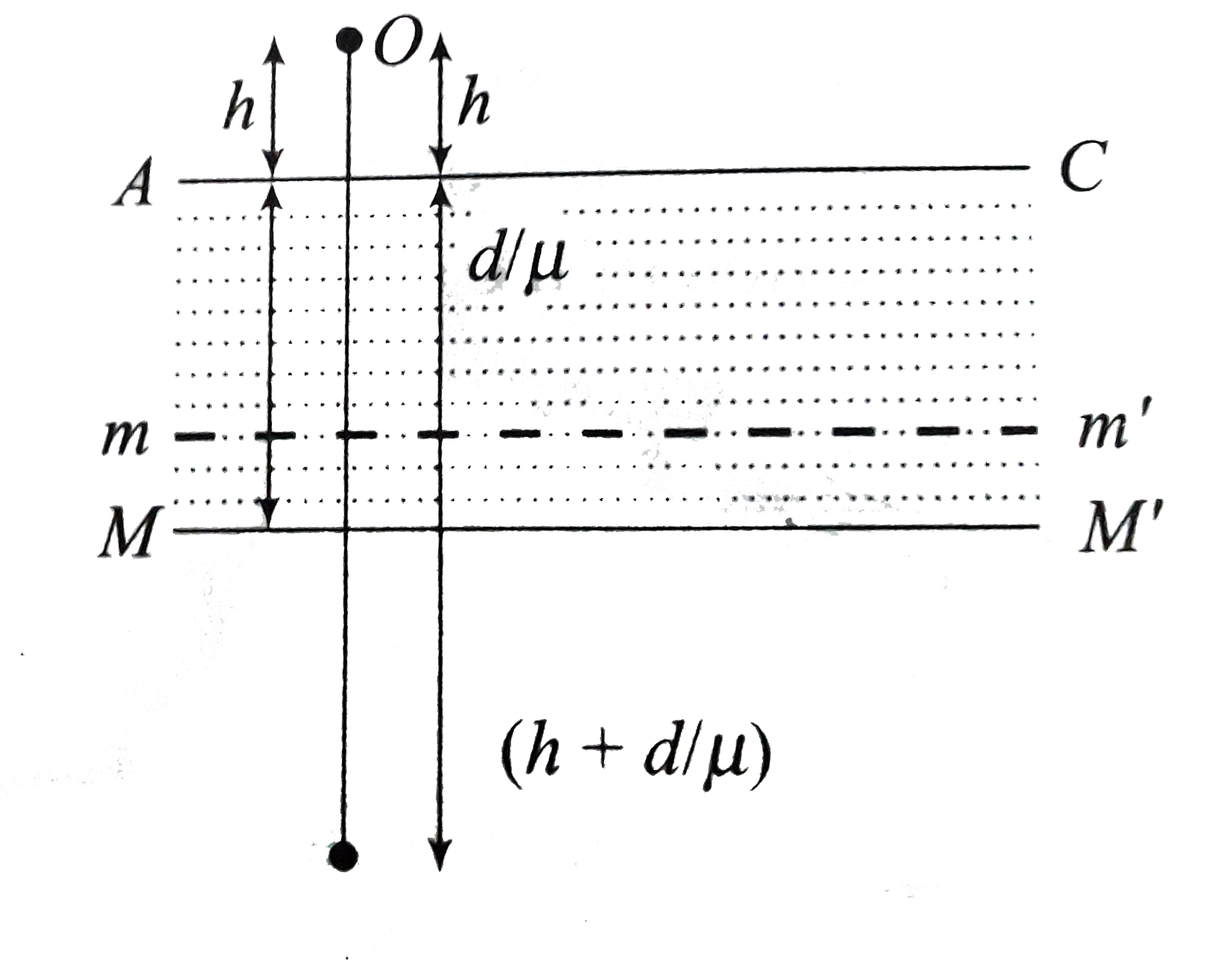
Now, as a plane mirror froms image behind of it, the distance of image I from mm' be `h+(d//mu)`. Also, as the distance of virtual mirror from the surface of water is `(d//mu)`, the distance of image I from the surface of water will be
`[h+d/mu]+d/mu=h+(2d)/mu=h+3/2 d` [as `mu=4/3`]


