Home
Class 12
PHYSICS
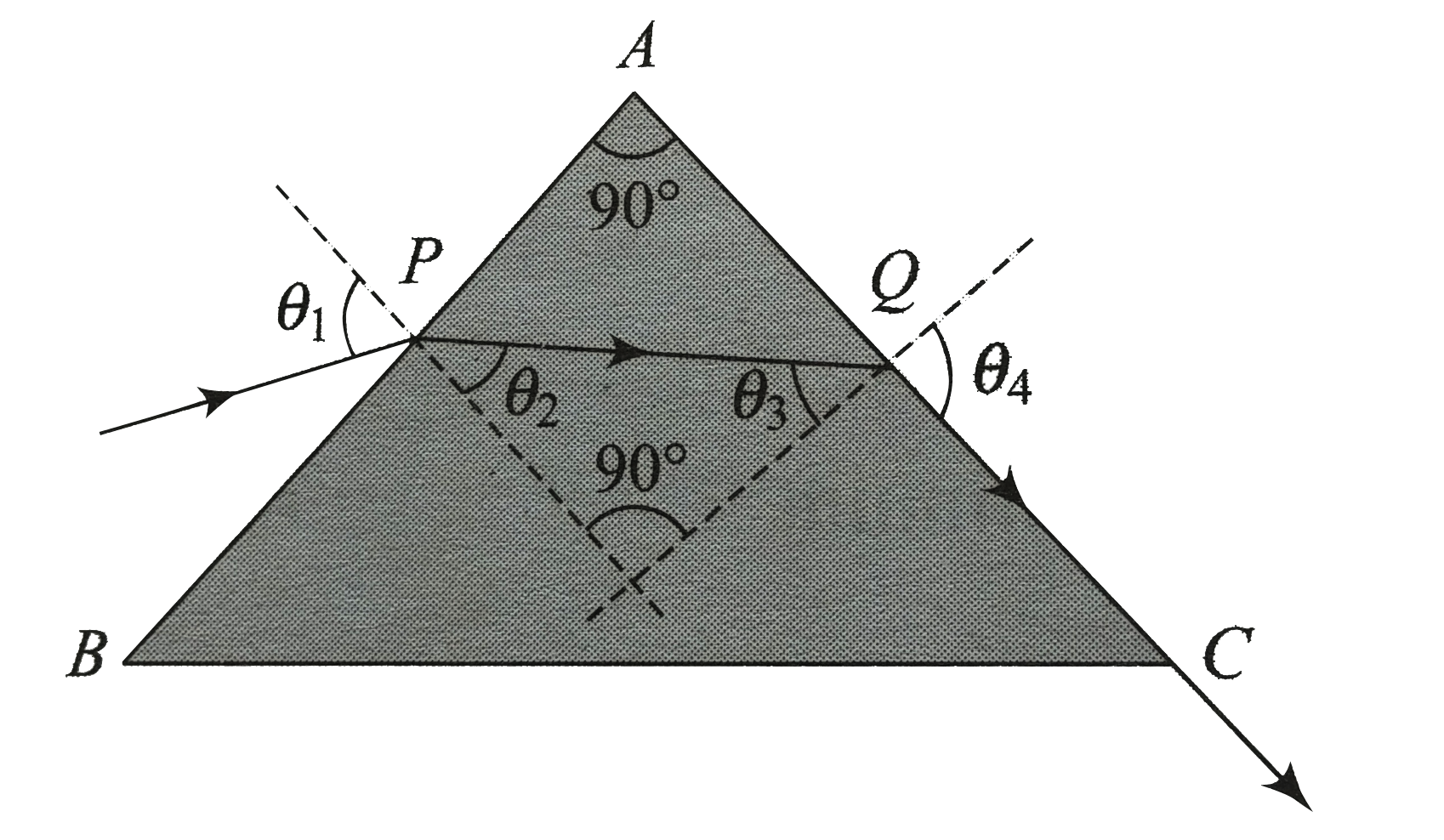
Figure.. Shows a triangular prism of ref...

Figure.. Shows a triangular prism of refracting angle `90^(@)` . A ray of light incident at face AB at an angle `theta _(1)`, refracts at point Q with an angle of refraction `90^(@)`.
a. What is the regractive index of the prism in terms of `theta_(1)`?
b. What is the maximum value that the refractive inde can have?
c. What happens to the light at Q if the incident angle at Q is (i) increased slightly, and (ii) decrease slightly?

Text Solution

Verified by Experts

a. Let the ray be incident at an angle `theta_(1)` at the face AB. It refracts at an angle `theta_(2)` and is incident at an angle `theta_(3)` at the face AC. Finally, the ray comes out at an angle `theta_(4)=90^@`.
From Fig. , the normal at faces AB and AB make an angle of `90^@` width each other, `theta_(3)=90^@-theta_(2)`
`sintheta_(3)=sin(90^(@)-theta_(2))=costheta_(2)=sqrt(1-sin^(2)theta_(2))` (i)
From Snell's law at face AC, `n sintheta_(2)=1`
`sqrt(1-sin^(2)theta_(2))=1` (ii)
Form Snell's law at face AB, `1sintheta_(1)=nsintheta_(2)`
`sintheta_(2)=(sing theta_(1))/(n)` (iii)
From Eqs. (ii) and (iii), we have
`nsqrt(1-(sin^(2)theta_(1))/(n^(2)))=1` (iv)
On squaring Eq. (iv) and solving for n, we get
`n=sqrt(1+(sin^(2)theta_(1)))`
b. The greatest possible value of `sin^(2)theta_(1)` is 1, hence, the greates possible value of n is `n_(max)=sqrt(2)=1.41`.
c. i. For a given n, if `theta_(1)` is increased the angle of refraction `theta_(2)` increases. As `theta_(3)=90^@-theta_(2)` the angle `theta` decreases, i.e., the angle of incidence at face AC is less than the critical angle for total reflection, hence light light emerges into air.
ii. If the angle of incidence is decresed, the angle of refraction `theta_(2)` decreases. So, the angle `theta_(3)` increases. The angle of incidence at the second surface is greater than the critical angle, so light is reflected at Q.
Promotional Banner

Topper's Solved these Questions

  • GEOMETRICAL OPTICS

    CENGAGE PHYSICS|Exercise Solved Examples|15 Videos
  • GEOMETRICAL OPTICS

    CENGAGE PHYSICS|Exercise Exercise1.1|14 Videos
  • FRICTION

    CENGAGE PHYSICS|Exercise QUESTION BANK|1 Videos
  • GRAVITATION

    CENGAGE PHYSICS|Exercise Question Bank|39 Videos

Similar Questions

Explore conceptually related problems

The refractive index of a prism is 2. this prism can have a maximum refracting angle of

A ray of light is incident at an angle of 60^(@) on the face of a prism with an angle of 60^(@) . Then the refractive index of the material of the prism is (the prism is in minimum deviation position)

A ray of light falls on a material body at an incident angle 60^(@) and refracted at angle 30^(@) . What is the refractive index of the material?

A ray of light falls on a material body at an incident angle of 30^(@) and refracted at angle 60^(@) . What is the refractive index of the material?

The face AC of a prism ABC of refracting angle 30^@ is silvered . A ray is incident on face AB at an angle of 45^@ as shown in figure . The refracted ray undergoes reflection at face AC and retraces its path . The refractive index of the prism is

The refractive index of a prism is 2. The prism can have a maximum refracting angle of

A ray of light is incident on a glass slab at an angle of 45^(@) . If refractive index of glass be 1.6, what is the angle of refraction ?

A ray of light is incident at 60^(@) on one face of a prism of angle 30^(@) and the emergent ray makes 30^(@) with the incident ray. The refractive index of the prism is

At what angle should a ray of light be incident on the face of a prism of refracting angle 60^(@) so that it just suffers total internal reflection at the other face ? The refractive index of the prism is 1.524.

A monochromatic ray of light strikes one face of a prism at an angle of 60^(@) and the angle of refraction is 30^(@) . The refracting angle of the prism is 60^(@) . What is the angle of emergence ?
