Home
Class 12
PHYSICS
The cross section of a glass prism has t...

The cross section of a glass prism has the form of an isosceles triangle. One of th erefracting faces is silvered. A ray of light falling normally on the other refracting face, being reflected twice, emerges through the base of the prism perpendicular to it. Find the angles of the prism.

Text Solution

Verified by Experts
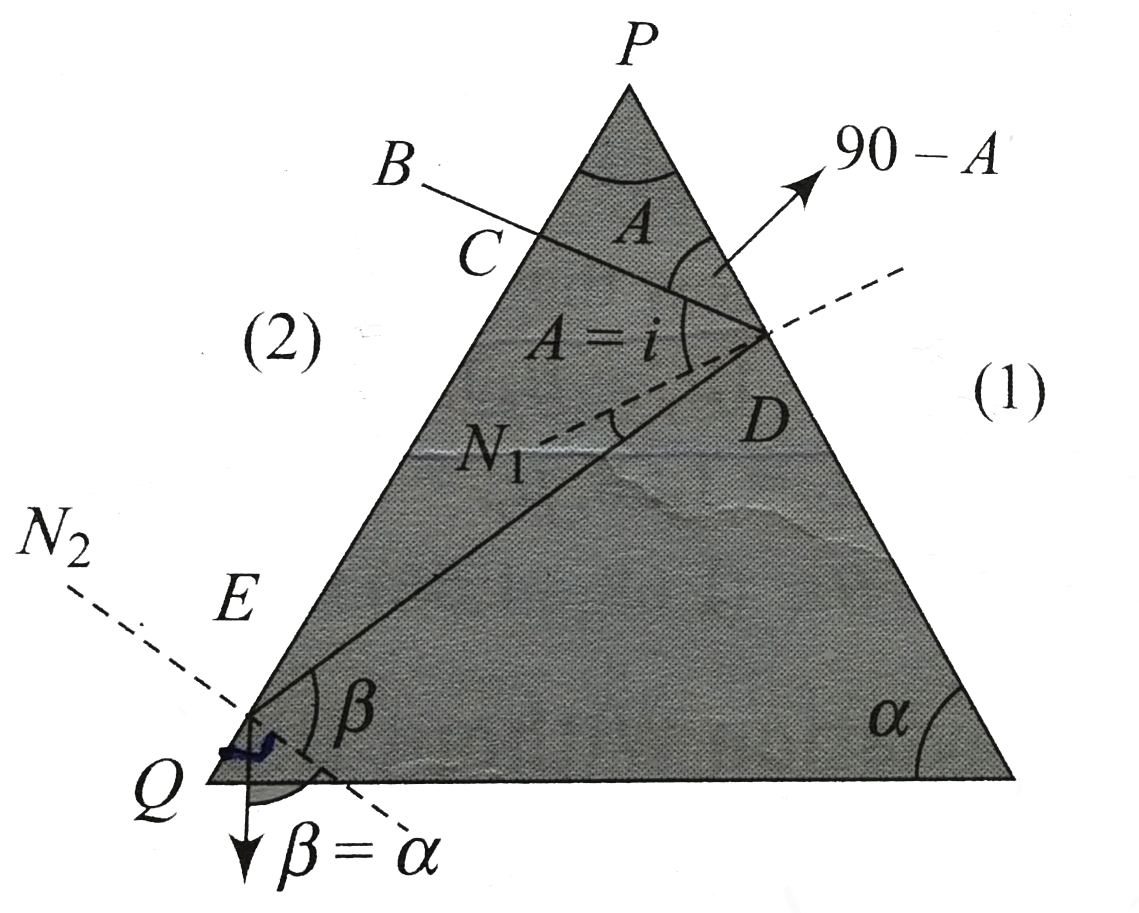
The incident ray BC at normal incidence is reflected at silvered face, along DE and at E it again sufferes reflection along EF. Since the ray emerges normally from the base, therefore the ray EF must fall normally on the base and emerges along EG.
We find `i=A`.
Also, `beta=d`
Since `EN_(2)||CD,beta=2i` (alternate angles)
`:. alpha=2A (beta=alpha,i=A)` (i)
Also, `2alpha+A =180^(@)`
(`:'` Sum of angles of a triangle = `180^(@)`) (ii)
Solving Eqs. (i) and (ii), we get A =`36^(@) , alpha=72^(@)` .
Promotional Banner

Topper's Solved these Questions

  • GEOMETRICAL OPTICS

    CENGAGE PHYSICS|Exercise Solved Examples|15 Videos
  • GEOMETRICAL OPTICS

    CENGAGE PHYSICS|Exercise Exercise1.1|14 Videos
  • FRICTION

    CENGAGE PHYSICS|Exercise QUESTION BANK|1 Videos
  • GRAVITATION

    CENGAGE PHYSICS|Exercise Question Bank|39 Videos

Similar Questions

Explore conceptually related problems

An isosceles prism has one of the refracting surfaces silvered. A ray of light is incident normally on the refracting face AB. After two reflections, the ray emerges from the base of the prism perpendicular to it. Find the angle of the prism.

An isosceles glass prism has one of its faces silvered. A light ray is incident normally on the other face which is identical in size to the silvered face. The light ray is reflected twice on the same sized faces and emerges through the base of the prism perpendicularly. Find the minimum value of refractive index of the material of the prism.

The cross section of a glass prism mu=2 has the form of an isosceles right-angled triangle. It is submerged in a liquid of refractive index 1.2 . A ray is incident on to one of the equal faces perpendicularly. What is the angle between the direction of incident ray and the ray that emerges from the prism ?

A ray of light is incident normally on one of the refracting surfaces of prism of refracting angle 60^@ . The emergent ray grazes the other refracting surface. The refractive index of the material of the prism is

A ray of light falls on a normally on a refracting face of a prism. Find the angle of prism if the ray just fails to emerge from the prism (mu=3//2).

If a light ray incidents normally on one of the faces of the prism of refractive index 2 and the emergent ray just grazes the second face of the prism, then the angle of deviation is

A ray of light is incident normally on one face of a right-angled isosceles prism and then it grazes the hypotenuse. The refractive index of the material of the prism is

One face of prism of refracting angle 30^@ and refractive index 1.414 is silvered. At what angle must a ray of light fall on the unsilvered face so that it retraces its path out of the prism ?

