Home
Class 12
PHYSICS
A glass slab of thickness 2cm and refrac...

A glass slab of thickness 2cm and refractive index 2 is placed in contact with a biconvex lens of focal length 20cm. The refractive index of the material of the lens 1.5 . The far side of the lens is silvered. Where should an object be placed in front of the slab so that it images on to itself?

Text Solution

Verified by Experts

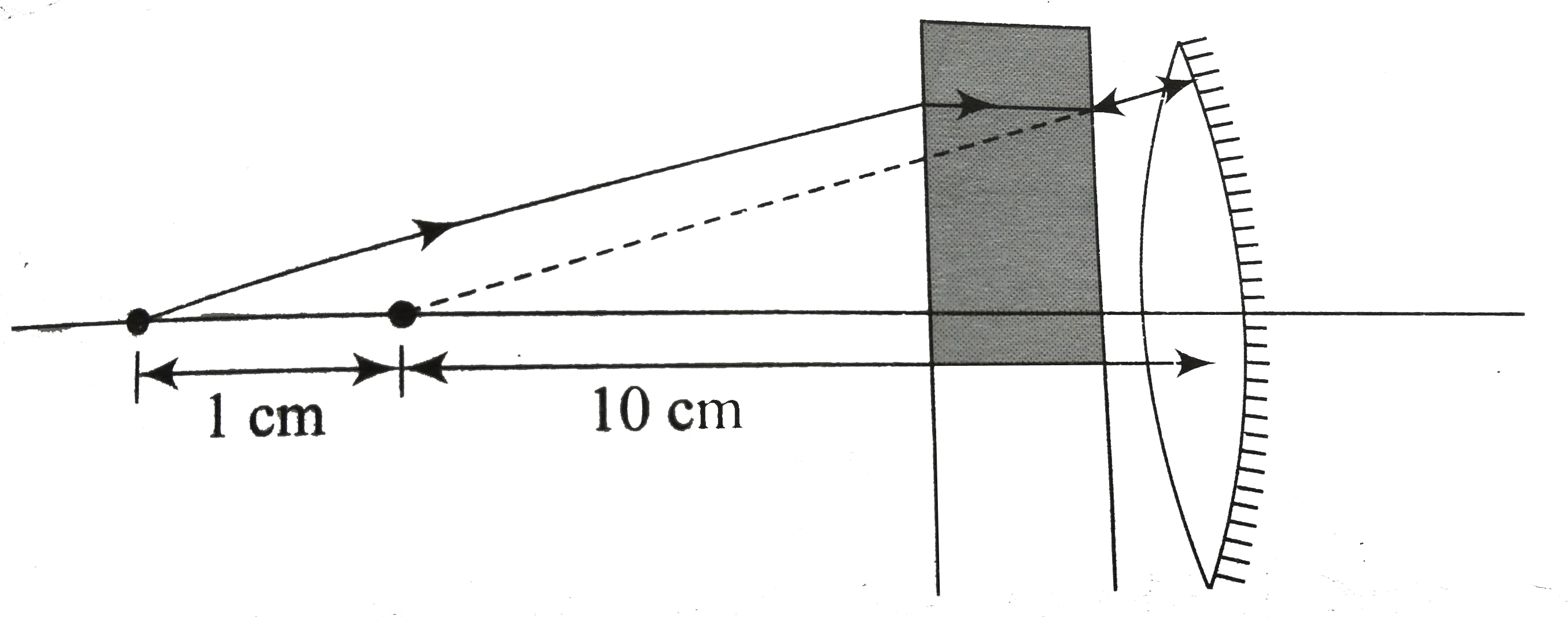
Step 1: Ray diagram: The path of a typical light ray is shown in Figure.
Step 2: The elements encountered are a glass slab, a silvered lens, and a glass slab.
Step 3: The lens is silvered, so it acts as a mirror. Since the image is formed on the object itself, the apparent position of the object after refraction from the glass slab should be at the center of curvature of the mirror.
Step 4: The effective focall length of the silvered lens is
`(1)/(f_(e))=(1)/(f_(m))-(2)/(f_(L))`
Now, `f_(L)=+20cm` ( assuming the +ve X-direction is to the right) .
It is a biconvex lens. Therefore,
`(1)/(f_(L))=(mu-1) ((1)/(R)+(1)/(R))` or `R=20cm`
Therefore, `f_(m)=-20//2=-10cm` and
` f_(e) =-5cm`
For the image to form on the object, the apparent position of the object after refraction at the glass slab must be at `2xxf_(e)=-10cm` , i.e., the object must appear to be 10cm to the left of the silvered lens.
Step 5: For the glass slab:
`Thickness =2cm , mu=2`
Shift due to slab `=s=t(1-(1)/(mu))=1cm`
Direction of shift is toward the left in the direction of the incident ray.
Therefore, the object should be at `10+1=11cm` to the left of the mirror so that after refraction at the glass slab it appears to be at 10 cm from the lens which is the center of curvature of the silvered lens. Hence, the rays retrace their paths and the image is on the object itself.
Promotional Banner

Topper's Solved these Questions

  • GEOMETRICAL OPTICS

    CENGAGE PHYSICS|Exercise Solved Examples|15 Videos
  • GEOMETRICAL OPTICS

    CENGAGE PHYSICS|Exercise Exercise1.1|14 Videos
  • FRICTION

    CENGAGE PHYSICS|Exercise QUESTION BANK|1 Videos
  • GRAVITATION

    CENGAGE PHYSICS|Exercise Question Bank|39 Videos

Similar Questions

Explore conceptually related problems

A glass slab of thickness 3cm and refractive index 1.5 is placed in front of a concave mirror of focal length 20cm. Where should a poing object be placed if it is to image on to itself?

A bicovex lens has radii of cuvature 20 cm each. If the refractive index of the material of the lens is 1.5, what is its focal length?

Focal length of an equiconvex lens is 20 cm. The refractive index of material of the lens is 1.5. Now one of the curved surface is silvered. At what distance from the lens an object is to be placed, so that image coincides with the object ?

A convex lens of focal length 20cm is placed 10cm in front of a convex mirror or radius of curvature 15cm. Where should a point object be placed in front of the lens so that it images on to itself?

A biconvex lens has radii of curvature 20 cm and 40cm. The refractive index of the material of the lens is 1.5. An object is placed 40cm in front of the lens. Calculate the psition of the image.

A thin equiconvex lens has focal length 10 cm and refractive index 1.5 . One of its faces is now silvered and for an object placed at a distance u in front of it, the image coincides with the object. The value of u is

If in a planoconvex lens, the radius of curvature of the convex surface is 10cm and the focal length is 30 cm , the refractive index of the material of the lens will be

A pin is placed 10cm in front of a convex lens of focal length 20cm, made of a material having refractive index 1.5 . The surface of lens farther away from the pin is silvered and has a radius of curvature 22cm. Determine the position of the final image. Is the image real or virtual?

A biconvex lens of focal length 20cm, made of glass or refractive index 1.5, has water (mu=1.33) on one side and air on the other. An object is placed 15 cm form the lens on the side with water. Where is the image formed?

