Home
Class 12
PHYSICS
A converging set of ray, traveling from ...

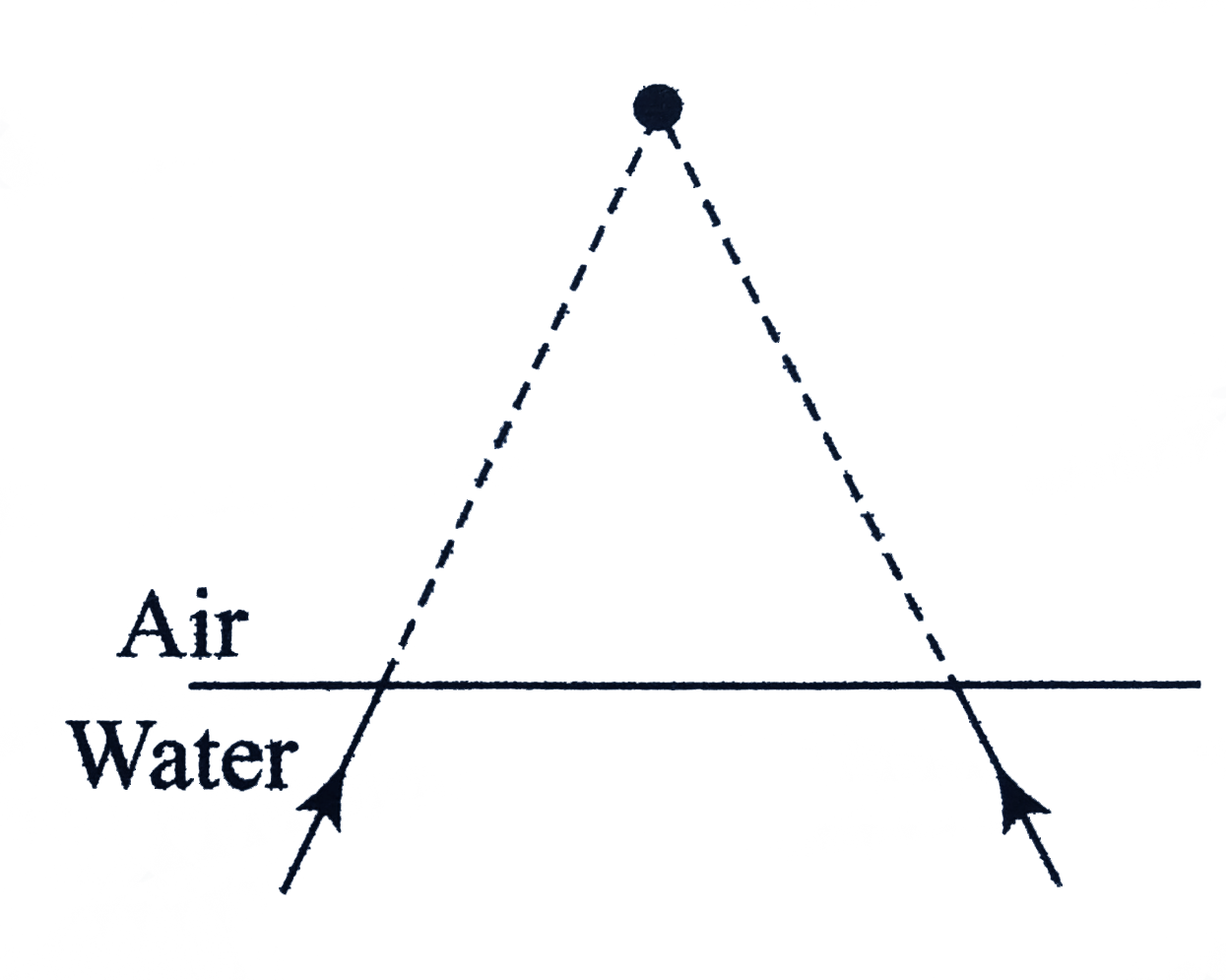
A converging set of ray, traveling from water to air, is incident on a plane interface. In the absence of the interface, the rays would have converged to a point O, 60 cm above the interface. However, dur to refraction the rays will bend. At what distance above the interface will the rays actually converge?

Text Solution

Verified by Experts
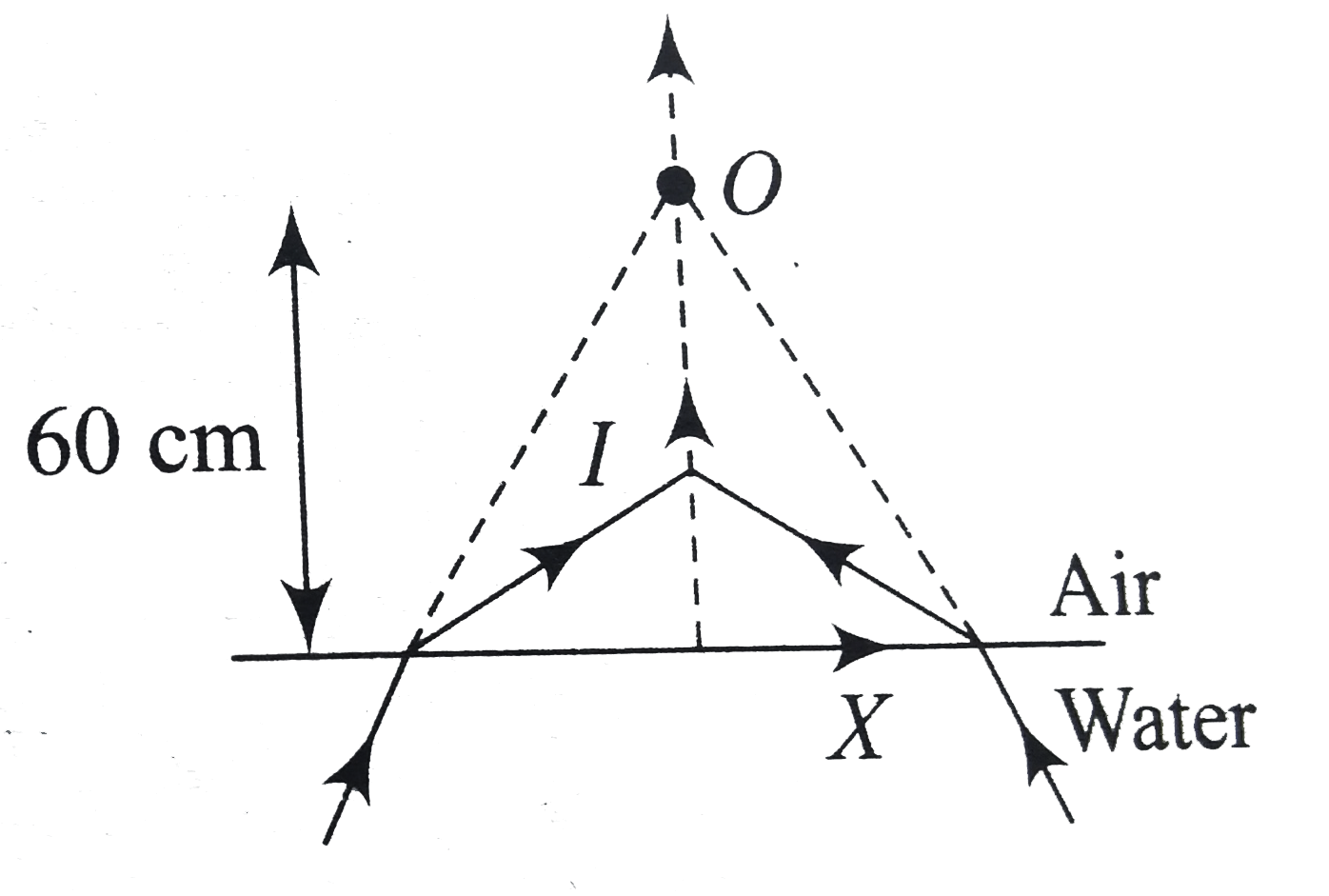
A ray of light now travels through water, across the interface through air and converges to form an image at I. Here, medium 1 is water and medium 2 is air.
`d_(1)=+60cm, mu_(1)=(4)/(3), mu_(2)=1`
As `(mu_(1))/(d_(1))=(mu_(2))/(d_(2)) ` or `d_(2)=(mu_(2))/(mu_(1))d_(1)`, we get
Thus, the i mage is formed 45 cm above the interface.
Promotional Banner

Topper's Solved these Questions

  • GEOMETRICAL OPTICS

    CENGAGE PHYSICS|Exercise Exercise1.4|12 Videos
  • GEOMETRICAL OPTICS

    CENGAGE PHYSICS|Exercise Exercise1.5|22 Videos
  • GEOMETRICAL OPTICS

    CENGAGE PHYSICS|Exercise Exercise1.2|20 Videos
  • FRICTION

    CENGAGE PHYSICS|Exercise QUESTION BANK|1 Videos
  • GRAVITATION

    CENGAGE PHYSICS|Exercise Question Bank|39 Videos

Similar Questions

Explore conceptually related problems

A converging bundle of rays travel from water (refractive index 4//3 ) to glass (refractive index 1.5) through a convex interface of radius 16cm. In the absence of the interface, The rays would have converged to a point 32 cm from the pole of the interface. Where will the rays actually meet after refraction?

A converging beam of light rays incident on a glasa-air interface as shown in figure. Find where these rays will meet after refraction.

In the given figure rasy incident on an interface would converge 10cm below the interface if they continues to move in straight lines without bending. But due to refraction, the rays will bend and meet some where else. Find the distance of meeting point of refracted rasy below the interface, assuming the rays to be making small angles with the normal to the interface.

A ray of light travelling in air is incident on the surface of glass slab at an angle of 40^(@) . If the ray is deviated through 18^(@) , determine critical angle for the glass-air interface.

The refractive index of water relative to air is 5/3. A ray of light passing from water into air is incident at the interface at an angle of 32^(@) with the normal. What angle does the refreacted ray make with the normal?

A converging beam of rays in incident on a diverging lens. Having passed through the lens the rays intersect at a point 15 cm from the lens. If the lens is removed, the point where the rays meet, move 5 cm closer to the mounting that holds the lens. Find the focal length of the lens.

A ray of light is incident on the interface between water and glass at an angle i and refracted parallel to the water surface, then value of mu_(g) will be

What happens when a ray of light is incident normal to the interface between two media? Draw the corresponding neat and labelled diagram.

CENGAGE PHYSICS-GEOMETRICAL OPTICS-Exercise1.3
  1. A beam of width t incident at 45^@ on an air-water boundary. The width...

    Text Solution

    |

  2. A fish is 60 cm under water ( mu=4//3). A bird directly overhead looks...

    Text Solution

    |

  3. A converging set of ray, traveling from water to air, is incident on a...

    Text Solution

    |

  4. A tank contains three layers of immiscible liquids. The first layer is...

    Text Solution

    |

  5. A convergent beam is incident on two slabs placed in contact as shown ...

    Text Solution

    |

  6. A slab of water is on the top of a glass slab of refractive index 2. A...

    Text Solution

    |

  7. A ray of light ravels from a liquid of refractive index mu to air. If ...

    Text Solution

    |

  8. What should be the value of refractive index n of a glass rod placed ...

    Text Solution

    |

  9. An object is placed on the principle axis of a concave mirror of focal...

    Text Solution

    |

  10. The image of an object kept at a distance of 30 cm in front of a conca...

    Text Solution

    |

  11. In Figure, a fish watcher watches a fish through a 3.0 cm thick glass ...

    Text Solution

    |

  12. An observer can see through a pin-hole the top end of a thin rod of he...

    Text Solution

    |

  13. A vesserl contains a slab of glass 8cm thick and of refractive index 1...

    Text Solution

    |

  14. An object O is placed at 8cm in front of a glass slab, whose one face ...

    Text Solution

    |

  15. x-y plane separates two media, zge0 contains a medium of refractive i...

    Text Solution

    |

  16. The n transparent slabs of refractive index1.5 each having thickness 1...

    Text Solution

    |

  17. A concave mirror with its optic axis vertical and mirror facinig upwar...

    Text Solution

    |

  18. Consider the situation shown in Figure. A plane mirror is fixed at a h...

    Text Solution

    |

  19. A concave mirror of radius 40 cm lies on a horizontla tale and wateis ...

    Text Solution

    |

  20. A concave mirror of radius R is kept on a horizontal table. Water (ref...

    Text Solution

    |

