Home
Class 12
PHYSICS
A convergent beam is incident on two sla...

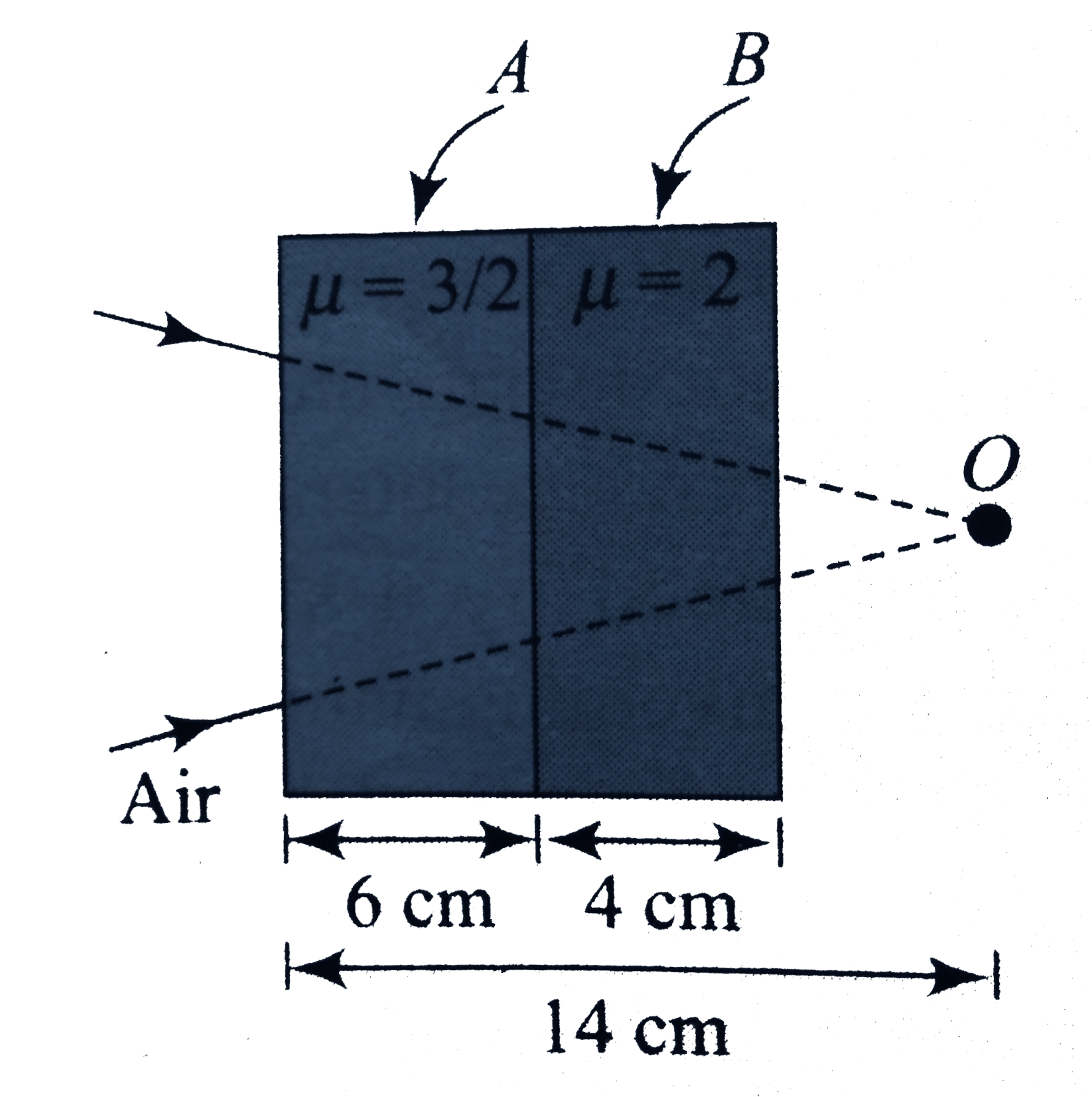
A convergent beam is incident on two slabs placed in contact as shown in figure. Where will the rays finally converge?

Text Solution

Verified by Experts
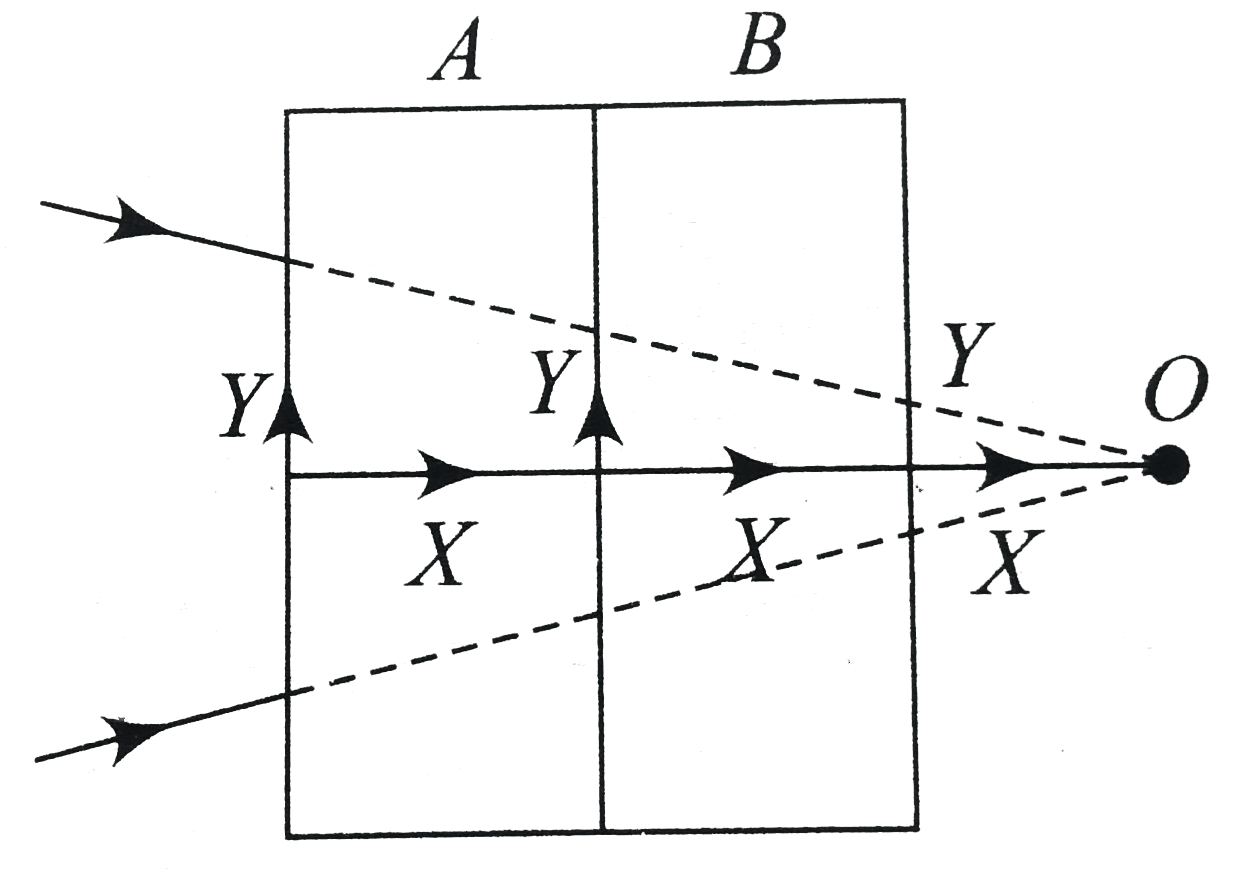
A ray of light from the object undergoes refraction at three interfaces: (1) Air-medium A, (2) Medium A-mudium B, (3) Medium B-air. The coordinate system for each of the interface is shown in the following figure.
Air-medium A interface:
`d_(1)=+14cm, mu_(1)=1, mu_(2)=1.5`
As `(mu_(1))/(d_(1))=(mu_(2))/(d_(2))` or `d_(2)=(mu_(2))/(mu_(1))d_(1)` , we get
`d_(2)=+21 cm`
Medium A-medium B interface:
`d_(1)=(21-6)=15 cm, mu_(1)=1.5, mu_(2)=2`
As `(mu_(1))/(d_(1))=(mu_(2))/(d_(2))` or ` d_(2)=(mu_(2))/(mu_(1))d_(1)` , we get
`d_(2)=+20cm`
Medium B-air interface:
`d_(1)=+(20-4)=+16cm, mu_(1)=2, mu_(2)=1`
As `(mu_(1))/(d_(1))=(mu_(2))/(d_(2))` or `d_(2)=(mu_(2))/(mu_(1))d_(1)` , we get
`d_(2)=+8cm`
Thus, the final image is 8cm in front of the medium B-air interface.
Method 2: Method of shifting
Net shifting `S=6(1-(1)/(3//2))+4(1-(1)/(2))`
`=4cm`
The shifting will be in the direction of ray travelling, i.e., towards right.
Hence, rays will coverge finally `=14+4=18 cm` from left surface or 8cm from right surface.
Promotional Banner

Topper's Solved these Questions

  • GEOMETRICAL OPTICS

    CENGAGE PHYSICS|Exercise Exercise1.4|12 Videos
  • GEOMETRICAL OPTICS

    CENGAGE PHYSICS|Exercise Exercise1.5|22 Videos
  • GEOMETRICAL OPTICS

    CENGAGE PHYSICS|Exercise Exercise1.2|20 Videos
  • FRICTION

    CENGAGE PHYSICS|Exercise QUESTION BANK|1 Videos
  • GRAVITATION

    CENGAGE PHYSICS|Exercise Question Bank|39 Videos

Similar Questions

Explore conceptually related problems

A converging beam of light rays incident on a glasa-air interface as shown in figure. Find where these rays will meet after refraction.

A convergent beam is incident on a convex mirror. Reflected light

A converging beam of light is incident on a right angled isosceles prism as shown in the Figure. The marginal rays in the beam are incident at angle +- theta . The refractive index for the glass of the prism is mu = 1.49 (= (1)/(sin 42°)) . Find the maximum value of theta for which no light comes out of the hypotenuse surface.

Two identical thin isosceles prisms of refracting angle A and refractive index mu are placed with their bases touching each other and this system can collectively act as a crude converging lens. A parallel beam of light is incident on this system as shown in Figure. Find the focal length of this so called converging lens.

A ray is incident on interface of two media at critical angle as shown in the figure.

A converging set of ray, traveling from water to air, is incident on a plane interface. In the absence of the interface, the rays would have converged to a point O, 60 cm above the interface. However, dur to refraction the rays will bend. At what distance above the interface will the rays actually converge?

Consider a light beam incident from air to a glass slab at Brewster's angle as shown in figure. A polaroid is placed in the path of the emergent ray at point P and rotated about an axis passing through the centre and pependicular to the plane of the plaroid.

CENGAGE PHYSICS-GEOMETRICAL OPTICS-Exercise1.3
  1. A converging set of ray, traveling from water to air, is incident on a...

    Text Solution

    |

  2. A tank contains three layers of immiscible liquids. The first layer is...

    Text Solution

    |

  3. A convergent beam is incident on two slabs placed in contact as shown ...

    Text Solution

    |

  4. A slab of water is on the top of a glass slab of refractive index 2. A...

    Text Solution

    |

  5. A ray of light ravels from a liquid of refractive index mu to air. If ...

    Text Solution

    |

  6. What should be the value of refractive index n of a glass rod placed ...

    Text Solution

    |

  7. An object is placed on the principle axis of a concave mirror of focal...

    Text Solution

    |

  8. The image of an object kept at a distance of 30 cm in front of a conca...

    Text Solution

    |

  9. In Figure, a fish watcher watches a fish through a 3.0 cm thick glass ...

    Text Solution

    |

  10. An observer can see through a pin-hole the top end of a thin rod of he...

    Text Solution

    |

  11. A vesserl contains a slab of glass 8cm thick and of refractive index 1...

    Text Solution

    |

  12. An object O is placed at 8cm in front of a glass slab, whose one face ...

    Text Solution

    |

  13. x-y plane separates two media, zge0 contains a medium of refractive i...

    Text Solution

    |

  14. The n transparent slabs of refractive index1.5 each having thickness 1...

    Text Solution

    |

  15. A concave mirror with its optic axis vertical and mirror facinig upwar...

    Text Solution

    |

  16. Consider the situation shown in Figure. A plane mirror is fixed at a h...

    Text Solution

    |

  17. A concave mirror of radius 40 cm lies on a horizontla tale and wateis ...

    Text Solution

    |

  18. A concave mirror of radius R is kept on a horizontal table. Water (ref...

    Text Solution

    |

  19. The refractive index of an anisotropic medium varies as mu=mu(0)sqrt((...

    Text Solution

    |

  20. A light beam of diameter sqrt(3R) is incident symmetrically on a glass...

    Text Solution

    |

