Home
Class 12
PHYSICS
The internal surface of the walls of a ...

The internal surface of the walls of a sphere is specular. The radius of the sphere is `R=36cm.` A point source S is placed at a distance `R//2` from the cneter of the sphere and sends light to the remote part of the sphere. Where will the image of the source be after two successive reflections from the remote and then nearest wall of the sphere? How will the position of the image change if the source sends light to the nearest wall first?Consider paraxial rays.

Text Solution

Verified by Experts

The correct Answer is:
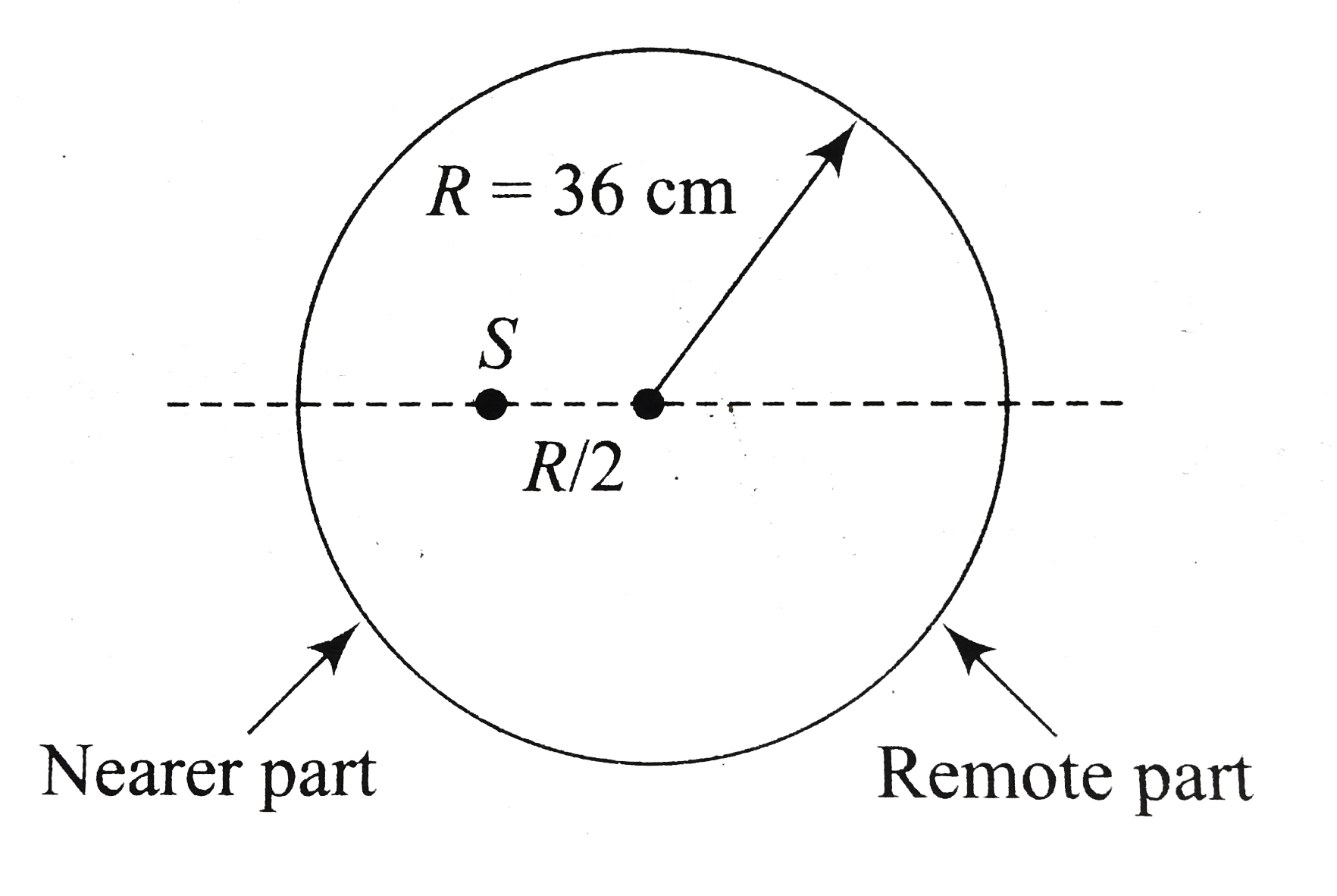
Image will be at `-(5R)/(6)` from near end towards source;
image will be at `-( R )/(2)` from remote end

Case I.
Applying mirror formula for remote part `(u=-(3R)/(2), f=-(R)/(2))`
`v=(uf)/(u-f)=(-3)/(4)R`
Now, consider reflection from the nearer part for nearer part
`u=(3R)/(4)-2R=-(5R)/(4)rArrv=(uf)/(u-f)=oo`
Reflection from remote part gives `v=-(2R)/(2)`
Thus, the Image will be at `-(5R)/(6)` from near end toward source image will be at `-(R)/(2)` from remote end.
Promotional Banner

Topper's Solved these Questions

  • GEOMETRICAL OPTICS

    CENGAGE PHYSICS|Exercise Single Correct|221 Videos
  • GEOMETRICAL OPTICS

    CENGAGE PHYSICS|Exercise Assertion-Reasoninig|2 Videos
  • GEOMETRICAL OPTICS

    CENGAGE PHYSICS|Exercise Exercise1.7|21 Videos
  • FRICTION

    CENGAGE PHYSICS|Exercise QUESTION BANK|1 Videos
  • GRAVITATION

    CENGAGE PHYSICS|Exercise Question Bank|39 Videos

Similar Questions

Explore conceptually related problems

The internal surface of the walls of a sphere is specular (i.e. reflecting). The radius of the sphere is R = 36 cm . A point source S is placed at a distance R//2 from the centre of the sphere and sends light to the remote part of the sphere. Where will the image of the source be after two successive reflection from the remote and then the nearest wall of the sphere ? How wil the position of the image change if the source sends light to the nearest wall first ? Consider paraxial rays.

The inner surface of the wall of a sphere is perfectly reflecting. Radius of the sphere is R. A point source S is placed at a distance R//2 from the centre of the sphere. Consider the reflection of light from the farthest wall followed by reflection from the nearest wall. Where is the image of the source? Consider paraxial rays only.

The potential at a distance R//2 from the centre of a conducting sphere of radius R will be

The radius of a sphere is 21cm, what is the surface area of the sphere?

A point charge q is placed at a distance of r from cebtre of an uncharged conducting sphere of rad R(lt r) . The potential at any point on the sphere is

Radius of a sphere is 14 cm. Find the surface area of the sphere.

A hollow metal sphere of radius 5 cm is charged such that the potential on its surface is 10 V . The potential at a distance of 2 cm from the centre of the sphere

A hollow metal sphere of radius 5 cm is charged such that the potential on its surface is 10V . The potential at the distance 3 cm from the centre of the sphere is:

The volume of a sphere is 36 pi cm^(3) . Find the surface area of the sphere.

CENGAGE PHYSICS-GEOMETRICAL OPTICS-Subjective
  1. A direct-vision prism is made out of three prisms, each with a refract...

    Text Solution

    |

  2. A person wants to see AB part of his image. His eye level is at 1.8m a...

    Text Solution

    |

  3. The internal surface of the walls of a sphere is specular. The radius...

    Text Solution

    |

  4. As shown in Figure,. And object O is at the position (-10,2) with resp...

    Text Solution

    |

  5. In figure, AB is the principal axis of the concave mirror. A point ob...

    Text Solution

    |

  6. If an observer sees the bottom of the vessel shown in Figure., at 8cm,...

    Text Solution

    |

  7. O is a point object kept on the principal axis of a concave mirror M o...

    Text Solution

    |

  8. In Figure ., L is a converging lens of focal length 10cm and M Iis a c...

    Text Solution

    |

  9. A stationary observer O looking at a fish F in water (mu(w)=4//3) thro...

    Text Solution

    |

  10. The back wall of an aqaurium is a mirror that is 30 cm away from the f...

    Text Solution

    |

  11. An object is placed 20cm to the left of a converging lens having focal...

    Text Solution

    |

  12. A composite slab consisting of different media is placed in front of a...

    Text Solution

    |

  13. A parallel beam of light falls on the surface of a convex lens whose r...

    Text Solution

    |

  14. A thin biconvex lens of refractive index 3//2 and radius of curvature...

    Text Solution

    |

  15. A convex lens of focal length f(1) is placed in front of a luminous po...

    Text Solution

    |

  16. A lens is made of three thin different mediums. Radius of curvature an...

    Text Solution

    |

  17. An equiconvex lens, f(1)=10cm, is placed 40 cm in front of a concave ...

    Text Solution

    |

  18. A biconvex lens, f(1)=20cm , is placed 5cm in front of a convex mirror...

    Text Solution

    |

  19. A transparent sphere of radius R ahs a cavity of radius R//2 as shown ...

    Text Solution

    |

  20. A stationary observer O looking at a fish F in water (mu(w)=4//3) thro...

    Text Solution

    |

