Home
Class 12
PHYSICS
O is a point object kept on the principa...

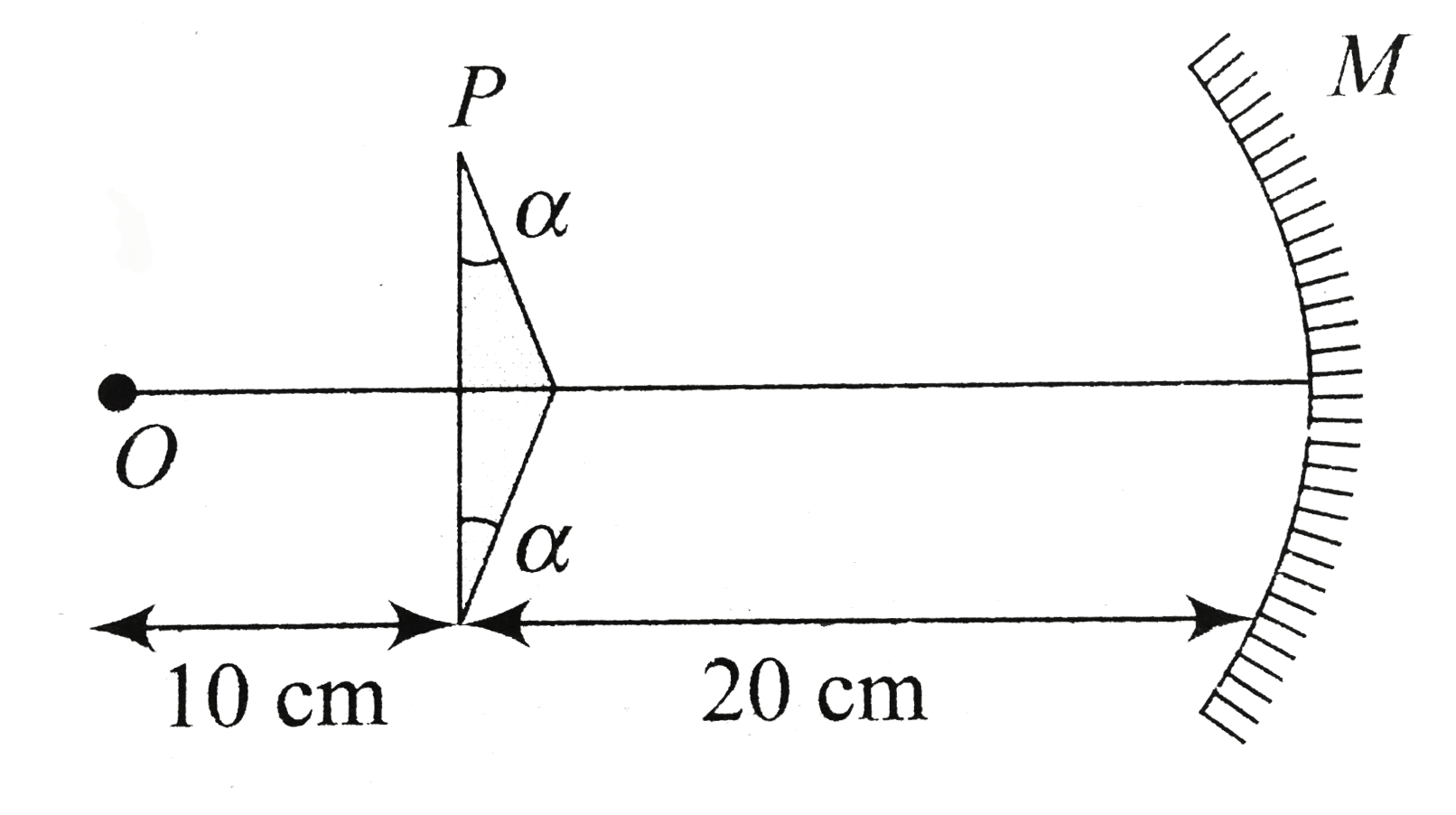
O is a point object kept on the principal axis of a concave mirror M of radius of curvature 20cm. P is a prism of angle `1.8^@` . Light falling on the prism (at small angle of incidence) gets refracted through the prism and then falls on the mirror. Refractive index of the prism is `3//2` . Find the distance between the images formed by the concave mirror due to this light.

Text Solution

Verified by Experts

The correct Answer is:
`(pi)/(20)cm`

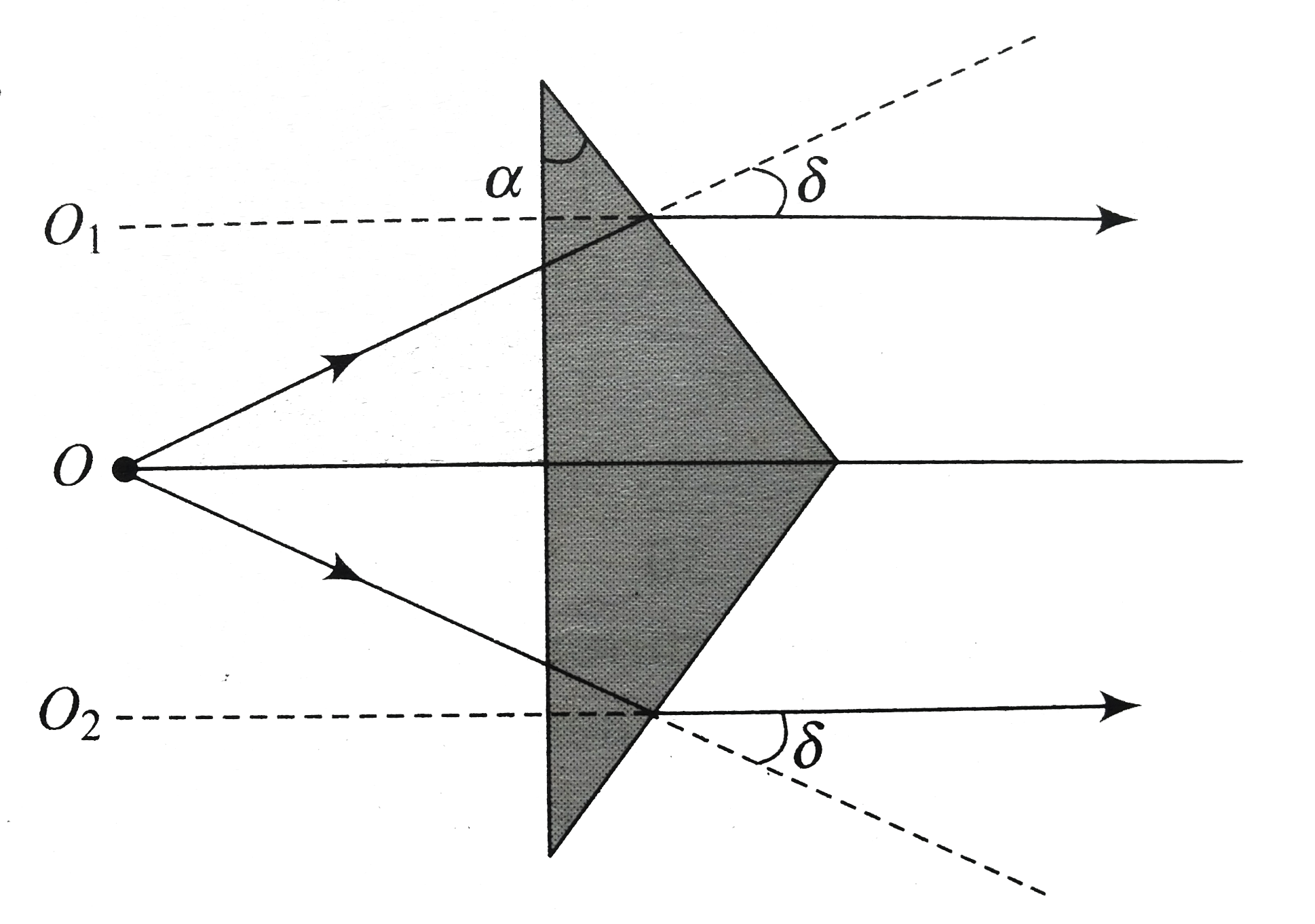
For thin prism `delta=(mu-1)alpha`
`=(1.5-1)1.8^(@)`
`=(0.5)1.8xx(pi)/(180)rad=(pi)/(200)rad`
`:.` Distance `OO_(1)=10xx(pi)/(200)=(pi)/(20)cm`
Similarly, distance `OO_(2)=(pi)/(20)cm`
`:. O_(1)O_(2)=(pi)/(10)cm`
For the mirror, `O_(1)` and `O_(2)` are two point objects, at a distance of 30cm.
Now, applying mirror formula
`(1)/(v)+(1)/(-30)=(1)/(-10)rArrv=-15cm`
Latent magnification is
`-(v)/(u)=((-15))/(-30)=-(1)/(2)`
`(-ve` sign indicates inverted image `)`
Therefore, if `O_(1)^(')` and `O_(2)^(')` are the images formed, then distance between them,
`O_(1)^(')O_(2)^(')=(1)/(2)O_(1)O_(2)=(1)/(2).(pi)/(10)=(pi)/(20)cm`
Promotional Banner

Topper's Solved these Questions

  • GEOMETRICAL OPTICS

    CENGAGE PHYSICS|Exercise Single Correct|221 Videos
  • GEOMETRICAL OPTICS

    CENGAGE PHYSICS|Exercise Assertion-Reasoninig|2 Videos
  • GEOMETRICAL OPTICS

    CENGAGE PHYSICS|Exercise Exercise1.7|21 Videos
  • FRICTION

    CENGAGE PHYSICS|Exercise QUESTION BANK|1 Videos
  • GRAVITATION

    CENGAGE PHYSICS|Exercise Question Bank|39 Videos

Similar Questions

Explore conceptually related problems

In the given figure, O is a point object kept on the principal axis of a concave mirror M of radius of curvature 20 cm . P is a prism of angle alpha=1.8^(@) . Light falling on the prism (at small angle of incidence) get refracted through the prism and then fall on the mirror. Rrfractive index of prism is 3//2 . Find the distance between the images formed by the concave mirror due to this light.

A thin prism deviates an incident ray by 3.2^@ . If the refractive index of the prism is 2.6 then the angle of prism is

The refractive index of a prism is 2. The prism can have a maximum refracting angle of

The refractive index of a prism is 2. this prism can have a maximum refracting angle of

A ray of light is incident at an angle of incidence 45^@ on an equilateral prism and emerge at an angle 45^@ then the refractive index of the medium of the prism is:

An object is present on the principal axis of a concave mirror at a distance 30cm from it. Focal length of mirror is 20cm. Q. Image formed by mirror is

A ray of light falls on a glass prism at a angle of incidence of 30^(@) . Find the direction of the emergent ray if the angle of the prism is 60^(@) and refractive index is 1.50

A thin prism of refracting angle 2^@ deviates an incident ray through an angle of 1^@ .Find the value of refractive index of material of prism.

A ray of light incident on one of the face of a prism as shown. After refraction through this surface ray is incident on base of the prism. The refractive index of the prism is sqrt(3) . The net deviation of the ray due to prism is

An object is present on the principal axis of a concave mirror at a distance 30cm from it.Focal length of mirror is 20cm Image formed by mirror is

CENGAGE PHYSICS-GEOMETRICAL OPTICS-Subjective
  1. In figure, AB is the principal axis of the concave mirror. A point ob...

    Text Solution

    |

  2. If an observer sees the bottom of the vessel shown in Figure., at 8cm,...

    Text Solution

    |

  3. O is a point object kept on the principal axis of a concave mirror M o...

    Text Solution

    |

  4. In Figure ., L is a converging lens of focal length 10cm and M Iis a c...

    Text Solution

    |

  5. A stationary observer O looking at a fish F in water (mu(w)=4//3) thro...

    Text Solution

    |

  6. The back wall of an aqaurium is a mirror that is 30 cm away from the f...

    Text Solution

    |

  7. An object is placed 20cm to the left of a converging lens having focal...

    Text Solution

    |

  8. A composite slab consisting of different media is placed in front of a...

    Text Solution

    |

  9. A parallel beam of light falls on the surface of a convex lens whose r...

    Text Solution

    |

  10. A thin biconvex lens of refractive index 3//2 and radius of curvature...

    Text Solution

    |

  11. A convex lens of focal length f(1) is placed in front of a luminous po...

    Text Solution

    |

  12. A lens is made of three thin different mediums. Radius of curvature an...

    Text Solution

    |

  13. An equiconvex lens, f(1)=10cm, is placed 40 cm in front of a concave ...

    Text Solution

    |

  14. A biconvex lens, f(1)=20cm , is placed 5cm in front of a convex mirror...

    Text Solution

    |

  15. A transparent sphere of radius R ahs a cavity of radius R//2 as shown ...

    Text Solution

    |

  16. A stationary observer O looking at a fish F in water (mu(w)=4//3) thro...

    Text Solution

    |

  17. The bottom of glass beaker is made of a thin equiconvex lens having bo...

    Text Solution

    |

  18. A thin convex lens of refractive index mu=1.5 is placed between a poi...

    Text Solution

    |

  19. A thin equiconvex glass lens (mu(g)=1.5) is beign placed on the top of...

    Text Solution

    |

  20. A point object is located at a distance of 100cm from a screen. A lens...

    Text Solution

    |

