Home
Class 12
PHYSICS
An equiconvex lens, f(1)=10cm, is placed...

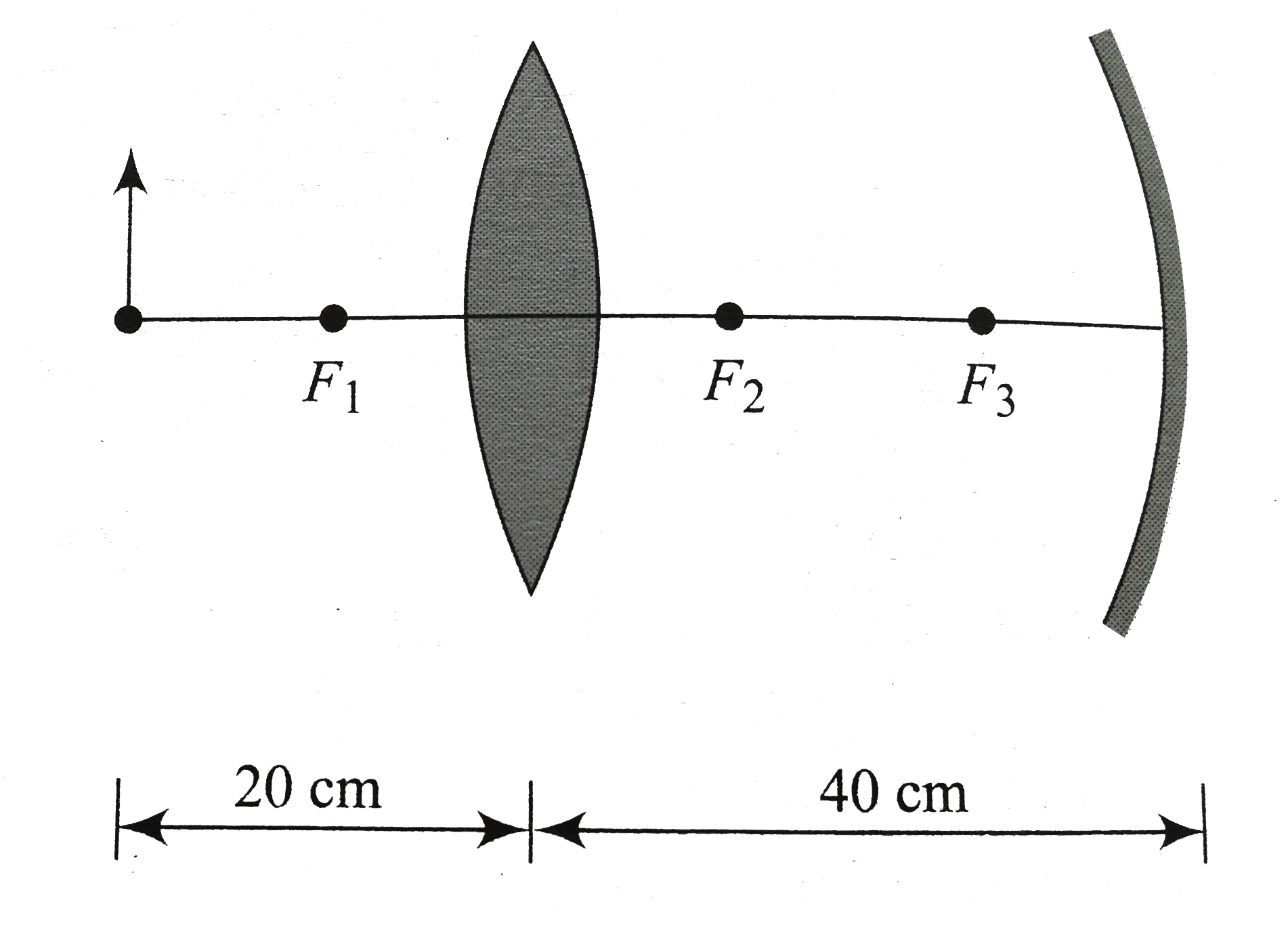
An equiconvex lens, `f_(1)=10cm`, is placed 40 cm in front of a concave mirror, `f_(2)=7.50cm` as shown in Figure ., An object 2 cm high is placed 20cm to the left of the lens . Find the position of the final image is formed when leftward travelling rays once again pass through the lens. Find overall magnification.

Text Solution

Verified by Experts

The correct Answer is:
Final image is real, inverted and lies 15.6cm to the left of the lens with overall magnification 0.333

From lens equation,
`(1)/(v)-(1)/((-20))=(1)/(10),v=-20cm`
Magnification, `m_(1)=(v)/(u)=((+20)/(-20))=-1`
Image is real and inverted, same size as object.
The first image acts as object for concave mirror. Object distance for mirror is `(40-20)` cm.
From mirror equation,
`(1)/(v^('))+(1)/((-20))=(1)/((-7.5)), v^(')=-12cm`
Magnification, `m_(2)=((u^('))/(v^(')))=-((-12)/(-20))=-0.6`
The second image is 12cm to the left of th emirror, real, erect (that is reinverted).
The second image acts as object for the lens. The object distance for second refraction at the lens, `u^('')=+28cm`
From lens equation, `(1)/(v^(''))-(1)/((+28))=(1)/(-10), v^('')=-15.6 cm`
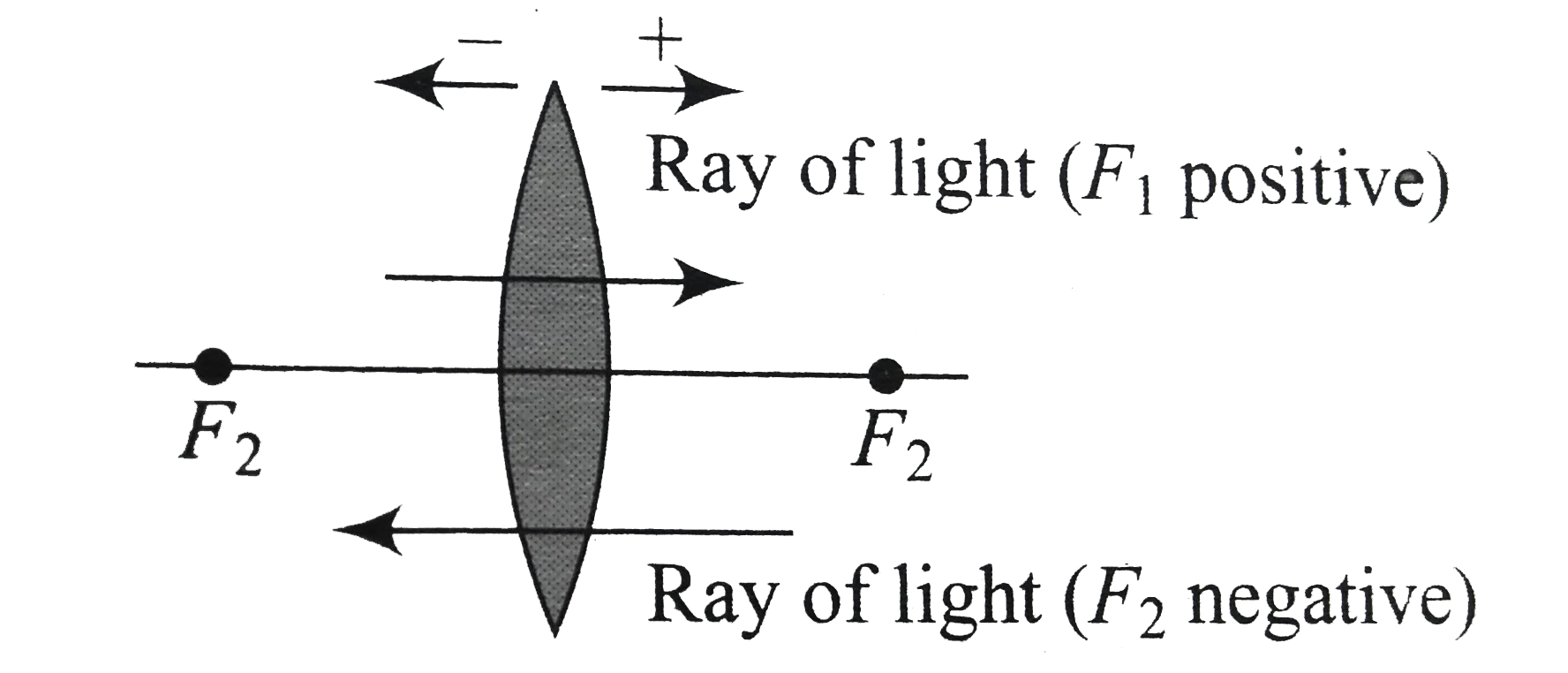
Note the sign convention for f and u.
Magnification, `m_(3)=(v^(''))/(u^(''))=((-15.6)/(+28))=-0.556`
Final image is real, inverted and lies 15.6 cm to the left fo the lens.
Overall magnification,
`m=m_(1)xxm_(2)xxm_(3)`
`=(-1)xx(0.6)xx(-0.556)=-0.333`
Promotional Banner

Topper's Solved these Questions

  • GEOMETRICAL OPTICS

    CENGAGE PHYSICS|Exercise Single Correct|221 Videos
  • GEOMETRICAL OPTICS

    CENGAGE PHYSICS|Exercise Assertion-Reasoninig|2 Videos
  • GEOMETRICAL OPTICS

    CENGAGE PHYSICS|Exercise Exercise1.7|21 Videos
  • FRICTION

    CENGAGE PHYSICS|Exercise QUESTION BANK|1 Videos
  • GRAVITATION

    CENGAGE PHYSICS|Exercise Question Bank|39 Videos

Similar Questions

Explore conceptually related problems

A biconvex lens, f_(1)=20cm , is placed 5cm in front of a convex mirror, f_(2)=15cm . An object of length 2 cm is placed at a distance 10cm from the lens. Find the loaction and nature of the final image after the leftward travelling rays once again pass through the lens. Find overall magnification.

A biconvex lens of focal length f_(1)=10cm is placed 40 cm in front of a concave mirror of focal length f_(2)=7.50 cm, as shown in the figure. An object, 2 cm high, is placed 20 cm to the left of the lens. The image formed by the lens, as rays travel to the right, is

An object is placed 25 cm in front of a concave lens of focal length 25 cm. The position of images is

A convex lens of focal length 10 cm is placed coaxially 5 cm away from a concave lens of focal length 10 cm. If an object is placed 30 cm in front of the convex lens, find the position of the final image formed by the combined system.

A convex lens of focal length 10 cm is placed co-axially 5 cm away from a concave lens of focal length 10 cm . If an object is placed 30 cm in front of the convex lens, find the position of final image formed by the combined system.

The focal length of a convex lens is 20 cm . If an object of height 4 cm is placed at 30 cm from the lens , find the position, nature and size of the image .

Focal length of a convex lense in air is 20cm. and of concave lens 40cm. Find the position of final image.

CENGAGE PHYSICS-GEOMETRICAL OPTICS-Subjective
  1. In figure, AB is the principal axis of the concave mirror. A point ob...

    Text Solution

    |

  2. If an observer sees the bottom of the vessel shown in Figure., at 8cm,...

    Text Solution

    |

  3. O is a point object kept on the principal axis of a concave mirror M o...

    Text Solution

    |

  4. In Figure ., L is a converging lens of focal length 10cm and M Iis a c...

    Text Solution

    |

  5. A stationary observer O looking at a fish F in water (mu(w)=4//3) thro...

    Text Solution

    |

  6. The back wall of an aqaurium is a mirror that is 30 cm away from the f...

    Text Solution

    |

  7. An object is placed 20cm to the left of a converging lens having focal...

    Text Solution

    |

  8. A composite slab consisting of different media is placed in front of a...

    Text Solution

    |

  9. A parallel beam of light falls on the surface of a convex lens whose r...

    Text Solution

    |

  10. A thin biconvex lens of refractive index 3//2 and radius of curvature...

    Text Solution

    |

  11. A convex lens of focal length f(1) is placed in front of a luminous po...

    Text Solution

    |

  12. A lens is made of three thin different mediums. Radius of curvature an...

    Text Solution

    |

  13. An equiconvex lens, f(1)=10cm, is placed 40 cm in front of a concave ...

    Text Solution

    |

  14. A biconvex lens, f(1)=20cm , is placed 5cm in front of a convex mirror...

    Text Solution

    |

  15. A transparent sphere of radius R ahs a cavity of radius R//2 as shown ...

    Text Solution

    |

  16. A stationary observer O looking at a fish F in water (mu(w)=4//3) thro...

    Text Solution

    |

  17. The bottom of glass beaker is made of a thin equiconvex lens having bo...

    Text Solution

    |

  18. A thin convex lens of refractive index mu=1.5 is placed between a poi...

    Text Solution

    |

  19. A thin equiconvex glass lens (mu(g)=1.5) is beign placed on the top of...

    Text Solution

    |

  20. A point object is located at a distance of 100cm from a screen. A lens...

    Text Solution

    |

