Home
Class 12
PHYSICS
A concave spherical refractive surface w...

A concave spherical refractive surface with radius R separates a medium of refractive index `5//2` from air. As an object is approaching the surface from far away from the surface along the central axis, its image

A

always remains real

B

always remains virtual

C

changes from real to virtual at a distance `2R//3` from the surface

D

changes from virtual to real at a distance `2R//3` from the surface

Text Solution

Verified by Experts

The correct Answer is:
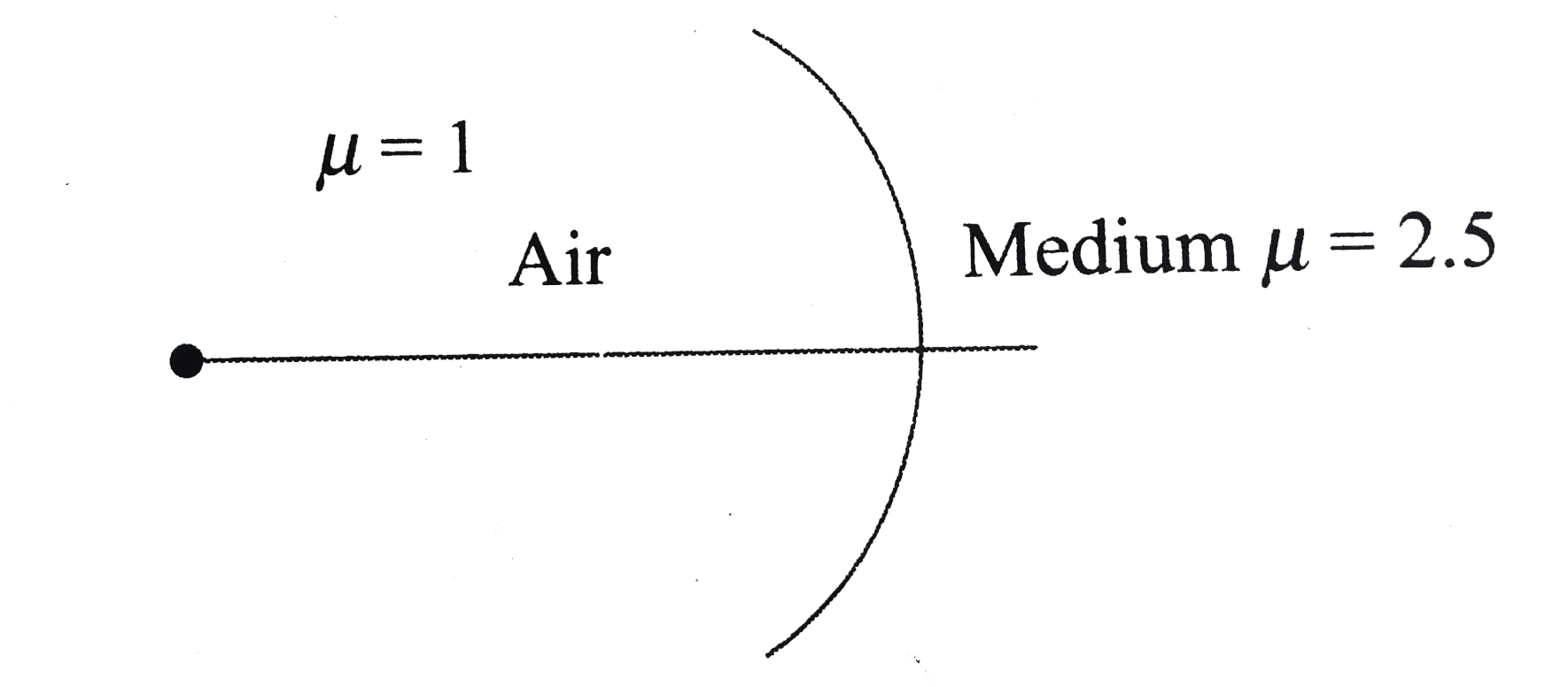
b.

`(2.5)/(v)-(1)/(-u)=(1.5)/(-R)`
`v=-(2.5uR)/(1.5u+R)`
`vlt0` for all values of u, so the image remains virtual.
Promotional Banner

Topper's Solved these Questions

  • GEOMETRICAL OPTICS

    CENGAGE PHYSICS|Exercise Assertion-Reasoninig|2 Videos
  • GEOMETRICAL OPTICS

    CENGAGE PHYSICS|Exercise Linked Comprehension|51 Videos
  • GEOMETRICAL OPTICS

    CENGAGE PHYSICS|Exercise Subjective|26 Videos
  • FRICTION

    CENGAGE PHYSICS|Exercise QUESTION BANK|1 Videos
  • GRAVITATION

    CENGAGE PHYSICS|Exercise Question Bank|39 Videos

Similar Questions

Explore conceptually related problems

A convex spherical refracting surface with radius R separates a medium having refractive index 5//2 from air. As an object is moved towards the surface from far away from the surface along the principle axis, its image

A concave spherical surface of radius of curvature 100 cm separates two media of refractive indices 1.50 and (4)/(3) . An object is kept in the first medium at a distance of 30 cm from the surface. Calculate the position of the image.

A concave spherical surface of radius of curvature 10 cm separates two medium x & y of refractive index 4/3 & 3/2 respectively. If the object is placed along principal axis in medium X then

A convex refracting surface of radius of curvature 20 cm separates two media of refractive indices 4//3 and 1.60 . An object is placed in the first medium (mu = 4//3) at a distance of 200 cm from the refracting surface. Calculate the position of image formed.

A convex surface of radius of curvature 40 cm separate two media of refractive indices (4)/(3) and 1.50. An object is kept in the first medium at a distance of 20 cm from the surface. Calculate the position of the image.

A concave spherical surface of radius of curvature 10 cm separates two mediums X and Y of refractive indices 4//3 and 3//2 respectively. Centre of curvature of the surfaces lies in the medium X . An object is placed in medium X .

A spherical surface of radius R separates air from a medium of refractive index mu . Parallel beam of light is incident, from medium side, making a small angle theta with the principal axis of the spherical surface. Find the co-ordinates of the point where the rays will focus in air.

A spherical convex surface separates object and image space of refractive index 1.0 and 4//3 . If radius of curvature of the surface is 10 cm , find its power.

A spherical convex surface separates object and image space of refractive index 1.0 and 4/3. If radius of curvature of the surface is 10cm, find its power.

A plane surface separates a denser medium of refractive index 1.5 from air. A plane wavefront travelling in air is incident on the interface at an angle of 30^(@) . What will be the angle of refraction ?

CENGAGE PHYSICS-GEOMETRICAL OPTICS-Single Correct
  1. A concave refractive surface of a medium having refractive index mu pr...

    Text Solution

    |

  2. A convex spherical refracting surface with radius R separates a medium...

    Text Solution

    |

  3. A concave spherical refractive surface with radius R separates a mediu...

    Text Solution

    |

  4. Two lenses shown in figure. Are illuminated by a beam of parallel ligh...

    Text Solution

    |

  5. In the arrangement shown in figure., the image of the extended object ...

    Text Solution

    |

  6. The table below shows object and image distances for four objects pla...

    Text Solution

    |

  7. A fish looks upward at an unobstructed overcast sky. What total angle ...

    Text Solution

    |

  8. For the situations shown in figure, determine the angle by which the m...

    Text Solution

    |

  9. A real object is placed in front of a convex mirror (fixed).The object...

    Text Solution

    |

  10. A point is placed in front of thick plane mirror as shown in figure. F...

    Text Solution

    |

  11. Rays from a lens are converging toward a point P, a shown in Figure. H...

    Text Solution

    |

  12. A right-angled prism of apex angle 4^(@) and refractive index 1.5 is l...

    Text Solution

    |

  13. Find the net deviation produced in the incident ray for the optical in...

    Text Solution

    |

  14. When an object is placed 15cm from a lens, a virtual image is formed. ...

    Text Solution

    |

  15. A glass hemisphere of radius R and of material having refractive index...

    Text Solution

    |

  16. The refracting angle of a prism is A and refractive index of the mater...

    Text Solution

    |

  17. An object kept on the principal axis and infront of a spherical mirro...

    Text Solution

    |

  18. A lens of focal length 20.0 cm and aperture radius 2.0cm is placed at ...

    Text Solution

    |

  19. An object is placed 21 cm in front of a concave mirror of radius of cu...

    Text Solution

    |

  20. It is found that all electromagnetic signals sent from A towards B rea...

    Text Solution

    |

