Home
Class 12
PHYSICS
Find the net deviation produced in the i...

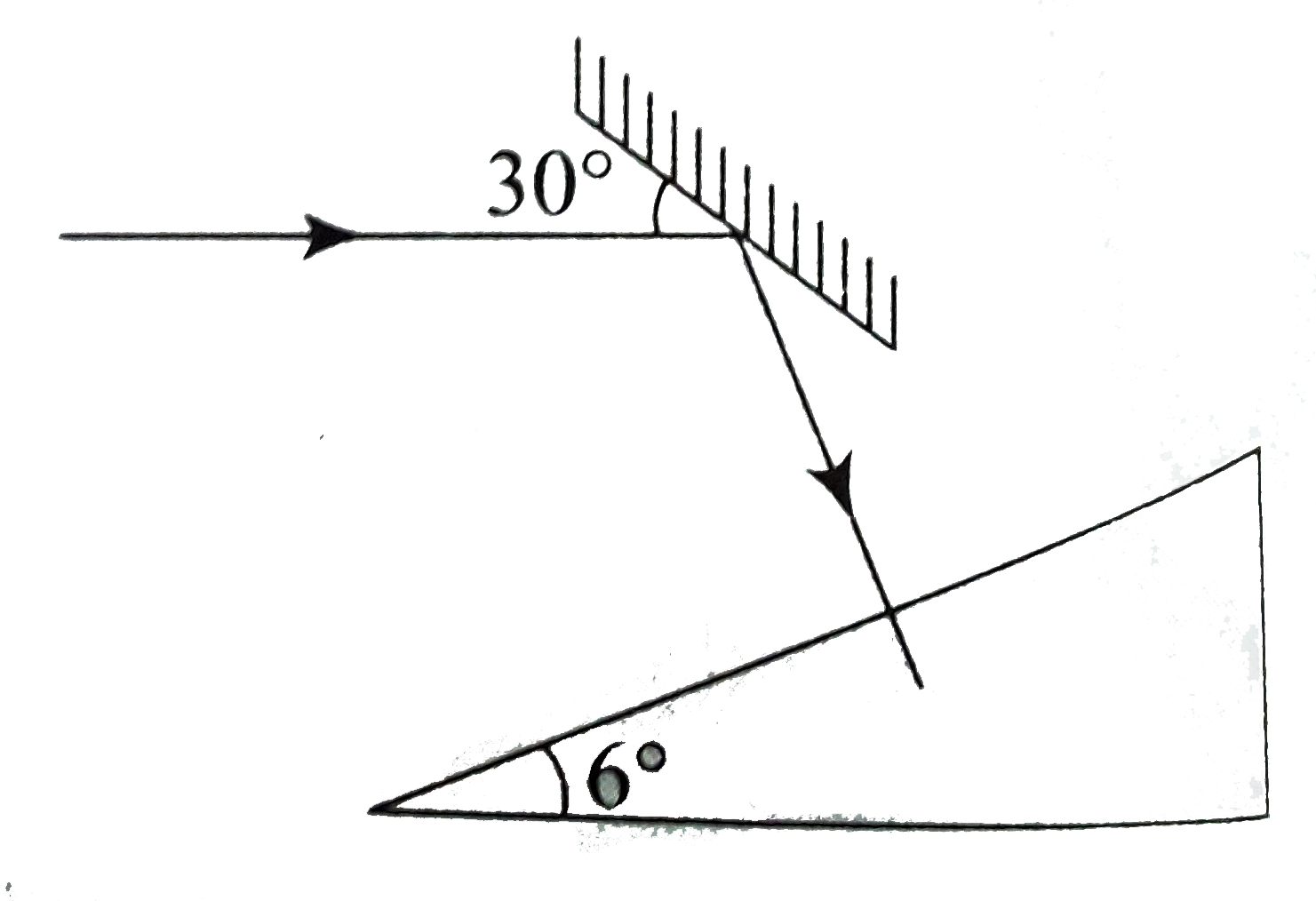
Find the net deviation produced in the incident ray for the optical instrument shown in figure. (Take refractive index of the prism material as 2.)

A

`66^(@)CW`

B

`66^(@)ACW`

C

`54^(@)ACW`

D

`54^(@)CW`

Text Solution

Verified by Experts

The correct Answer is:
D

Deviation produced by the mirror is
`delta_(1)=pi-2xx60=60^(@)CW`
Deviation produced by the prism is
`delta_(2)=(1-2)xx6=6^(@)ACW`
So, net deviation, `delta=delta+delta_(2)=(60^(@)-6^(@))CW=54^(@)CW`
Promotional Banner

Topper's Solved these Questions

  • GEOMETRICAL OPTICS

    CENGAGE PHYSICS|Exercise Assertion-Reasoninig|2 Videos
  • GEOMETRICAL OPTICS

    CENGAGE PHYSICS|Exercise Linked Comprehension|51 Videos
  • GEOMETRICAL OPTICS

    CENGAGE PHYSICS|Exercise Subjective|26 Videos
  • FRICTION

    CENGAGE PHYSICS|Exercise QUESTION BANK|1 Videos
  • GRAVITATION

    CENGAGE PHYSICS|Exercise Question Bank|39 Videos

Similar Questions

Explore conceptually related problems

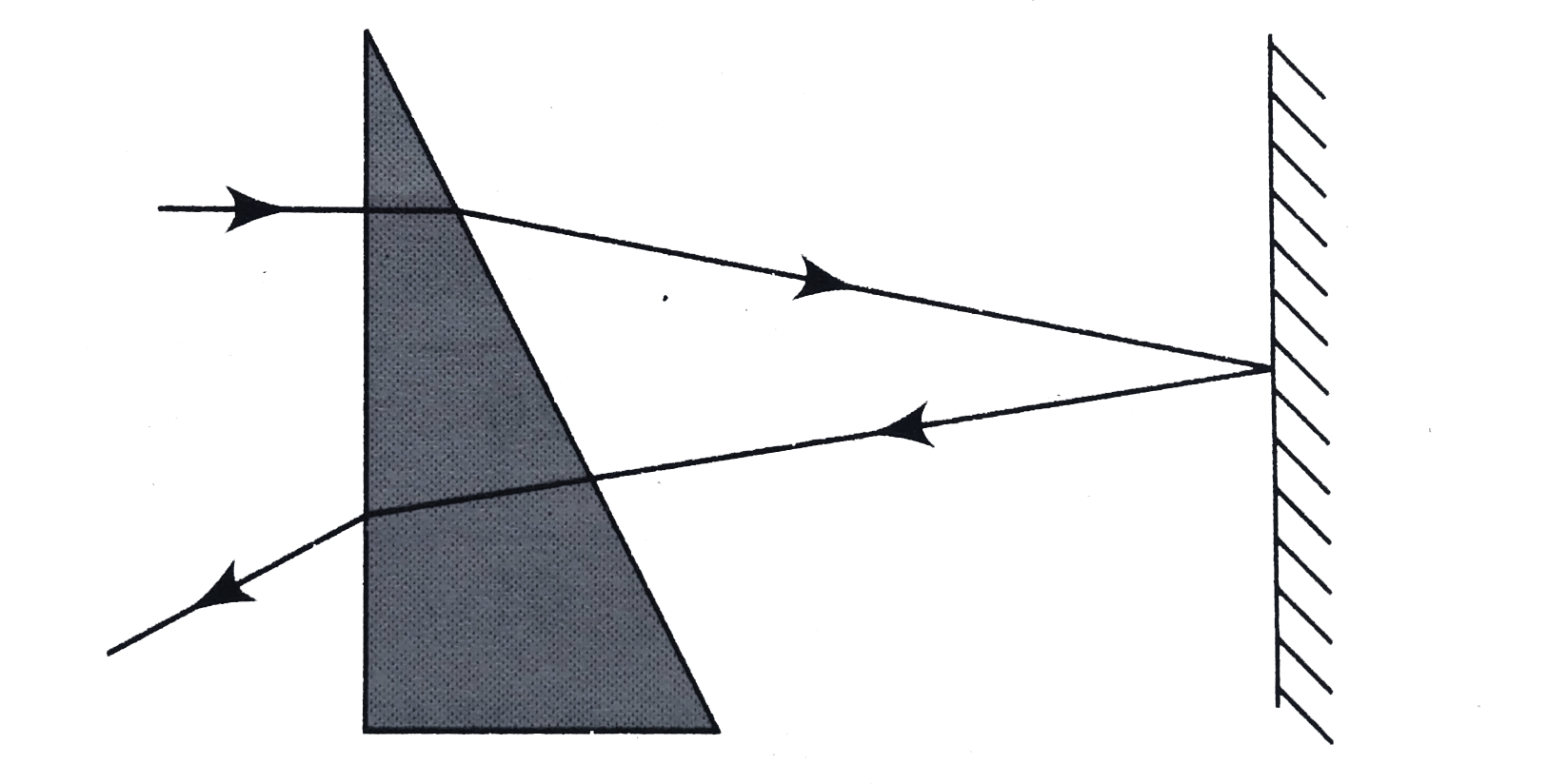
Find the angle of deviation suffered by the light ray shown in figure. The refractive index mu = for the prism material.

A ray of light is incident normally on one face of a prism as shown in figure. The refractive index of the material of the prism is (5)/(3) and the prism is immersed in water of refractive index (4)/(3) , then

An equilateral glass prism of refractive index 1.5 is immersed in water. Find the angle of deviation produced when a ray of light is incident at 42^(@) on one face of the prism. (Refractive index of water = 1.33)

A ray falls on a prism ABC(AB=BC) and travels as shown in adjoining figure.The minimum refraction index of the prism material should be -

In an isosceles prism of prism angle 45^(@) , it is found that when the angle of incidence is same as the prism angle, the emergent ray grazes the emergent surface. Find the refractive index of the material of the prism.For what angle of incidence the angle of deviation will be minimum ?

A ray of light is incident at an angle of 60^(@) on a prism whose refracting angle is 30^(@) . The ray emerging out of the prism when produced backward makes an angle of 30^(@) with the incident ray produced forward. Find the refractive index of the material of the prism.

In an isosceles prism of angle 45^@ , it is found that when the angle of incidence is same as the prism angle, the emergen ray grazes the emergent surface. Find the refractive index of the material of the prism. For what angle of incidenc, the angle of deviation will be minimum?

The angle of minimum deviation for an incident ligt ray on an equillateral prism is equal to its refracting angle. The refractive index of ite refracting angle. The refractive index of its material is

The angle of minimum deviation produced by an equilateral prism is 46^@ The refractive index of material of the prism.

A ray of light incident normally on an isosceles right angled prism travels as shown in the figure. The least value of the refractive index of the prism must be

CENGAGE PHYSICS-GEOMETRICAL OPTICS-Single Correct
  1. Rays from a lens are converging toward a point P, a shown in Figure. H...

    Text Solution

    |

  2. A right-angled prism of apex angle 4^(@) and refractive index 1.5 is l...

    Text Solution

    |

  3. Find the net deviation produced in the incident ray for the optical in...

    Text Solution

    |

  4. When an object is placed 15cm from a lens, a virtual image is formed. ...

    Text Solution

    |

  5. A glass hemisphere of radius R and of material having refractive index...

    Text Solution

    |

  6. The refracting angle of a prism is A and refractive index of the mater...

    Text Solution

    |

  7. An object kept on the principal axis and infront of a spherical mirro...

    Text Solution

    |

  8. A lens of focal length 20.0 cm and aperture radius 2.0cm is placed at ...

    Text Solution

    |

  9. An object is placed 21 cm in front of a concave mirror of radius of cu...

    Text Solution

    |

  10. It is found that all electromagnetic signals sent from A towards B rea...

    Text Solution

    |

  11. A diverging lens of focal length 10cm is placed 10cm away in front of ...

    Text Solution

    |

  12. An object starts moviing at an angle of 45^(@) with the principal axis...

    Text Solution

    |

  13. A concave mirror of radius of curvature 40cm forms an image of an obje...

    Text Solution

    |

  14. A converging beam of rays in incident on a diverging lens. Having pass...

    Text Solution

    |

  15. Consider a sphere of radius R made of glass of refractive index mu. A ...

    Text Solution

    |

  16. A ray of light AO is incident on a diverging lens as shown in figure. ...

    Text Solution

    |

  17. In the arrangement shown in figure, O is the object. An observer is to...

    Text Solution

    |

  18. The observer at O views two closely spaced spots on a vertical wall th...

    Text Solution

    |

  19. An equiconcave diverging lens of focal length F is cut into two equal ...

    Text Solution

    |

  20. In an optics experiment, with the position of the object fixed, a stud...

    Text Solution

    |

