Home
Class 12
PHYSICS
An object starts moviing at an angle of ...

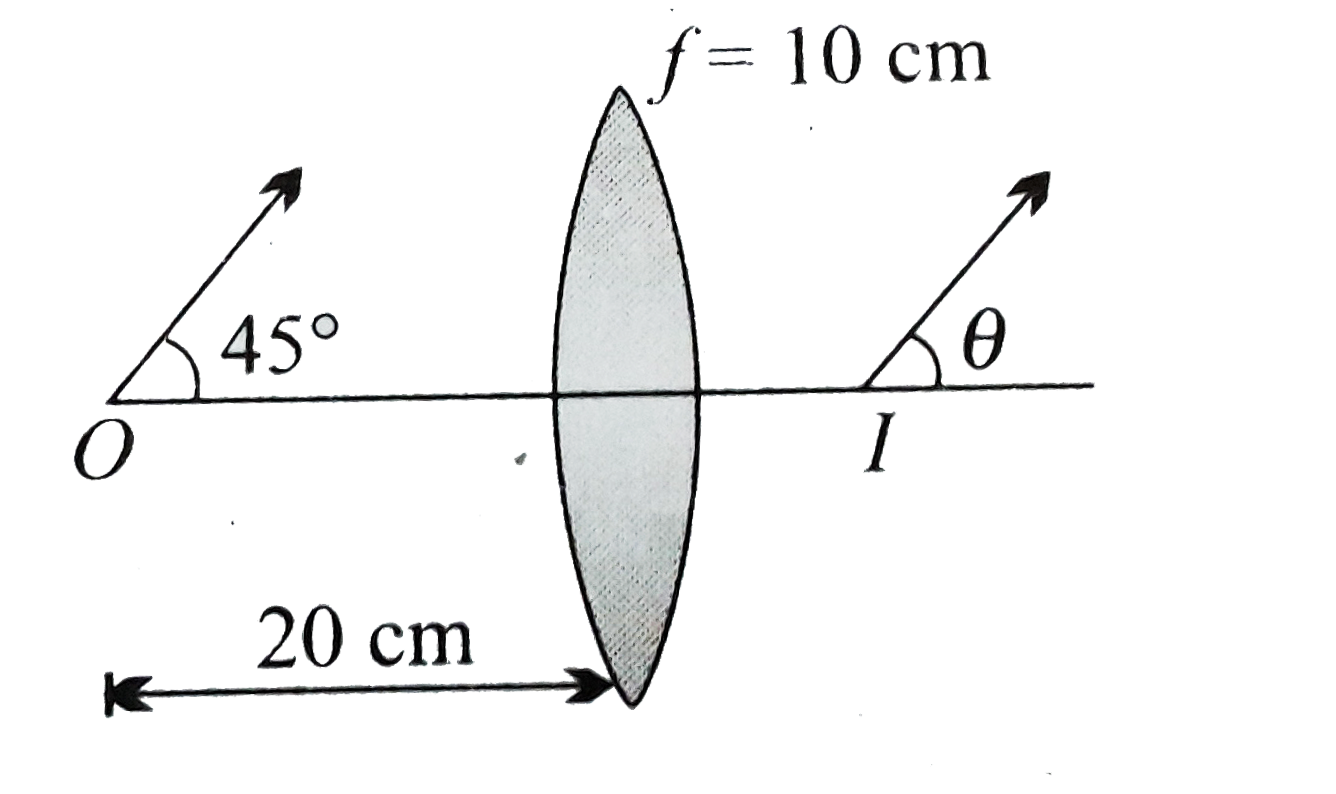
An object starts moviing at an angle of `45^(@)` with the principal axis as shown in figure. In front of a biconvex lens of focal length `+10cm` . If `theta` denotes the angle at which image starts to move with principal axis, then

A

`theta=(3pi)/(4)`

B

`theta=(pi)/(2)`

C

`theta=(pi)/(4)`

D

`theta=-(pi)/(4)`

Text Solution

Verified by Experts

The correct Answer is:
d.

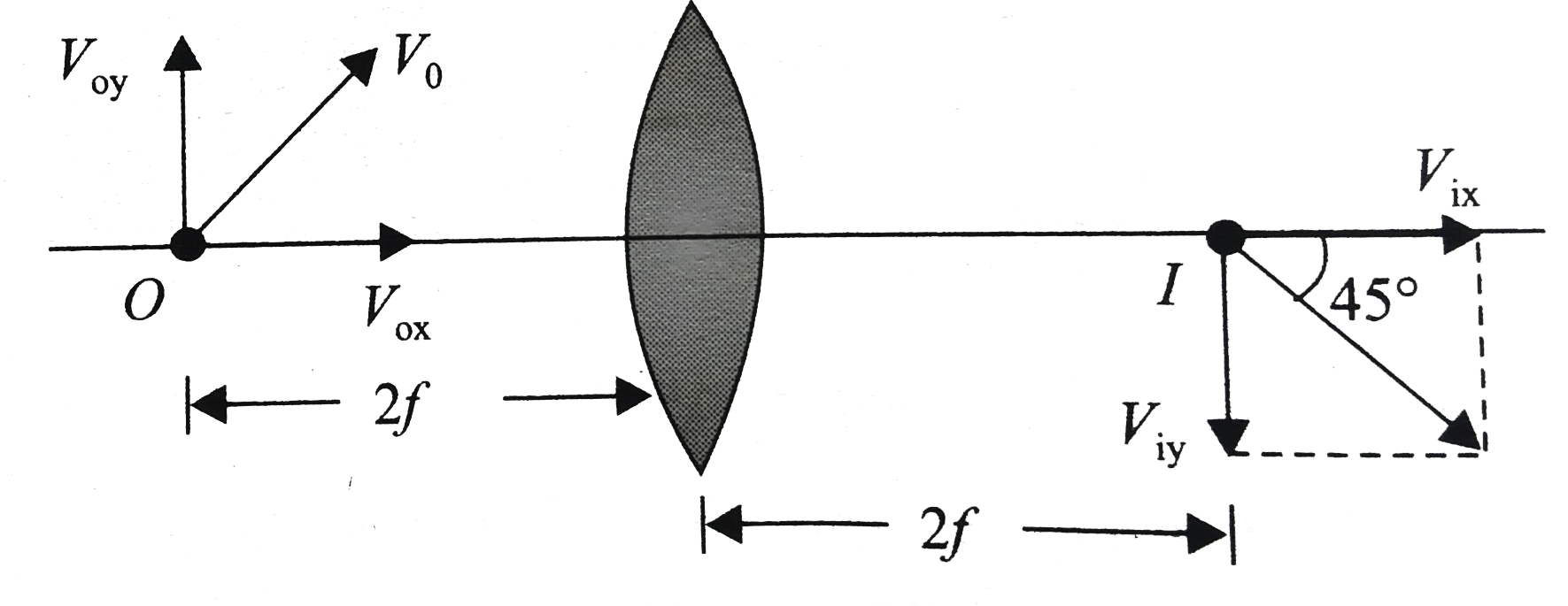
Object is at `2f`, so image is also formed at 2f.
`V_(ly)=V_(oy)` and `V_(lx)=V_(Ox)`
Promotional Banner

Topper's Solved these Questions

  • GEOMETRICAL OPTICS

    CENGAGE PHYSICS|Exercise Assertion-Reasoninig|2 Videos
  • GEOMETRICAL OPTICS

    CENGAGE PHYSICS|Exercise Linked Comprehension|51 Videos
  • GEOMETRICAL OPTICS

    CENGAGE PHYSICS|Exercise Subjective|26 Videos
  • FRICTION

    CENGAGE PHYSICS|Exercise QUESTION BANK|1 Videos
  • GRAVITATION

    CENGAGE PHYSICS|Exercise Question Bank|39 Videos

Similar Questions

Explore conceptually related problems

An object placed 10 cm in front of a convex lens of focal length 15 cm. The image produced will be

The image distance of an object placed 10 cm in front of a thin lens of focal length + 5 cm is

An object is kept in front of a lens of focal length +10 cm. Describe the nature of the image in the object distance is 25 cm.

An object is kept in front of a lens of focal length +10 cm. Describe the nature of the image in the object distance is 5 cm.

A point object (O) lies at a distance of 20 cm on the principal axis of a convex lens of focal length f = 10 cm . The object begins to move in a direction making an angle of 45° with the principal axis. At what angle with the principal axis does the image beings to move?

Point object O is placed on the principal axis of a convex lens of focal length 20cm at a distance of 40 cm to the left of it. The diameter of the lens is 10cm to the right of the lens at a distance h below the principal axis, then the maximum value of h to see the image will be

Monochromatic light rays parallel to the principal axis (the x axis) are incident on a convex lens of focal length f. If the lens oscillates such that it tilts up to a small angle theta on either side of the y axis, then find the distance between the exterme positions of the image. Take sec theta ~~ 1 + (theta^(2))/(2) for small theta .

(a) Derive lens maker's formula for a biconvex lens. (b) A point object is placed at a distance of 12 cm on the principal axis of a convex lens of focal length 10 cm. A convex mirror is placed coaxially on the other side of the lens at a distance of 10 cm. If the final image coincides with the object, sketch the ray diagram and find the focal length of the convex mirror.

An extended object of size 2mm is placed on the principal axis of a converging lens of focal length 10cm. It is found that when the object is placed perpendicular to the principal axis the image formed is 4mm in size. The size of image when it is placed along the principal axis is "____________" mm.

CENGAGE PHYSICS-GEOMETRICAL OPTICS-Single Correct
  1. It is found that all electromagnetic signals sent from A towards B rea...

    Text Solution

    |

  2. A diverging lens of focal length 10cm is placed 10cm away in front of ...

    Text Solution

    |

  3. An object starts moviing at an angle of 45^(@) with the principal axis...

    Text Solution

    |

  4. A concave mirror of radius of curvature 40cm forms an image of an obje...

    Text Solution

    |

  5. A converging beam of rays in incident on a diverging lens. Having pass...

    Text Solution

    |

  6. Consider a sphere of radius R made of glass of refractive index mu. A ...

    Text Solution

    |

  7. A ray of light AO is incident on a diverging lens as shown in figure. ...

    Text Solution

    |

  8. In the arrangement shown in figure, O is the object. An observer is to...

    Text Solution

    |

  9. The observer at O views two closely spaced spots on a vertical wall th...

    Text Solution

    |

  10. An equiconcave diverging lens of focal length F is cut into two equal ...

    Text Solution

    |

  11. In an optics experiment, with the position of the object fixed, a stud...

    Text Solution

    |

  12. The lens in an overhead projector forms an image P^(') of a point P on...

    Text Solution

    |

  13. A convex lens of focal length 20cm and another plano convex lens of fo...

    Text Solution

    |

  14. A light ray hits the pole of a thin biconvex lens as shown in fig. The...

    Text Solution

    |

  15. In a vessel, as shown in Figure., point P is just visible when no liqu...

    Text Solution

    |

  16. In the previous problem what will be refractive index of the liquid so...

    Text Solution

    |

  17. A concave mirror of radius of curvature h is placed at the bottom of a...

    Text Solution

    |

  18. A cylindrical vessel of diameter 12 cm contains 800picm^(3) of water. ...

    Text Solution

    |

  19. When the sun is either rising or setting and appears to be just in the...

    Text Solution

    |

  20. A lens form a diminshed and erect image of an object. The magnifiation...

    Text Solution

    |

