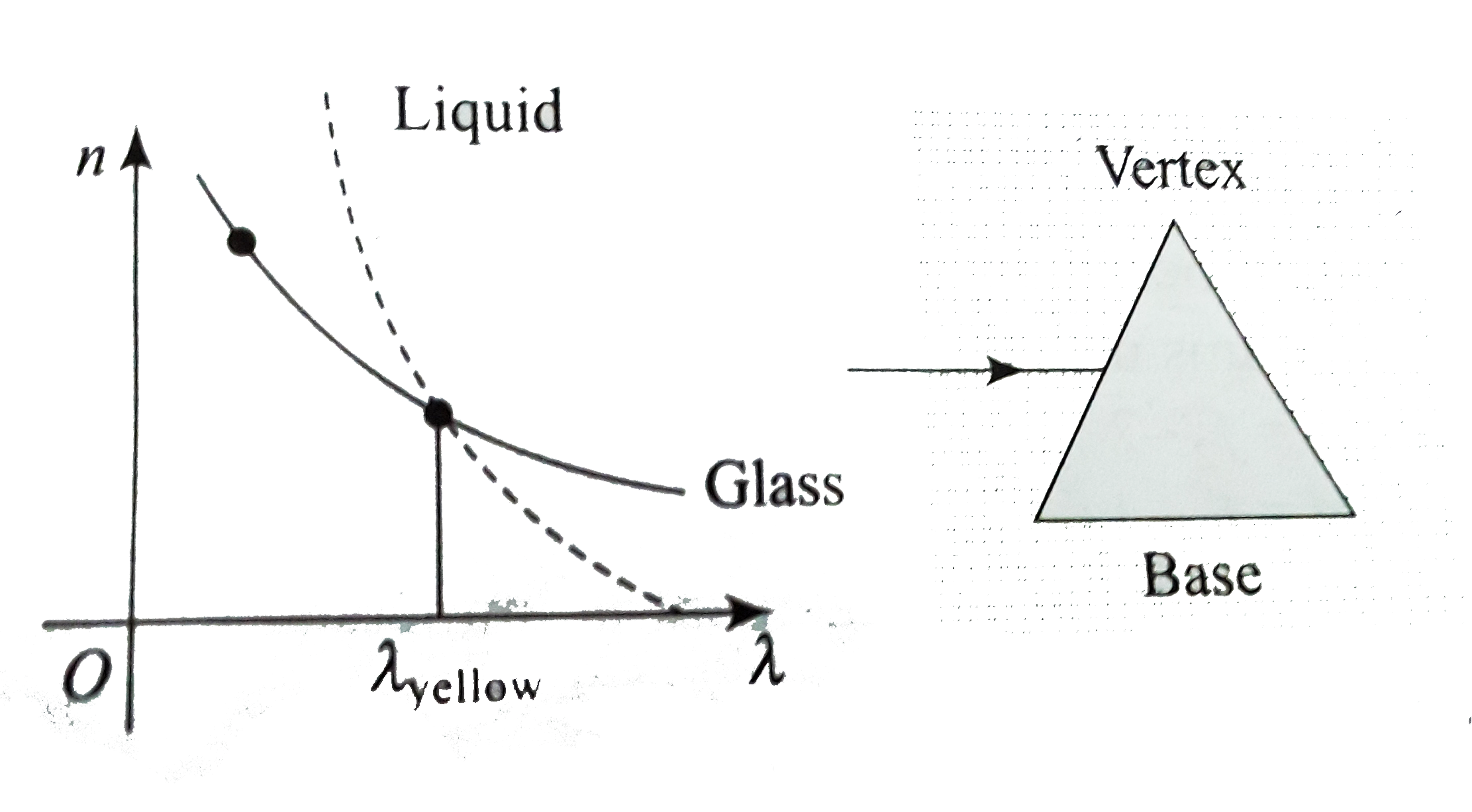
A
B
C
D
Text Solution
Verified by Experts
The correct Answer is:



Topper's Solved these Questions
GEOMETRICAL OPTICS
CENGAGE PHYSICS|Exercise Assertion-Reasoninig|2 VideosGEOMETRICAL OPTICS
CENGAGE PHYSICS|Exercise Linked Comprehension|51 VideosGEOMETRICAL OPTICS
CENGAGE PHYSICS|Exercise Subjective|26 VideosFRICTION
CENGAGE PHYSICS|Exercise QUESTION BANK|1 VideosGRAVITATION
CENGAGE PHYSICS|Exercise Question Bank|39 Videos
Similar Questions
Explore conceptually related problems
CENGAGE PHYSICS-GEOMETRICAL OPTICS-Single Correct
- An image of a bright square is obtained on a screen with the aid of a ...
Text Solution
|
- Consider the rays shown in figure, as paraxial. The image of the virtu...
Text Solution
|
- A glass prism is immersed in a hypothetical liquid. The curves showing...
Text Solution
|
- An object AB is placed parallel and close to the optical axis between ...
Text Solution
|
- Which of the following statement is // are correct about the refracti...
Text Solution
|
- A luminous point object is placed at O, whose image is formed at I as ...
Text Solution
|
- Mark the correct statement(s) w.r.t. a concave spherical mirror.
Text Solution
|
- Mark the correct statement(s) from the following:
Text Solution
|
- When a real object is placed 25cm from a lens, a real image if formed....
Text Solution
|
- Two converging lenses of focal lengths f(1)=10cm and f(2)=20cm are pla...
Text Solution
|
- A real object is moving toward a fixed spherical mirror. The image
Text Solution
|
- A real point source is 5cm away from a plane mirror whose reflectinig ...
Text Solution
|
- A plane mirror M is arranged parallel to a wall W at a distance l from...
Text Solution
|
- A thini, symmetric double convex lens of power P is cut into three par...
Text Solution
|
- A diverging lens of focal length f(1) is placed in front of and coaxia...
Text Solution
|
- A converging lens of focal length f(1) is placed in front of and coaxi...
Text Solution
|
- Which of th efollowing statements are correct?
Text Solution
|
- A fish F, in the pond is at a depth of 0.8m from the water surface and...
Text Solution
|
- In the previous question,
Text Solution
|
- Figure, shows variation of magnification m (produced by a thin convex ...
Text Solution
|