Home
Class 12
PHYSICS
A real point source is 5cm away from a p...

A real point source is 5cm away from a plane mirror whose reflectinig ability is `50%` , while the eye of an observer (pupil diameter 5mm) is 10cm away form the mirror. Asuume that both source and eye are on the same line perpendicular to the surface and refracted rays have no effect on intensity. Then,

A

the area of the mirro used in observing the image of source is `(25pi//36)mm^(2)`

B

the area of the mirror used in observing the image of source is `25pimm^(2)`

C

the ratio of the intensities of light as received by the observer in the presence to that in the absence of mirror is `(10//9)`

D

the ratio of the intensities of light as received in the presence to that in the absence of mirror is `19//18`

Text Solution

Verified by Experts

The correct Answer is:
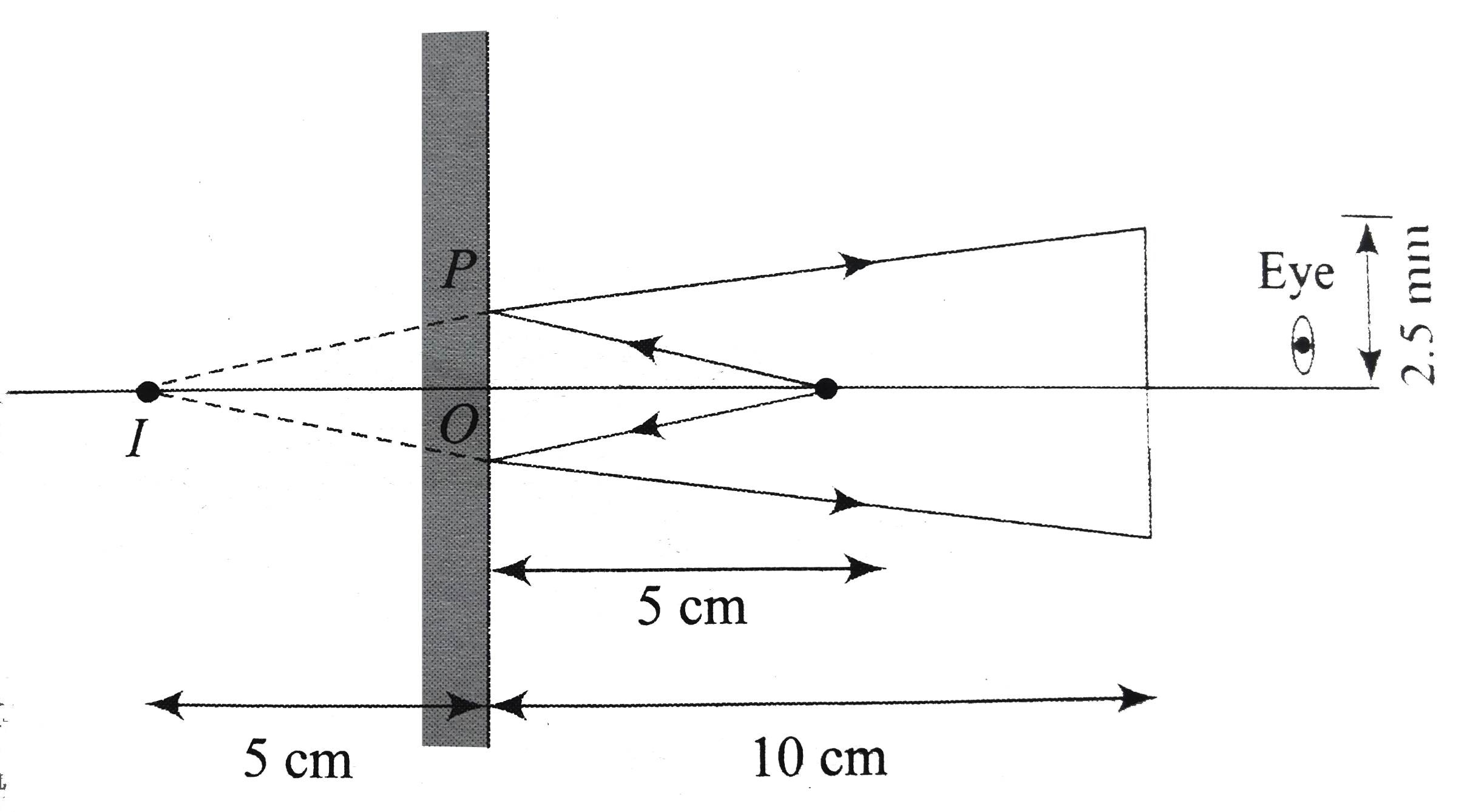
a.,d.

Here, `(OP)/(5cm)=(2.5mm)/(15cm)`
`OP=(5)/(6)mm`
Area of mirror used in reflection is
`pixxOP^(2)=(25pi)/(36)mm^(2)`
Let the power of source be P.
Intensity in absence of mirror is
`I_(1)=(P)/(4pixx(5)^(2))`
Intensity in presence of mirror is
`I_(2)=(P)/(4pixx(5)^(2))+(P//2)/(4pixx(5)^2)`
`(I_(2))/(I_(1))=(19)/(18)`
Promotional Banner

Topper's Solved these Questions

  • GEOMETRICAL OPTICS

    CENGAGE PHYSICS|Exercise Assertion-Reasoninig|2 Videos
  • GEOMETRICAL OPTICS

    CENGAGE PHYSICS|Exercise Linked Comprehension|51 Videos
  • GEOMETRICAL OPTICS

    CENGAGE PHYSICS|Exercise Subjective|26 Videos
  • FRICTION

    CENGAGE PHYSICS|Exercise QUESTION BANK|1 Videos
  • GRAVITATION

    CENGAGE PHYSICS|Exercise Question Bank|39 Videos

Similar Questions

Explore conceptually related problems

If the object is 5 cm away from the plane mirror , the image formed by it and the object will be ------- cm apart .

A concave mirror forms an image of 20 cm high object on a screen placed 5.0 m away from the mirror. The height of the image is 50 cm. Find the focal length of the mirror and the distance between the mirror and the object.

a sound source emits frequency of 180 h_(Z) when moving towards a rigid wall with speed 5 m//s and an observer is moving away from with speed 5 m//s . Both source and observer moves on a straight line which is perpendicular to the wall. The number of beatd per second heard by the observer will be [speed of sound = 335 m//s ]

A monochromatic point source (S_(1)) is at a distance d from a screen. Another identical source (S_(2)) is at a large distance from the screen. The two sources are on a line which is perpendicular to the screen. Sources are coherent. What is the shape of interference fringes on the screen? (b) Three identical coherent sources are placed on a straight line with two neighbouring ones separated by a distance "d = 0.06 mm" . The sources produce monochromatic light of wavelength lambda" = 550.4 nm" . A line AB is located at a distance D = 2.50 m from the sources and is perpendicular to line joining the three sources. Intensity of light at P with any one of the sources switched on is I_(o) . Find the intensity when all three sources are switched on. Distance of point P from O is "y = 1.72 cm (see figure)"

Object O is placed in front of a plane mirror M. A glass slab S having thickness t = 3 cm and refractive index mu = 1.8 is placed between the object and the mirror. The refracting faces of the slab are parallel to the mirror surface. The object is made to move with a velocity of u = 2 m//s perpendicular to the mirror surface. Find the speed of the image formed after (a) refraction from the slab followed by reflection from the mirror. (b) refraction from the slab followed by reflection from the mirror followed by the refraction from the slab.

Concave mirror forms the real image of a point source lying on the optical axis at a distance of 50 cm from the mirror. The focal length of the mirror is 25 cm. The mirror is cut into and its halves are drawn a distance of 1 cm apart in a direction perpendicular to the optical axis. How will the image formed by the halves of the mirror be arranged?

A concave mirror forms real image of a point source lying on the optical axis at a distance of 50cm from the mirror. The focal length of the mirror is 25cm. The mirror is cut in two, and its halves are drawn at a distance of 1 cm apart in a direction perpendicular to the optical axis. Q. The distance between the two images formed by the two halves of the mirror is

CENGAGE PHYSICS-GEOMETRICAL OPTICS-Single Correct
  1. Two converging lenses of focal lengths f(1)=10cm and f(2)=20cm are pla...

    Text Solution

    |

  2. A real object is moving toward a fixed spherical mirror. The image

    Text Solution

    |

  3. A real point source is 5cm away from a plane mirror whose reflectinig ...

    Text Solution

    |

  4. A plane mirror M is arranged parallel to a wall W at a distance l from...

    Text Solution

    |

  5. A thini, symmetric double convex lens of power P is cut into three par...

    Text Solution

    |

  6. A diverging lens of focal length f(1) is placed in front of and coaxia...

    Text Solution

    |

  7. A converging lens of focal length f(1) is placed in front of and coaxi...

    Text Solution

    |

  8. Which of th efollowing statements are correct?

    Text Solution

    |

  9. A fish F, in the pond is at a depth of 0.8m from the water surface and...

    Text Solution

    |

  10. In the previous question,

    Text Solution

    |

  11. Figure, shows variation of magnification m (produced by a thin convex ...

    Text Solution

    |

  12. An object is placed in front of a converging lens at a distance equal ...

    Text Solution

    |

  13. Converging rays strike a spherical convex mirror such that they can fo...

    Text Solution

    |

  14. In the above question, if the rays were to converge between F and C of...

    Text Solution

    |

  15. In the above question, if the rays were to converge beyond C, then fin...

    Text Solution

    |

  16. A concave mirror forms an image of the sun at a distance of 12 cm from...

    Text Solution

    |

  17. A real object is placed infront of a convex mirror (focal length f). I...

    Text Solution

    |

  18. An object is moving towards a convex mirror with a constant velocity. ...

    Text Solution

    |

  19. A person is looking at the flat surface of a transparent hemispher of ...

    Text Solution

    |

  20. Refractive index of an equilateral prism is sqrt(2).

    Text Solution

    |

