Home
Class 12
PHYSICS
A fish F, in the pond is at a depth of 0...

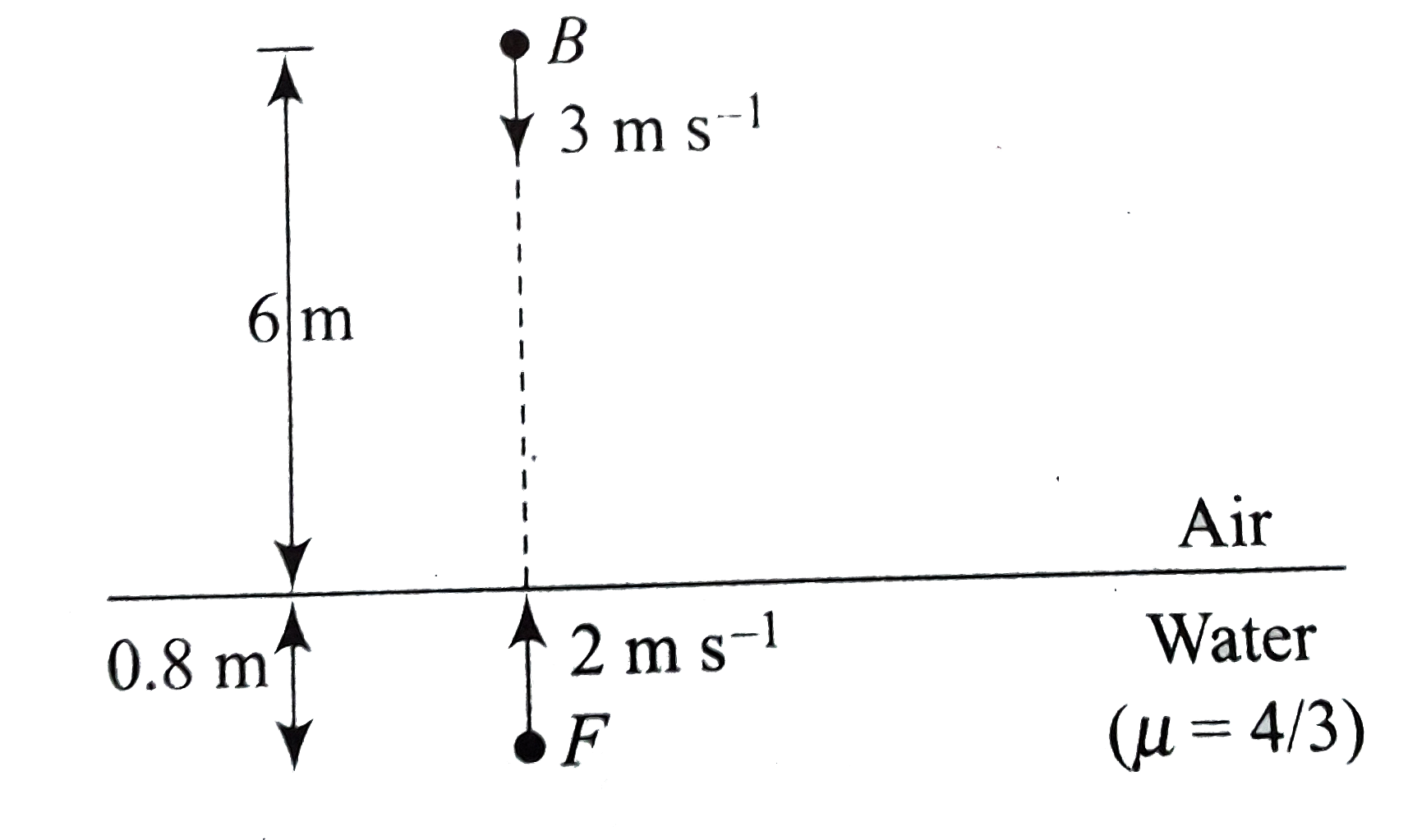
A fish F, in the pond is at a depth of 0.8m from the water surface and is moving vertically upward with velocity `2ms^(-1)`. At the same instant, a bird B is at a height of 6m from the water surface and is moving downward with velocity `3ms^(-1)`. At this instant. both are on the same vertical line as shown in figure . Which of the following statements are correct?

A

Height of B, observed by F(from itself), is equal to 5.30m

B

Depth of F, Observed by B (from itselft), is equal to 6.60m

C

Height of B, observed by F (From itself), is equal to 8.80m

D

None of the above

Text Solution

Verified by Experts

The correct Answer is:

b.,c.

If an object is at a distance x from a plane refractinig surface and is viewed normally, then it apears at a distance `x//mu` from the surface, where `mu` is refractive index of that medium ( in which it is situated) with respect to the medium ini which observer is situated.
Suppose height of bird from water surface is x and depth of fish from the surface is y, then depth of fish, as observed by the bird, will be equal to
`r_(1)=x+(y)/(mu)` (i)
where `mu` is refractive index of water with respect to air.
`r_(1)=6.60m`
Hence, option(b) is correct.
Height of bird, as observed by the fish, will be equal to
`r_(2)=(x)/(mu)+y` (ii)
where `mu^(')` is refractive index of air with respect to water.
Now, `mu^(')=(1)/(mu)=(3)/(4)`
Hence, `r_(2)=8.80m`
Hence, option (a) is wrong while (c) is correct.
Promotional Banner

Topper's Solved these Questions

  • GEOMETRICAL OPTICS

    CENGAGE PHYSICS|Exercise Assertion-Reasoninig|2 Videos
  • GEOMETRICAL OPTICS

    CENGAGE PHYSICS|Exercise Linked Comprehension|51 Videos
  • GEOMETRICAL OPTICS

    CENGAGE PHYSICS|Exercise Subjective|26 Videos
  • FRICTION

    CENGAGE PHYSICS|Exercise QUESTION BANK|1 Videos
  • GRAVITATION

    CENGAGE PHYSICS|Exercise Question Bank|39 Videos

Similar Questions

Explore conceptually related problems

A projectile moving vertically upwards with a velocity of 200 ms^(-1) breaks into equal parts at a height of 490 m.One part starts moving vertically upwards with a velocity of 400 ms^(-1) .How much time it will take,after the break up with the other part to hit the ground?

A particle is projected vertically upward with initial velocity 25" ms"^(–1) . During third second of its motion, which of the following statement is correct ?

A rod AB is shown in figure. End A of the rod is fixed on the ground. Block is moving with velocity 2 ms^-1 towards right. The velocity of end B of rod at the instant shown in figure is

A stone is dropped from a height of 100m .At the same instant another stone is projected vertically upwards with velocity of 50ms^(-1) .If g=10ms^(-2) ,the height from the ground at which the 2 stones meet is

Consider a horizontal surface moving vertically upward with velocity 2ms^(-1) . A small ball of mass 2 kg is moving with velocity (2hati-2hatj)ms^(-2) If the coefficient of restitution and coefficient of friction are (1)/(2) and (1)/(3 respectively, find the horizontal velocity ("in "ms^(-1)) of the ball after the collision.

A body of mass m is from surface of the earth projected vertically upwards with a velocity such that it rises to a height of 20 m. If the same body is projected with same velocity from a planet density is (1)/(4) th of density of earth and radius is (1)/(2) of that of Earth, then find the height to which the body will rise on the planet.

CENGAGE PHYSICS-GEOMETRICAL OPTICS-Single Correct
  1. A converging lens of focal length f(1) is placed in front of and coaxi...

    Text Solution

    |

  2. Which of th efollowing statements are correct?

    Text Solution

    |

  3. A fish F, in the pond is at a depth of 0.8m from the water surface and...

    Text Solution

    |

  4. In the previous question,

    Text Solution

    |

  5. Figure, shows variation of magnification m (produced by a thin convex ...

    Text Solution

    |

  6. An object is placed in front of a converging lens at a distance equal ...

    Text Solution

    |

  7. Converging rays strike a spherical convex mirror such that they can fo...

    Text Solution

    |

  8. In the above question, if the rays were to converge between F and C of...

    Text Solution

    |

  9. In the above question, if the rays were to converge beyond C, then fin...

    Text Solution

    |

  10. A concave mirror forms an image of the sun at a distance of 12 cm from...

    Text Solution

    |

  11. A real object is placed infront of a convex mirror (focal length f). I...

    Text Solution

    |

  12. An object is moving towards a convex mirror with a constant velocity. ...

    Text Solution

    |

  13. A person is looking at the flat surface of a transparent hemispher of ...

    Text Solution

    |

  14. Refractive index of an equilateral prism is sqrt(2).

    Text Solution

    |

  15. A convex lens made of glass (mu(g)=3//2) has focal length f in air. Th...

    Text Solution

    |

  16. In the situation as shown in Figure, (cos53^(@)=(3)/(5))

    Text Solution

    |

  17. A planoconvex lens of focal length 20cm has its plane side silvered.

    Text Solution

    |

  18. For a concave mirror of focal length f, image is 2 times larger. Then ...

    Text Solution

    |

  19. A linear object of size 1.5cm placed at 10cm from a lens of focal leng...

    Text Solution

    |

  20. Statement I: Although the surfaces of gogggle lengses are curved, it d...

    Text Solution

    |
