Home
Class 12
PHYSICS
Two thin convex lenses of focal lengths ...

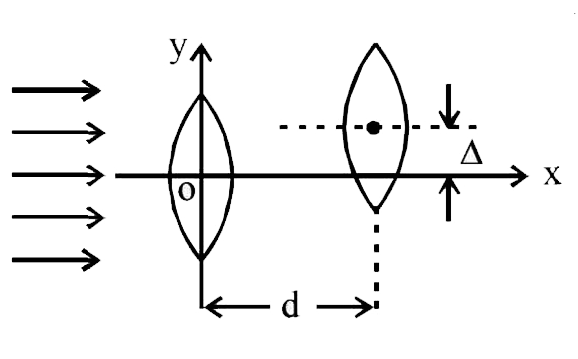
Two thin convex lenses of focal lengths `f_(1)` and `f_(2)` are separated by a horizontal distance d (where`dltf_(1)`,`dltf_(2)`) and their centres are displaced by a vertical separation `triangle` as shown in the fig.
Taking the origin of coordinates O, at the centre of the first lens the x and y coordinates of the focal point of this lens system, for a parallel beam of rays coming form the left, are given by: `

A

`(d(f_(1)-d)+f_(1)f_(2))/((f_(1)+f_(2)-d))`

B

`(f_(1)f_(2))/((f_(1)+f_(2)-d))`

C

`(d(f_(1)-d))/((f_(1)+f_(2)-d))`

D

`(2d(f_(1)+d)-f_(1)f_(2))/((f_(1)+f_(2)-d))`

Text Solution

Verified by Experts

The correct Answer is:
a

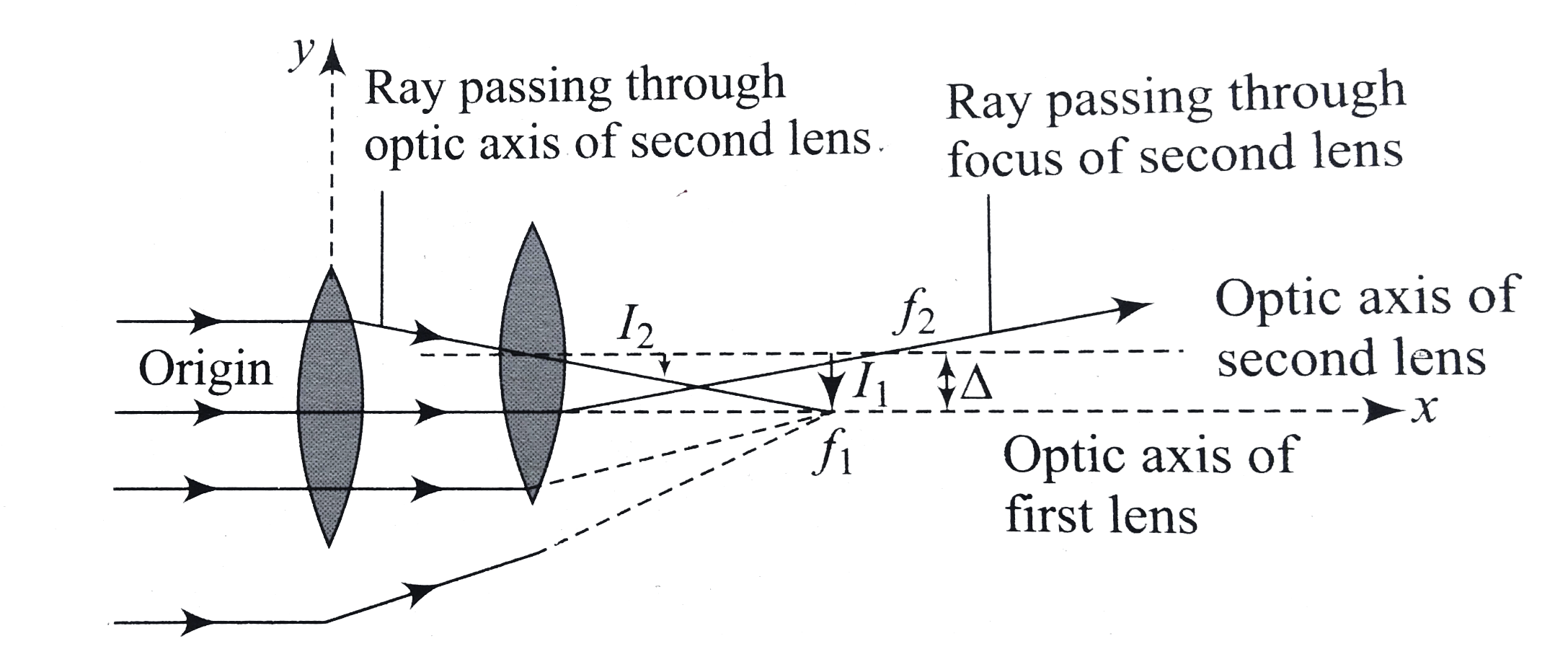
The parallel rays will be focussed at the focal point of the first lens. The first image lies at I, at a distance `f_(1)` from the origin. This image`I_(1)` will act as an object for refraction through the second lens. The object distance for the second, `u=(f_(1)-d)`.
From lens equation, `(1)/(upsilon)-(1)/(+(f_(1)-d))=(1)/(f_(2))`
`upsilon=(f_(2)(f_(1)-d))/((f_(1)+f_(2)-d))`
Hence, the x-coordinate of final image `I_(2)` is
`x=d+u=(d+f_(2)(f_(1)-d))/((f_(1)+f_(2)-d))=(d(f_(1)-d)+f_(1)f_(2))/((f_(1)+f_(2)-d))`
Imagine an arrow tip is at `f_(1):` its image from lens `f_(1)` is the final image.
Magnification, `m+(upsilon)/(u)=(I_(2))/(O)=(I_(2))/(Delta)`
`I_(2)=((upsilon)/(u))Delta=(f_(2))/((f_(1)+f_(2)-d))Delta`
Thus, y-coordinate of tip of `I_(2)` is
`Delta-I_(2)=Delta[1-(f_(1))/((f_(1)+f_(2)-d))]=((f_(1)-d)Delta)/((f_(1)+f_(2)-d))`
Promotional Banner

Topper's Solved these Questions

  • GEOMETRICAL OPTICS

    CENGAGE PHYSICS|Exercise Integer|15 Videos
  • GEOMETRICAL OPTICS

    CENGAGE PHYSICS|Exercise Archives|7 Videos
  • GEOMETRICAL OPTICS

    CENGAGE PHYSICS|Exercise Assertion-Reasoninig|2 Videos
  • FRICTION

    CENGAGE PHYSICS|Exercise QUESTION BANK|1 Videos
  • GRAVITATION

    CENGAGE PHYSICS|Exercise Question Bank|39 Videos

Similar Questions

Explore conceptually related problems

In the figure- it is shown,the focal length f of the two thin convex lenses is the same. They are separated by a horizontal distance 3f and their optical axes are displaced by a vertical separation 'd'(d lt lt f) as shown. Taking the origin of coordinates O at the centre of the first lens , find the x and y coordinates of the point where aparallel beam of rays coming from the left finally gets focussed ? ((5f, 2d)]

the focal length of the two thin convex lenses is the same =f They are separated by a horizontal distance 3f and their optical axes are displaced by a vertical separation 'd'(dltltf) .Taking the origin of coordinates O at the centre of the first,lens ,find the xand y coordiates of the point where a parallel beamof rays coming from the left finally get focused?

Two thin convex lenses of focal length f_(1) and f_(2) are separated by a horizontal distance 'd' where (dltf_(1) "and" dltf_(2)) and their optical centers are displaced vertically by x_(0) .Taking the origin at the centre of lens L_(1) consider the following cases when a parallel beam of paraxial rays are coming form left. x coordinate of the final image is

Two thin convex lenses of focal length f_(1) and f_(2) are separated by a horizontal distance 'd' where (dltf_(1) "and" dltf_(2)) and their optical centers are displaced vertically by x_(0) .Taking the origin at the centre of lens L_(1) consider the following cases when a parallel beam of paraxial rays are coming form left. for the lens1 L_(2) ,object distance is

TTwo thin convex lenses of focal length f_(1) and f_(2) are separated by a horizontal distance 'd' where (dltf_(1) "and" dltf_(2)) and their optical centers are displaced vertically by x_(0) .Taking the origin at the centre of lens L_(1) consider the following cases when a parallel beam of paraxial rays are coming form left. Y coordinate of the final image is given by:

Two thin convex lenses of focal lengths f_(1) and f_(2) are in contact and coaxial. The power of the combination is

Two convex lenses of focal lengths f_(1) and f_2 are separated co-axially by a distance d. The power of the combination will be one if

Two thin lenses of focal lengths f_(1) and f_(2) are in contact. The focal length of this combination is

Two convex lenses of focal length f_1 and f_2 are mounted coaxially separated by a distance. If the power of the combination is zero, the distance between the lenses is

CENGAGE PHYSICS-GEOMETRICAL OPTICS-Linked Comprehension
  1. The convex surface of a thin concave-convex lens of glass of refractiv...

    Text Solution

    |

  2. Two thin convex lenses of focal lengths f(1) and f(2) are separated by...

    Text Solution

    |

  3. Two thin convex lenses of focal lengths f(1) and f(2) are separated by...

    Text Solution

    |

  4. A parallel beam of light falls successively on a thin convex lens of ...

    Text Solution

    |

  5. A parallel beam of light falls successively on a thin convex lens of ...

    Text Solution

    |

  6. Two identical plano-convex lenses L(1)(mu(1)-1.4) and L(2)(mu(2)-1.5) ...

    Text Solution

    |

  7. Two identical plano-convex lenses L(1)(mu(1)-1.4) and L(2)(mu(2)-1.5) ...

    Text Solution

    |

  8. A beam of light converges towards a point O, behind a convex mirror of...

    Text Solution

    |

  9. A beam of light converges towards a point O, behind a convex mirror of...

    Text Solution

    |

  10. A ray of light enters a spherical drop of water of refractive index mu...

    Text Solution

    |

  11. A ray of light enters a spherical drop of water of refractive index mu...

    Text Solution

    |

  12. A ray of light enters a spherical drop of water of refractive index mu...

    Text Solution

    |

  13. The ciliary muscles of eye control the curvature of the lens in the ey...

    Text Solution

    |

  14. The ciliary muscles of eye control the curvature of the lens in the ey...

    Text Solution

    |

  15. The ciliary muscles of eye control the curvature of the lens in the ey...

    Text Solution

    |

  16. The ciliary muscles of eye control the curvature of the lens in the ey...

    Text Solution

    |

  17. The ciliary muscles of eye control the curvature of the lens in the ey...

    Text Solution

    |

  18. A parallel beam of light falls on a solid tranparent sphere. Q. W...

    Text Solution

    |

  19. A parallel beam of light falls on a solid tranparent sphere. Q. I...

    Text Solution

    |

  20. A parallel beam of light falls on a solid tranparent sphere. Q. F...

    Text Solution

    |

