Home
Class 12
PHYSICS
Two thin convex lenses of focal lengths ...

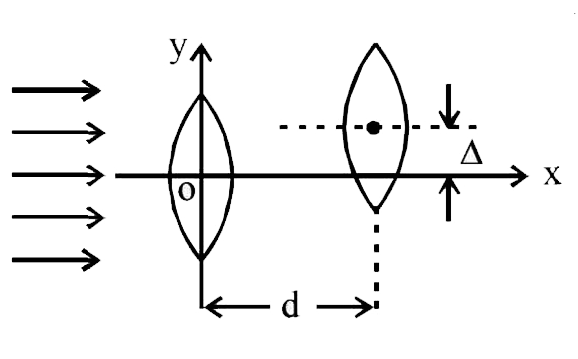
Two thin convex lenses of focal lengths `f_(1)` and `f_(2)` are separated by a horizontal distance d (where`dltf_(1)`,`dltf_(2)`) and their centres are displaced by a vertical separation `triangle` as shown in the fig.
Taking the origin of coordinates O, at the centre of the first lens the x and y coordinates of the focal point of this lens system, for a parallel beam of rays coming form the left, are given by: `

A

`x=(f_(1)f_(2))/(f_(1)+f_(2)),y=Delta`

B

`x=(f_(1)(f_(2)+d))/(f_(1)+f_(2)-d),y=(Delta)/(f_(1)+f_(2))`

C

`x=(f_(1)f_(2)+d(f_(1)-d))/(f_(1)+f_(2)-d),y=(Delta(f_(1)-d))/(f_(1)+f_(2)-d)`

D

`x=(f_(1)f_(2)+d(f_(1)-d))/(f_(1)+f_(2)-d),y=(Delta(f_(1)-d))/(f_(1)+f_(2)-d)`

Text Solution

Verified by Experts

The correct Answer is:
c.

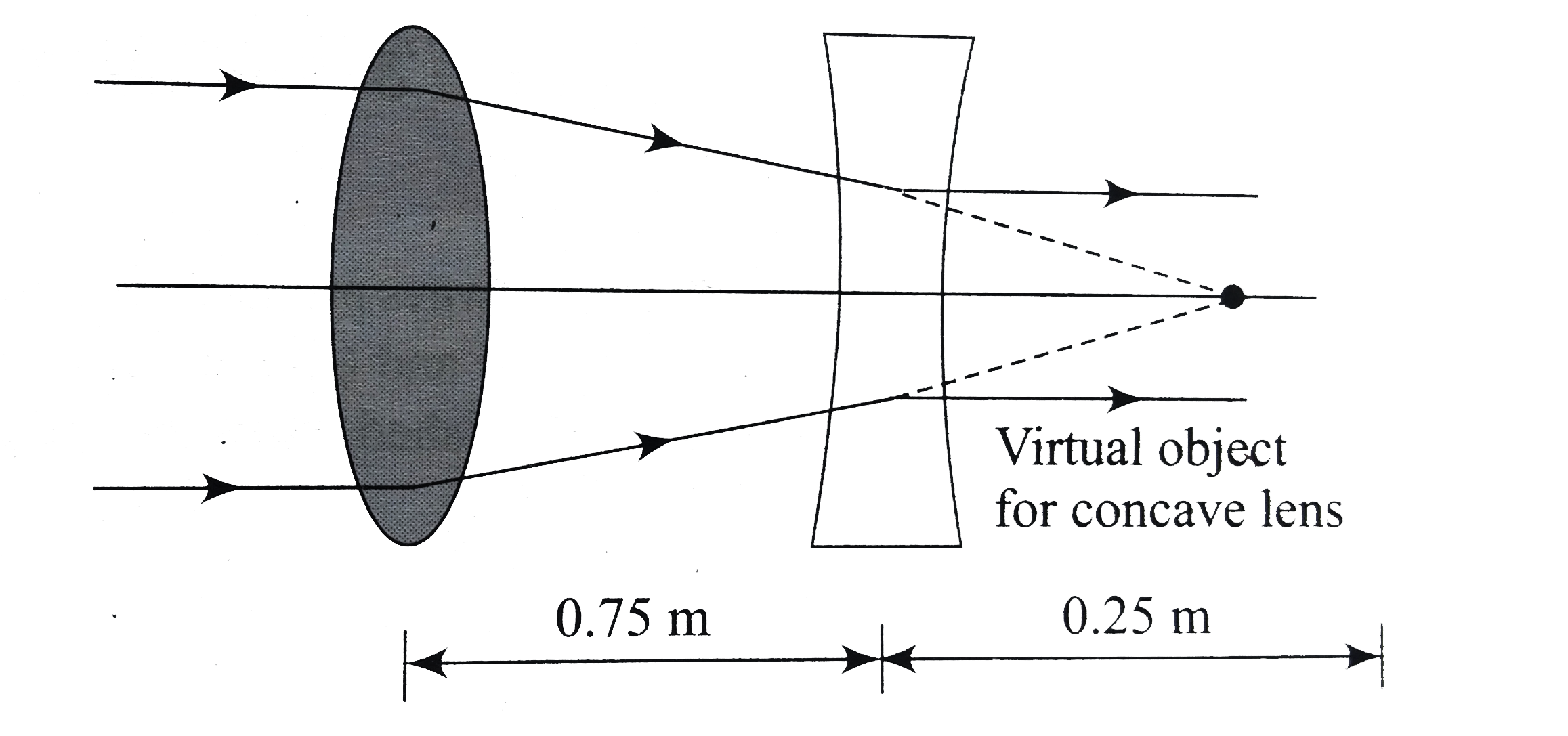
The image `I^(')` of parallel rays formed by lens 1 will act as a virtual object.
Applying lens formula for lens 2,
`(1)/(v)-(1)/(u)=(1)/(f)`
`rArr(1)/(v)-(1)/(f_(1)-d)=(1)/(f_(2))`
`rArr v=(f_(2)(f_(1)-d))/(f_(2)+f_(1)-d)`
The horizontal distance of the image O is
`x=d+(f_(2)(f_(1)-d))/(f_(2)+f_(1)-d)`
`=(df_(2)+df_(1)-d^(2)+f_(2)f_(1)-df_(2))/(f_(2)+f_(1)-d)`
`=(f_(1)f_(2)+d(f_(1)-d))/(f_(2)+f_(1)-d)`
To find teh y-coordinate, we use magnification formula for lens 2,
`m=(v)/(u)=(f_(2)(f_(1)-d)/(f_(1)+f_(2)-d))/(f_(1)-d)=(f_(2))/(f_(1)+f_(2)-d)`. Also
`m=(h^(2))/(Delta)rArr h_(2)=(Deltaxx f_(2))/(f_(1)+f_(2)-d)`
Therefore, the y-coordinate,
`y=Delta-h_(2)`
`=Delta-(Deltaf_(2))/(f_(1)+f_(2)-d)`
`=(Deltaf_(1)+Deltaf_(2)-Deltad-Deltaf_(2))/(f_(1)+f_(2)-d)=(Delta(f_(1)-d))/(f_(1)-f_(2)-d)`
Promotional Banner

Topper's Solved these Questions

  • GEOMETRICAL OPTICS

    CENGAGE PHYSICS|Exercise Multiple Correct Answers Type|8 Videos
  • GEOMETRICAL OPTICS

    CENGAGE PHYSICS|Exercise Assertion-Reasoninig Type|2 Videos
  • GEOMETRICAL OPTICS

    CENGAGE PHYSICS|Exercise True/False|5 Videos
  • FRICTION

    CENGAGE PHYSICS|Exercise QUESTION BANK|1 Videos
  • GRAVITATION

    CENGAGE PHYSICS|Exercise Question Bank|39 Videos

Similar Questions

Explore conceptually related problems

In the figure- it is shown,the focal length f of the two thin convex lenses is the same. They are separated by a horizontal distance 3f and their optical axes are displaced by a vertical separation 'd'(d lt lt f) as shown. Taking the origin of coordinates O at the centre of the first lens , find the x and y coordinates of the point where aparallel beam of rays coming from the left finally gets focussed ? ((5f, 2d)]

the focal length of the two thin convex lenses is the same =f They are separated by a horizontal distance 3f and their optical axes are displaced by a vertical separation 'd'(dltltf) .Taking the origin of coordinates O at the centre of the first,lens ,find the xand y coordiates of the point where a parallel beamof rays coming from the left finally get focused?

Two thin convex lenses of focal length f_(1) and f_(2) are separated by a horizontal distance 'd' where (dltf_(1) "and" dltf_(2)) and their optical centers are displaced vertically by x_(0) .Taking the origin at the centre of lens L_(1) consider the following cases when a parallel beam of paraxial rays are coming form left. x coordinate of the final image is

Two thin convex lenses of focal length f_(1) and f_(2) are separated by a horizontal distance 'd' where (dltf_(1) "and" dltf_(2)) and their optical centers are displaced vertically by x_(0) .Taking the origin at the centre of lens L_(1) consider the following cases when a parallel beam of paraxial rays are coming form left. for the lens1 L_(2) ,object distance is

TTwo thin convex lenses of focal length f_(1) and f_(2) are separated by a horizontal distance 'd' where (dltf_(1) "and" dltf_(2)) and their optical centers are displaced vertically by x_(0) .Taking the origin at the centre of lens L_(1) consider the following cases when a parallel beam of paraxial rays are coming form left. Y coordinate of the final image is given by:

Two thin convex lenses of focal lengths f_(1) and f_(2) are in contact and coaxial. The power of the combination is

Two convex lenses of focal lengths f_(1) and f_2 are separated co-axially by a distance d. The power of the combination will be one if

Two thin lenses of focal lengths f_(1) and f_(2) are in contact. The focal length of this combination is

Two convex lenses of focal length f_1 and f_2 are mounted coaxially separated by a distance. If the power of the combination is zero, the distance between the lenses is

CENGAGE PHYSICS-GEOMETRICAL OPTICS-Single Correct Answer Type
  1. A beam of light consisting of red, green, and blue colors is incident ...

    Text Solution

    |

  2. A thin prism P(1) with angle 4degree and made from glass of refractive...

    Text Solution

    |

  3. Two thin convex lenses of focal lengths f(1) and f(2) are separated by...

    Text Solution

    |

  4. Spherical aberration in a thin lens can be reduced by

    Text Solution

    |

  5. A beam of light of wavelength 600nm from a distance source falls on a ...

    Text Solution

    |

  6. An isosceles prism of angle 120degree has a refractive index 1.44. Two...

    Text Solution

    |

  7. A diminished image of an object is to be obtained on a screen 1.0 m fr...

    Text Solution

    |

  8. The focal lengths of the objective and the eyepiece of a compound mic...

    Text Solution

    |

  9. An eye specialist prescribes spectacles having combination of convex l...

    Text Solution

    |

  10. Areal image of a distant object is formed by a plano-convex lens on it...

    Text Solution

    |

  11. A concave mirror is placed on a horizontal table, with its axis direc...

    Text Solution

    |

  12. A spherical surface of radius of curvature R separates air (refractive...

    Text Solution

    |

  13. A concave lens of glass, refractive index 1.5, has both surfaces of sa...

    Text Solution

    |

  14. A hollow double concave lens is made of very thin transparent material...

    Text Solution

    |

  15. A point source of light B is placed at a distance L in front of the ce...

    Text Solution

    |

  16. A diverging beam of light from a point source S having divergence ang...

    Text Solution

    |

  17. A rectangular glass slab ABCD of refractive index n(1) is immersed in ...

    Text Solution

    |

  18. In a compound microscope, the intermediate image is

    Text Solution

    |

  19. A ray of light passes through four transparent media with refractive i...

    Text Solution

    |

  20. A given ray of light suffers minimum deviation in an equilateral prism...

    Text Solution

    |

