Home
Class 12
PHYSICS
A light beam is traveling from Region I ...

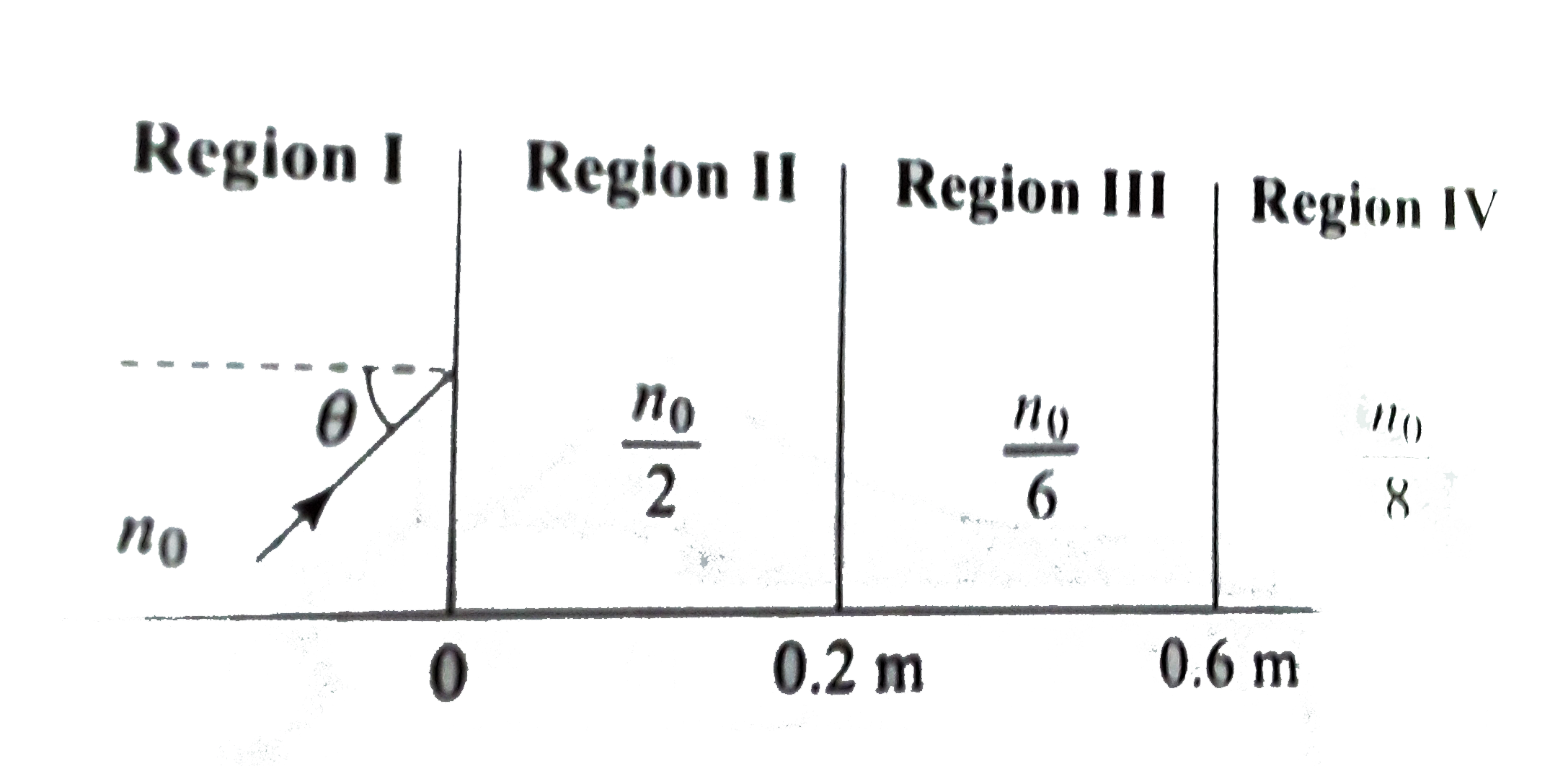
A light beam is traveling from Region I to region IV (refer figure). The refractive indices in Region I, II, III, and IV are `n_(0), n_(0)//2,n_(0)//6 and n_(0)//8` , respectively. The angle of incidence `theta` for which the beam just misses entering Region IV is

A

`sin^(-1)(3//4)`

B

`sin^(-1)(1//8)`

C

`sin^(-1)(1//4)`

D

`sin^(-1)(1//3)`

Text Solution

Verified by Experts

The correct Answer is:

b.

Critical angle from region III to region IV
`sintheta_(c)=(n_(0)//8)/(n_(0)//6)=(3)/(4)`
Now, applying Snell's law in region I and region III
`n_(0)sintheta =(n_(0))/(6)sintheta_(c)`
`sintheta =(1)/(6)sintheta_(c)=(1)/(6)((3)/(4))=(1)/(8)rArr theta=sin^(-1)((1)/(8))`
`:.` Correct option is (b).`
Promotional Banner

Topper's Solved these Questions

  • GEOMETRICAL OPTICS

    CENGAGE PHYSICS|Exercise Multiple Correct Answers Type|8 Videos
  • GEOMETRICAL OPTICS

    CENGAGE PHYSICS|Exercise Assertion-Reasoninig Type|2 Videos
  • GEOMETRICAL OPTICS

    CENGAGE PHYSICS|Exercise True/False|5 Videos
  • FRICTION

    CENGAGE PHYSICS|Exercise QUESTION BANK|1 Videos
  • GRAVITATION

    CENGAGE PHYSICS|Exercise Question Bank|39 Videos

Similar Questions

Explore conceptually related problems

A light beam is travelling from Region I to IV (figure). The refractive index in regionals I,II,III and IV are n_0=(n_0)/(2) (n_0)/(6) and (n_0)/(8) respectively. The angle of incidence theta for which the beam just misses entering region IV is-

A beam of light passes from medium 1 to medium 2 to medium 3 as shown figure. What may be concluded about the three indices of refraction, n_(1),n_(2),and n_(3) ?

For a prism angle theta = 60^0 the refractive indices of the left half and right half are resp, n1 and n2 (n2gen1) as shown in figure. The angle of incidence i is chosen such that the incident light rays will have minimum deviation if n1 = n2 = n = 1.5. For case of unequal refractive indices n1 = n and n2 = n+ delat(n) the angle of emergence e = i + delta (e) . Which of the following statement is/are correct?

An intially parallel cyclindrical beam travels in a medium of refractive index mu (I) = mu_(0) + mu_(2) I , where mu_(0) and mu_(2) are positive constants and I is intensity of light beam. The intensity of the beam is decreasing with increasing radius. Answer the following questions : As the beam enters the medium, it will

A light beam travelling along the x axis with planar wavefront is incident on a medium of thickness t. In the region, where light is falling the refractive index can be taken to be varying such that (dn)/(dy)gt0 . The light beam on the other side of the medium will emerge

An intially parallel cyclindrical beam travels in a medium of refractive index mu (I) = mu_(0) + mu_(2) I , where mu_(0) and mu_(2) are positive constants and I is intensity of light beam. The intensity of the beam is decreasing with increasing radius. Answer the following questions : The initial shape of the wavefront of the beam is

An intially parallel cyclindrical beam travels in a medium of refractive index mu (I) = mu_(0) + mu_(2) I , where mu_(0) and mu_(2) are positive constants and I is intensity of light beam. The intensity of the beam is decreasing with increasing radius. Answer the following questions : The speed of light in the medium is

A parallel beam of monochromatic light of frequency v is incident on a surface. Intensity of the beam is I and area of the surface is A. Find the force exerted by the light beam on the surface for following cases– (i) the surface is perfectly absorbing and the light beam is incident normally on it. (ii) the surface is perfectly reflecting and the light beam is incident normally. (iii) the surface is perfectly absorbing and the light beam is incident at an angle of incidence theta . (iv) the surface is perfectly reflecting and the light beam is incident at an angle of incidence theta .

A ray of light travels from a medium of refractive index n_(1) to a medium of refractive index n_(2) . If angle of incidence is i and angle of refraction is r, than (sin i)/(sin r) is equal to

A fine pencil of beta -particles, moving with a speed v, enters a region (region I), where a uniform electric field and a uniform magnetic field are both present. These beta -particles then move into region II where only the magnetic field, (out of the two fields present in region I) exists. The path of the beta -particles, in the two regions is as shown in the figure. (i) state the direction of magnetic field. (ii) state the relation between E and B in region I. (iii) Drive the expression for the radius of the circular path of the beta -particle in region II. (iv) If the magnitude of magnetic field, in region II is changed to n times its earlier value, (without changing the magnetic field in region I) find the factor by which the radius of this circular path would change.

CENGAGE PHYSICS-GEOMETRICAL OPTICS-Single Correct Answer Type
  1. The size of the image of an object, which is at infinity, as formed by...

    Text Solution

    |

  2. A ray of light is incident at the glass-water interface at an angle i....

    Text Solution

    |

  3. A beam of white light is incident on the glass-air interface from glas...

    Text Solution

    |

  4. An equilateral prism is placed on a horizontal surface. A ray PQ is in...

    Text Solution

    |

  5. A point object is placed at the center of a glass sphere of radius 6cm...

    Text Solution

    |

  6. A convex lens is in contact with a concave lens. The magnitude of the...

    Text Solution

    |

  7. A container is filled with water (mu=1.33) upto a height of 33.25cm. A...

    Text Solution

    |

  8. Focal length of the plano-convex lens is 15cm. A small object is place...

    Text Solution

    |

  9. The graph shown relationship between object distance and image distanc...

    Text Solution

    |

  10. A biconvex lens of focal length f forms a circular image of radius r o...

    Text Solution

    |

  11. A ray of light travelling in water is incident on its surface open to ...

    Text Solution

    |

  12. In an experiment to determine the focal length (f) of a concave mirror...

    Text Solution

    |

  13. Rays of light from Sunn falls on a biconvex lens of focal length f an...

    Text Solution

    |

  14. A light beam is traveling from Region I to region IV (refer figure). T...

    Text Solution

    |

  15. Two beam of red and violet colors are made to pass separately through ...

    Text Solution

    |

  16. A ball is dropped from a height of 20m above the surface of water in a...

    Text Solution

    |

  17. A biconvex lens of focal length 15cm is in front of a plane mirror. Th...

    Text Solution

    |

  18. A bi-convex lens is formed with two thin plano-convex lenses as shown ...

    Text Solution

    |

  19. A ray of light travelling in the direction 1/2 (hati+sqrt(3)hatj) is i...

    Text Solution

    |

  20. The image of an object, forme by a plano-convex lens at a distance of ...

    Text Solution

    |
