Home
Class 12
PHYSICS
Two parallel beams of light P and Q are ...

Two parallel beams of light P and Q are incident normally on a prism and the transmitted rays are brought to focus with the help of a convergent lens as shown in Fig. 2.23. If the intensities of the upper and lower beams immediately after transmission from face AC are 4I abd I, respectively, find the resultant intensity at the focus.

Text Solution

Verified by Experts
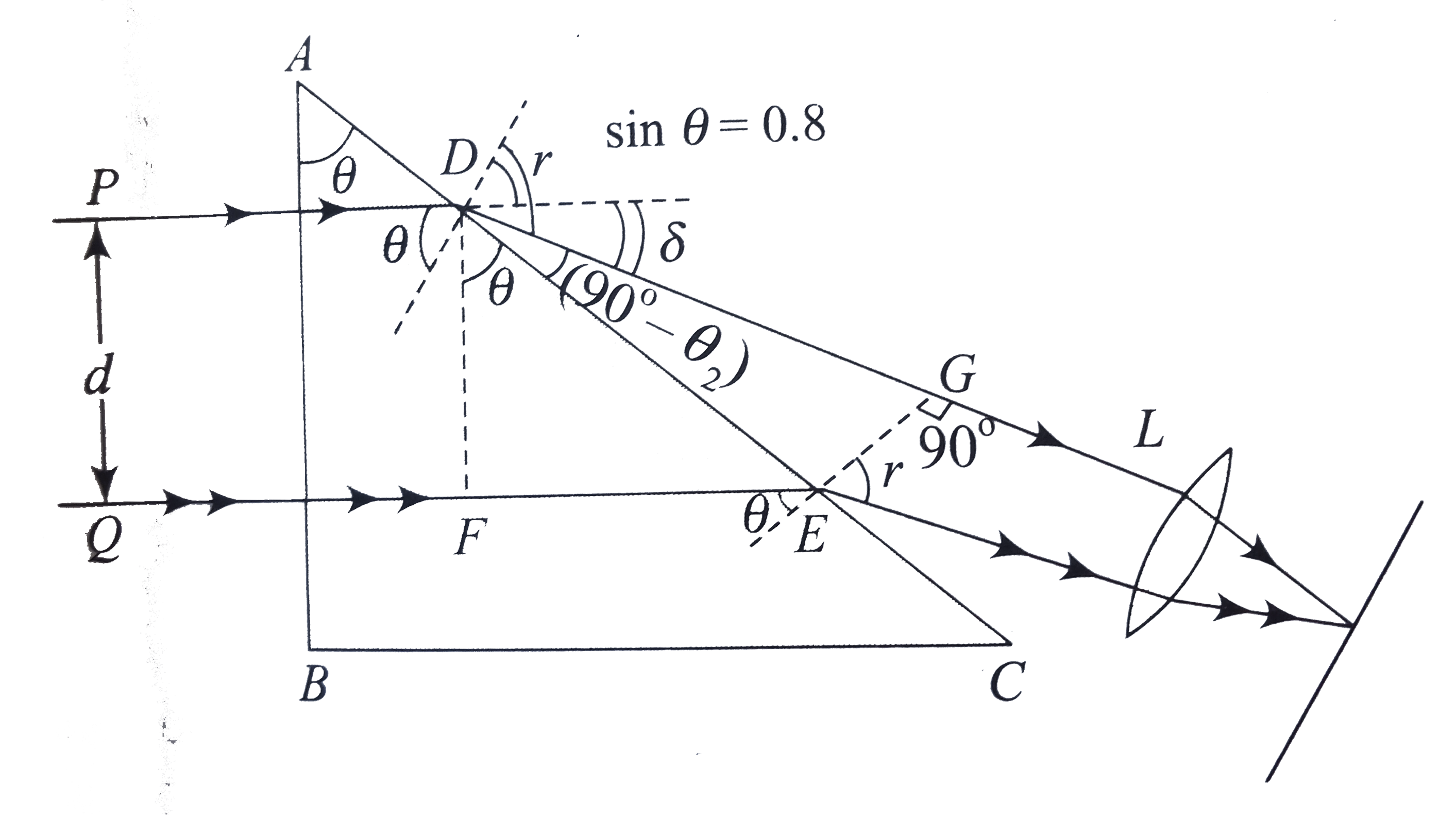
In case of interference,
`I = I_(1) + I_(2) (sqrt (I_(1) I_(2))) cos phi`
Here, `I_(1) = I and I_(2) = 4I.` So,
`I_(R) = 5I + 4I cos phi`
`= I [1 + 8 cos^(2) ((phi)/(2))]`
with ` phi = (2 pi)/(lambda) (Delta x)`
where `Delta x = [DG - EF ("in medium")]`
Now, from Fig. 2.23,
`FE ("in medium") = mu (FE) = mu d tan theta`, [as `FE = d tan theta`] (iv)
`DG = DE cos (90^(@) - r) = DE sin r`
or `DG = (d sin r/cos theta) ["as" DE = d//cos theta]`
or ` DG = mu tan theta ["as at" D, mu sin theta = 1 sin r]` (v)
Substituting the value of FE and DG from Eqs. (iv) and (v) in Eq. (iii), we get
`Delta x = mu d tan theta - mu d tan theta = 0`
So, Eq. (ii) gives ` phi = 0^@` Hence, from Eq. (i),
`I_(R) = I [1 + 8 cos^(2) 0^(@) ]= 9I`.
Promotional Banner

Topper's Solved these Questions

  • WAVE OPTICS

    CENGAGE PHYSICS|Exercise Solved Examples|10 Videos
  • WAVE OPTICS

    CENGAGE PHYSICS|Exercise Exercise 2.1|12 Videos
  • THERMODYNAMICS

    CENGAGE PHYSICS|Exercise QUESTION BANK|34 Videos
  • WAVES

    CENGAGE PHYSICS|Exercise QUESTION BANK|38 Videos

Similar Questions

Explore conceptually related problems

Two parallel beams of light P and Q (separation d) containing radiations of wavelengts 4000Å and 5000 Å (which are mutually coherent in each wavelength separately) are incident normally on a prism as shown in figure the refractive index of the prism as a function of wavelength is given by the relation mu(lamda)=1.20+(b)/(lamda^(2)) where lamda is in Å and b is a positive constant. The value of b is such that the condition for total reflection at the face AC is just satisfied for one wavelength and is not satisfied for the other. A convergent lens is used to bring these transmitted beams into focus. If the intensities of the upper and the lower beams immediately after transmission from the face AC, are 4I and I respectively, find the resultant intensity at the focus.

Two parallel beams of light P and Q (separation d) containing radiation of wavelengths 4000A and 5000A (which are mutually coherent in each wavelength separately) are incident normally on a prism as shown in fig. The refractive index of the prism as a function of wavelength is given by the relation. mu(lamda)=1.20+(b)/(lamda^(2)) Where lamda is in A and b is positive constant. The value of b is such that the condition wave length and is not satisfied for the other. (a) Find the value of b. (b) find the deviation of the beams transmitted through the face AC. (c) A convergent lens is used to bring these transmitted beams into focus. If the intensities of transmission form the face AC, are 41 and I respectively, find the resultant intensity at the focus.

A parallel beam of light is incident on a prism as shown in figure. Such that the rays get reflected from opposite faces. The angle of deviation delta between reflected rays from faces AB and AC is-

A mixture of plane polarised and unpolarised light falls normally on a polarising sheet. On rotating the polarising sheet about the direction of the incident beam, the transmitted intensity varies by a factor 4. Find the ratio of the intensities I_(P) and I_(0) respectively of the polarized and unpolarised components in the incident beam. Next the axis of polarising sheet is fixed at an angle of 45^(@) with the direction when the transmitted intensity is maximum. Then obtain the total intensity of the transmitted beam in terms of I_(0) . [(3)/(2),(5I_(0))/(4)]

In a YDSE a parallel beam of light of wavelength 6000Å is incident on slits at angle of incidence 30^(@) . A and B are two thin transparent films each of refractive index 1.5. thickness of A is 20.4mum . Light coming through A and B have intensities I and 4I resepctively on the screen. Intensity at point O which is symmetric relative to the slits is 3I. The central maxima is above O. (i). what is the maximum thickness of B to do so. Assuming thickness of B to be that found in part (i) answer the following parts. (ii). Find fringe width, maximum intensity and minimum intensity on screen. (iii). Dinstance of nearest minima from O (iv) intensity at 5 cm on either side of O.

Two monochromatic ray of light are incident normally on the face AB of an isosceles right - angled 'I' and '2' are respectively 1.35 and 1.45. Trace path of these rays after entering through the prism.

A monochromatic beam of light of 6000 Å is used in YDSE set-up. The two slits are covered with two thin films of equal thickness t but of different refractive indices as shown in figure. Considering the intensity of the incident beam on the slits to be I_(0) , find the point on the screen at which intensity is I_(0) and is just above the central maxima. (Assume that there is no change in intensity of the light after passing through the films.) Consider t = 6 mu m, d = 1 mm, and D = 1 m, where d and D have their usual meaning. Give your answer in mm.

In the given figure a parallel beam of ligth is incident on the upper part of a prism of angle 1.8^(@) and R.I.3//2 . The light coming out of the prism falls on a concave mirror of radius of curvature 20 cm . The distance of the point (where the rays are focused after reflrction from the mirror) from the pricipal axis is: [use pi=3.14 ]

CENGAGE PHYSICS-WAVE OPTICS-QUESTION BANK
  1. Two parallel beams of light P and Q are incident normally on a prism a...

    Text Solution

    |

  2. In a single slit diftion, slit width is 0.6mm and distance of first mi...

    Text Solution

    |

  3. The ratio of resolving powers of an optical microscope for two wavelen...

    Text Solution

    |

  4. A beam of light of lambda=600 nm from a.distant sourcé falls on a sing...

    Text Solution

    |

  5. In Young's double slit experiment, the slits are 2 mm apart and are il...

    Text Solution

    |

  6. In a Young's double slit experiment the spacing between the slits is 0...

    Text Solution

    |

  7. A slit of size 0.15m is placed at 2.1m from a screen. On illuminated i...

    Text Solution

    |

  8. In the Young's double-slit experiment, the intensity of light at a poi...

    Text Solution

    |

  9. In YDSE distance between slits and screen is 1.5 m. When light of wave...

    Text Solution

    |

  10. Two Polaroids P(1) and P(2) are placed with their axis perpendicular t...

    Text Solution

    |

  11. In an YDSE, the fringes are formed at a distance of 1 m from double sl...

    Text Solution

    |

  12. In Young's double slit experiment the separation d between the slits i...

    Text Solution

    |

  13. A single slit is of width 0.5mm. Distance of screen from slit is 1 m. ...

    Text Solution

    |

  14. In YDSE distance between slits is 0.2 mm, distance between slit & scre...

    Text Solution

    |

  15. In an interference pattern the (n+4)^(th) blue bright fringe and n^(th...

    Text Solution

    |

  16. In double slit experiment, the angular width of the fringes is 0.20^(c...

    Text Solution

    |

  17. A light has amplitude A and angle between analyser and polariser is 60...

    Text Solution

    |

  18. A unpolarised light is passing through three polaroids as shown. If fi...

    Text Solution

    |

  19. In YDSE, if sources are incoherent, the intensity on screen is 13 I(0^...

    Text Solution

    |

  20. An unpolarized light passes through three polarizing sheets whose pola...

    Text Solution

    |

  21. In a Young's double slit experiment, 60 fringes were seen in the field...

    Text Solution

    |

