Home
Class 12
PHYSICS
A glass lens is coated on one side with ...

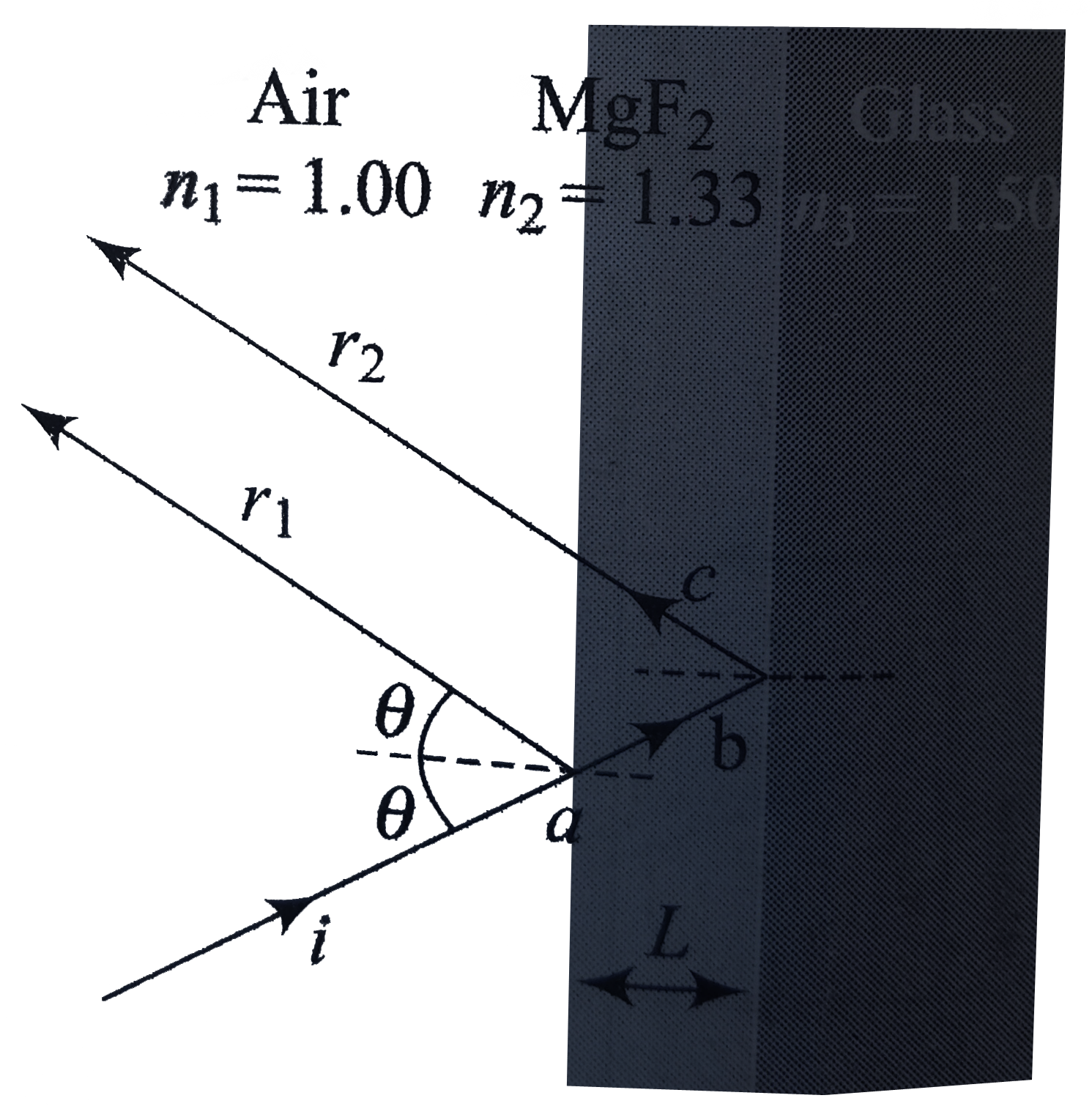
A glass lens is coated on one side with a thin film of magnesium fluoride `(MgF_(2))`to reduce reflection from the lens surface (Fig. 2.26). The Index of refraction of `MgF_(2)` is 1.38, that of the glass is 1.50. What is the least coating thickness that eliminates (via interference) the reflections at the middle of the visible specturm `(lambda = 550nm)`? Assume that the light is approxmately perpendicular to the lens surface.

Text Solution

Verified by Experts

This situation here is different from previous problem in that `n_(3) gt n_(2) gt n_(1)`. The reflection at point a still introduces a phase difference of `Pi` but now the reflection at point b also does the same (see Fig. 2.26). Unwanted reflections from glass can be suppressed ( at a chosen wavelength) by coating the glass with a thin transparent film of magnesium fluoride of a properly chosen thickness which introduces a phase change of half a wavelenght. For this, the path length difference 2L within the film must be equal to an odd nunber of half wavelength:
`2n_(2) L = (n + 1//2) lambda`
We want the least thickness for the coating, that is, the smallest L. Thus, we choose, `n = 0`, the smallest value of n. Solving for L and inserting the given data, we obtain
` L = (lambda)/(4n_(2)) = (550nm)/((4)(1.38)) = 96.6 nm`
Promotional Banner

Topper's Solved these Questions

  • WAVE OPTICS

    CENGAGE PHYSICS|Exercise Solved Examples|10 Videos
  • WAVE OPTICS

    CENGAGE PHYSICS|Exercise Exercise 2.1|12 Videos
  • THERMODYNAMICS

    CENGAGE PHYSICS|Exercise QUESTION BANK|34 Videos
  • WAVES

    CENGAGE PHYSICS|Exercise QUESTION BANK|38 Videos

Similar Questions

Explore conceptually related problems

On face of a glass (mu = 1.50) lens is coated with a thin film of magnesium fluoride MgF_(2)(mu = 1.38) to reduce reflection from the lens surface. Assuming the incident light to be perpendicular to the lens surface. The least coating thickness that eliminates the reflection at the centre of the visible spectrum (lamda = 550 nm) is about

Blue light of wavelength 480 nm is most strongly reflected off a thin film of oil on a glass slab when viewed near normal incidence. Assuming that the index of refraction of the oil is 1.2 and that of the glass is 1.6, what is the minimum thickness of the oil film (other then zero)?

What is the minimum thickness of a soap bubble needed for constructive interference in reflected light, if the light incident on the film is 750 nm? Assume that the refractive index for the film is n=1.33

A material having an index of refraction of 1.30 is used as an antireflective coating on a piece of glass (n = 1.50). What should be the minimum thickness of this film in order to minimize reflection of 500 nm light?

Refractive index of a thin soap film of a uniform thickness is 1.34. Find the smallest thickness of the film that gives in interference maximum in the reflected light when light of wavelength 5360 Å fall at normal incidence.

A thin film of thickness t and index of refractive 1.33 coats a glass with index of refraction 1.50 .What is the least thickness t that will strong refelct light with wavelength 600nm incident normally?

Refractive index of a thin soap film of a uniform thickness is 1.38. The smallest thickness of the film that gives an interference maxima in the reflected light when light of wavelength 5520 Å falls at normal incidence is

What is the minimum thickness of thin film required for constructive interference in the reflected light through it ? (Given, the refractive index of the film =1.5, wavelength of the lilght incident on the film =600 nm.

CENGAGE PHYSICS-WAVE OPTICS-QUESTION BANK
  1. A glass lens is coated on one side with a thin film of magnesium fluor...

    Text Solution

    |

  2. In a single slit diftion, slit width is 0.6mm and distance of first mi...

    Text Solution

    |

  3. The ratio of resolving powers of an optical microscope for two wavelen...

    Text Solution

    |

  4. A beam of light of lambda=600 nm from a.distant sourcé falls on a sing...

    Text Solution

    |

  5. In Young's double slit experiment, the slits are 2 mm apart and are il...

    Text Solution

    |

  6. In a Young's double slit experiment the spacing between the slits is 0...

    Text Solution

    |

  7. A slit of size 0.15m is placed at 2.1m from a screen. On illuminated i...

    Text Solution

    |

  8. In the Young's double-slit experiment, the intensity of light at a poi...

    Text Solution

    |

  9. In YDSE distance between slits and screen is 1.5 m. When light of wave...

    Text Solution

    |

  10. Two Polaroids P(1) and P(2) are placed with their axis perpendicular t...

    Text Solution

    |

  11. In an YDSE, the fringes are formed at a distance of 1 m from double sl...

    Text Solution

    |

  12. In Young's double slit experiment the separation d between the slits i...

    Text Solution

    |

  13. A single slit is of width 0.5mm. Distance of screen from slit is 1 m. ...

    Text Solution

    |

  14. In YDSE distance between slits is 0.2 mm, distance between slit & scre...

    Text Solution

    |

  15. In an interference pattern the (n+4)^(th) blue bright fringe and n^(th...

    Text Solution

    |

  16. In double slit experiment, the angular width of the fringes is 0.20^(c...

    Text Solution

    |

  17. A light has amplitude A and angle between analyser and polariser is 60...

    Text Solution

    |

  18. A unpolarised light is passing through three polaroids as shown. If fi...

    Text Solution

    |

  19. In YDSE, if sources are incoherent, the intensity on screen is 13 I(0^...

    Text Solution

    |

  20. An unpolarized light passes through three polarizing sheets whose pola...

    Text Solution

    |

  21. In a Young's double slit experiment, 60 fringes were seen in the field...

    Text Solution

    |
