Home
Class 12
PHYSICS
Consider the situation shown in fig. The...

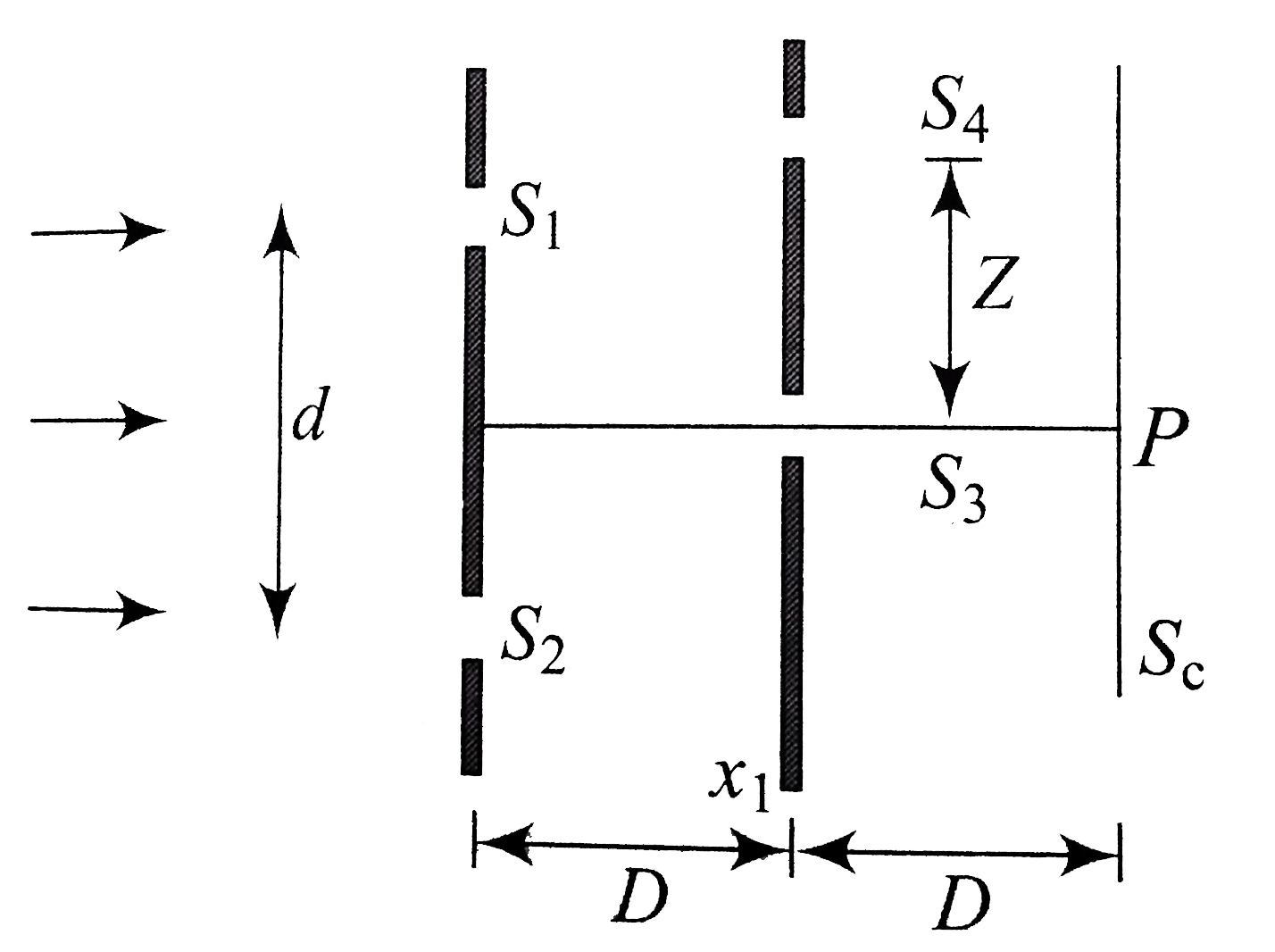
Consider the situation shown in fig. The two slits `S_(1)` and `S_(2)` placed symmetrically around the central line are illuminated by monochromatic light of wavelength `lambda`. The separation between the slit is d. The ligth transmitted by the slits falls on a screen `S_(0)` placed at a distance D form the slits. The slit `S_(3)` is at the central line and the slit `S_(4)` is at a distance z from `S_(3)` Another screen `S_(c)` is placed a further distance D away from `S_(c)` Find the ratio of the maximum to minimum intensity observed on `S_(c)`

If `z = (lambda D)/(4 d)`

A

`[3 - 2 sqrt 2]^(2)`

B

`[3 + sqrt 2]^(2)`

C

`[3 - sqrt 2]^(2)`

D

`[3 + 2 sqrt 2]^(2)`

Text Solution

Verified by Experts

The correct Answer is:

d

`z = (lambda D)/(4d)`
`Delta x = y (d)/(D) = (lambda D)/(4 d) (d)/(D) = (lambda)/(4)`
`phi = (2 pi)/(lambda) ((lambda)/(4)) = (pi)/(4)`
Intensity at `S_(4): I_(4) = 2 I_(0) (1 + cos ((pi)/(2))) = 2 I_(0)`
Intensity at `S_(3): I_(3) = 4 I_(0)`
`:. (I_(max))/(I_(min))=([(4I_(0))^(1//2)+(2I_(0))^(1//2)]^(2))/([(4I_(0))^(1//2)-(2I_(0))^(1//2)]^(2))=[((2+sqrt(2)))/((2-sqrt(2)))]^(2)`
`= [((2 + sqrt 2)^(2))/(4 - 2)]^(2) = (1)/(4) [4 + 2 + 4 sqrt 2]^(2)`
`= (1)/(4) [ 6 + 4 sqrt 2]^(2) = [3 + 2 sqrt 2]^(2)`
Promotional Banner

Topper's Solved these Questions

  • WAVE OPTICS

    CENGAGE PHYSICS|Exercise Integer|3 Videos
  • WAVE OPTICS

    CENGAGE PHYSICS|Exercise Archives|4 Videos
  • WAVE OPTICS

    CENGAGE PHYSICS|Exercise Assertion- Reasoning|13 Videos
  • THERMODYNAMICS

    CENGAGE PHYSICS|Exercise QUESTION BANK|34 Videos
  • WAVES

    CENGAGE PHYSICS|Exercise QUESTION BANK|38 Videos

Similar Questions

Explore conceptually related problems

Consider the situation shown in figure-6.35. The two slits S_(1) and S_(2) placed symmetrically around the central line are illuminated by a monochromatic light of wavelength lambda . The separation between the slits is d. The light transmitted by the slits falls on a screen E_(1) placed at a distance D from the slits. The slit S_(3) is at the central line and the slit S_(4) is at a distance z from S_(3) . Another screen E_(2) is placed a further distance D away from E_(1) . Find the ratio of the maximum to minimum intensity observed on E_(2) if z is equal is : (a) (lambdaD)/(2d) " "(b) (lambdaD)/(d)" " (c )(lambdaD)/(4d)

In the set up shown in figure, the two slits S_1 and S_2 are not equidistant from the slit S. The central fringe at O is then

Young’s double slit experiment is performed with light of wavelength 550 nm . The separation between the slits is 1.10 mm and screen is placed at distance of 1 m . What is the distance between the consecutive bright or dark fringes

In a double slit experiment, the distance between the slits is d. The screen is at a distance D from the slits. If a bright fringe is formed opposite to one of the slits, its order is

Light d of wavelength 5000Å is incident normally on a slite. The first minimum of the distance of 5 mm from the central maximum on a screen placed at a distance of 2 m from the slit. The width of slit is

For a parallel beam of monochromatic light of wavelength 'lambda' differaction is produced by a single slit whose width 'a' is of the order as wavelength of the light. If 'D' is the distance of the screen from the slit, the width of the central maxima will be

Separation between the slits in Young's double-slit experiment is d and screen is placed at a distance D from the slits to observe the interference pattern. Wavelength of light used is lambda . Find the distance of point from centre of screen where intensity falls to (i) half the maximum and (ii) one-fourth of the maximum.

In a single slit diffraction of light of wavelength lambda by a slit of width e, the size of the central maximum on a screen at a distance b is

CENGAGE PHYSICS-WAVE OPTICS-Linked Comprehension
  1. Consider the situation shown in fig. The two slits S(1) and S(2) place...

    Text Solution

    |

  2. Consider the situation shown in fig. The two slits S(1) and S(2) place...

    Text Solution

    |

  3. Consider the situation shown in fig. The two slits S(1) and S(2) place...

    Text Solution

    |

  4. The arrangement for a mirror experiment is shown in figure. S is a poi...

    Text Solution

    |

  5. The arrangement for a mirror experiment is shown in figure. S is a poi...

    Text Solution

    |

  6. The arrangement for a mirror experiment is shown in figure. S is a poi...

    Text Solution

    |

  7. Young's double-slit experiment setup with ligth of wavelength lambda =...

    Text Solution

    |

  8. Young's double-slit experiment setup with ligth of wavelength lambda =...

    Text Solution

    |

  9. Young's double-slit experiment setup with ligth of wavelength lambda =...

    Text Solution

    |

  10. An interference is observed due to two coherent sources S(1) placed at...

    Text Solution

    |

  11. An interference is observed due to two coherent sources S(1) placed at...

    Text Solution

    |

  12. The figure shows the interfernece pattern obtained in double slit expe...

    Text Solution

    |

  13. The figure shows the interfernece pattern obtained in double slit expe...

    Text Solution

    |

  14. The figure shows the interfernece pattern obtained in double slit expe...

    Text Solution

    |

  15. This interference film is used to measure the thickness of slides, pap...

    Text Solution

    |

  16. This interference film is used to measure the thickness of slides, pap...

    Text Solution

    |

  17. This interference film is used to measure the thickness of slides, pap...

    Text Solution

    |

  18. This interference film is used to measure the thickness of slides, pap...

    Text Solution

    |

  19. A block o plastic having a thin air cavity (whose thickenss is compara...

    Text Solution

    |

  20. A block o plastic having a thin air cavity (whose thickenss is compara...

    Text Solution

    |
