Home
Class 12
PHYSICS
Thin films, including soap bubbles and o...

Thin films, including soap bubbles and oil show patterns of alternative dark and bright regions resulting from interference among the reflected ligth waves. If two waves are in phase, their crests and troughs will coincide. The interference will be cosntructive and the amlitude of resultant wave will be greater then either of constituent waves. If the two wave are not of phase by half a wavelength `(180^(@))`, the crests of one wave will coincide width the troughs of the other wave. The interference will be destructive and the ampliutde of the resultant wave will be less than that of either consituent wave.
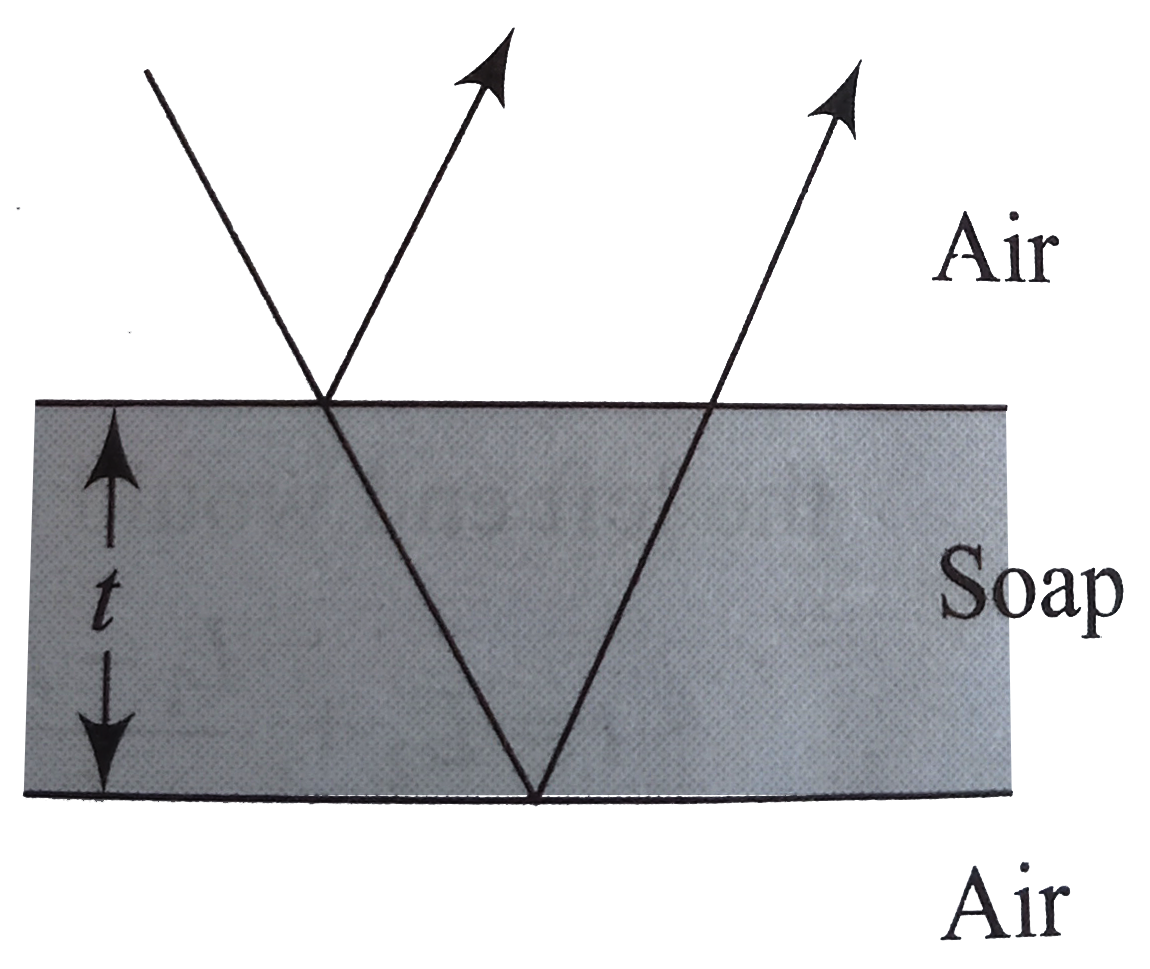
1. When incident light I, reaches the surface at point a, some of the ligth is reflected as ray `R_(a)` and some is refracted following the path ab to the back of the film.
2. At point b, some of the light is refracted out of the film and part is reflected back through the film along path bc. At point c, some of the light is reflected back into the film and part is reflected out of the film as ray `R_(c)`.

`R_(a)` and `R_(c)` are parallel. However, `R_(c)` has travelled the extra distance within the film fo abc. If the angle of incidence is small, then abc is approxmately twice the film's thickness .
If `R_(a)` and `R_(c)` are in phase, they will undergo constructive interference and the region ac will be bright. If `R_(a)` and `R_(c)` are out of phase, they will undergo destructive interference and the region ac will be dark.
I. Refraction at an interface never changes the phase of the wave.
II. For reflection at the interfere between two media 1 and 2, if `n_(1) gt n_(2)`, the reflected wave will change phase. If `n_(1) lt n_(2)`, the reflected wave will not undergo a phase change.
For reference, `n_(air) = 1.00`.

III. If the waves are in phase after reflection at all intensities, then the effects of path length in the film are:
Constrictive interference occurs when `2 t = m lambda // n, m = 0, 1,2,3`,...
Destrcutive interference occurs when `2 t = (m + (1)/(2)) (lambda)/(n)`,
`m = 0, 1, 2, 3`,...
If the waves are `180^(@)` out of the phase after reflection at all interference, then the effects of path length in the film ara:
Constructive interference occurs when
`2 t = (m + (1)/(2)) (lambda)/(n), m = 0, 1, 2, 3`,...
Destructive interference occurs when
`2 t = (m lambda)/(n) , m = 0, 1, 2, 3`,...
A soap film of thickness t is surrounded by air and is illuminated at near normal incidence by noonochromatic light wavelength `lambda` in the film. With respect to the wavelength of the monochromatic ligth in the film, what film thickness will produce maximum consturctive interference

A

`(1)/(4) lambda`

B

`(1)/(2) lambda`

C

`1 lambda`

D

`2 lambda`

Text Solution

Verified by Experts

It is not necessary to know if
`n_("air") lt n_("film") lt n_("glass")`
Either ray a or ray will undergo a phase change during reflection. Therefore, the two rays will be out of phase. For constructive interference to occur, the optical path difference must provide a `108^(@)` phase change for ray b. This happens if 2t is an odd multiple of `lambda//2`. Since `2 t = lambda//2, t = lambda//4`
Promotional Banner

Topper's Solved these Questions

  • WAVE OPTICS

    CENGAGE PHYSICS|Exercise Integer|3 Videos
  • WAVE OPTICS

    CENGAGE PHYSICS|Exercise Archives|4 Videos
  • WAVE OPTICS

    CENGAGE PHYSICS|Exercise Assertion- Reasoning|13 Videos
  • THERMODYNAMICS

    CENGAGE PHYSICS|Exercise QUESTION BANK|34 Videos
  • WAVES

    CENGAGE PHYSICS|Exercise QUESTION BANK|38 Videos
CENGAGE PHYSICS-WAVE OPTICS-Linked Comprehension
  1. When light from two sources (say slits S(1) and S(2)) interfere, they ...

    Text Solution

    |

  2. When light from two sources (say slits S(1) and S(2)) interfere, they ...

    Text Solution

    |

  3. When light from two sources (say slits S(1) and S(2)) interfere, they ...

    Text Solution

    |

  4. Thin films, including soap bubbles and oil show patterns of alternativ...

    Text Solution

    |

  5. Thin films, including soap bubbles and oil show patterns of alternativ...

    Text Solution

    |

  6. Thin films, including soap bubbles and oil show patterns of alternativ...

    Text Solution

    |

  7. Thin films, including soap bubbles and oil show patterns of alternativ...

    Text Solution

    |

  8. Thin films, including soap bubbles and oil show patterns of alternativ...

    Text Solution

    |

  9. Thin films, including soap bubbles and oil show patterns of alternativ...

    Text Solution

    |

  10. In YDSE set up (see fig.), the light sources executes SHM between P an...

    Text Solution

    |

  11. In YDSE set up (see fig.), the light sources executes SHM between P an...

    Text Solution

    |

  12. In YDSE set up (see fig.), the light sources executes SHM between P an...

    Text Solution

    |

  13. In the arrangement shown in Fig., slits S(1) and S(4)are having a vari...

    Text Solution

    |

  14. In the arrangement shown in Fig., slits S(1) and S(4)are having a vari...

    Text Solution

    |

  15. In the arrangement shown in Fig., slits S(1) and S(4)are having a vari...

    Text Solution

    |

  16. In Young's double-slit experiment lambda = 500 nm, d = 1 mm, and D = 4...

    Text Solution

    |

  17. A monochromatic light of lambda = 500 Å is incident on two indentical ...

    Text Solution

    |

  18. A screen is at distance D = 80 cm form a diaphragm having two narrow s...

    Text Solution

    |

  19. In a modified Young's double-slit experiment, a monochromatic uniform ...

    Text Solution

    |

  20. A narrow monochromatic beam of light of intensity 1 is incident on a g...

    Text Solution

    |