Home
Class 12
PHYSICS
In an experiment on the photoelectric ef...

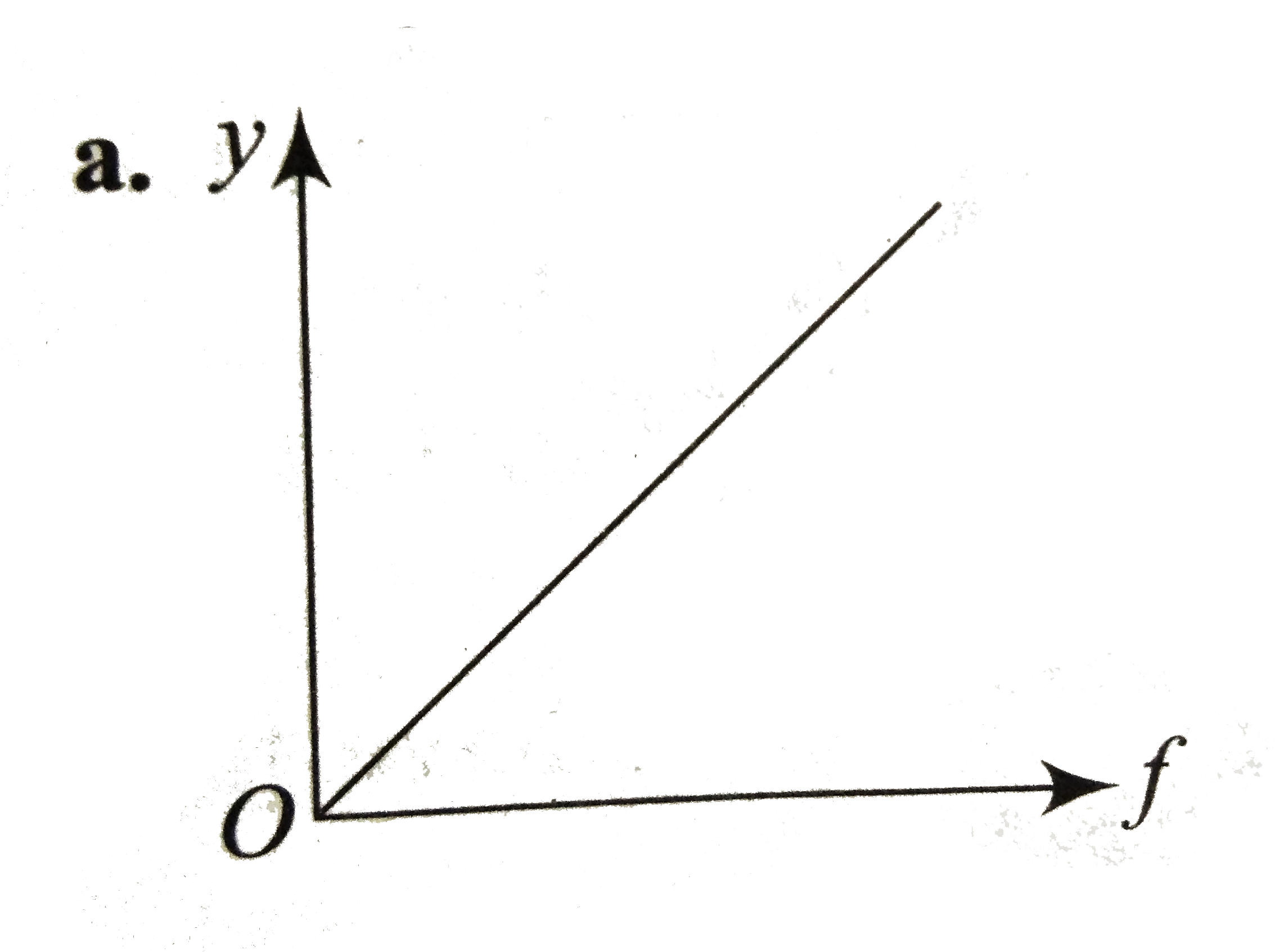
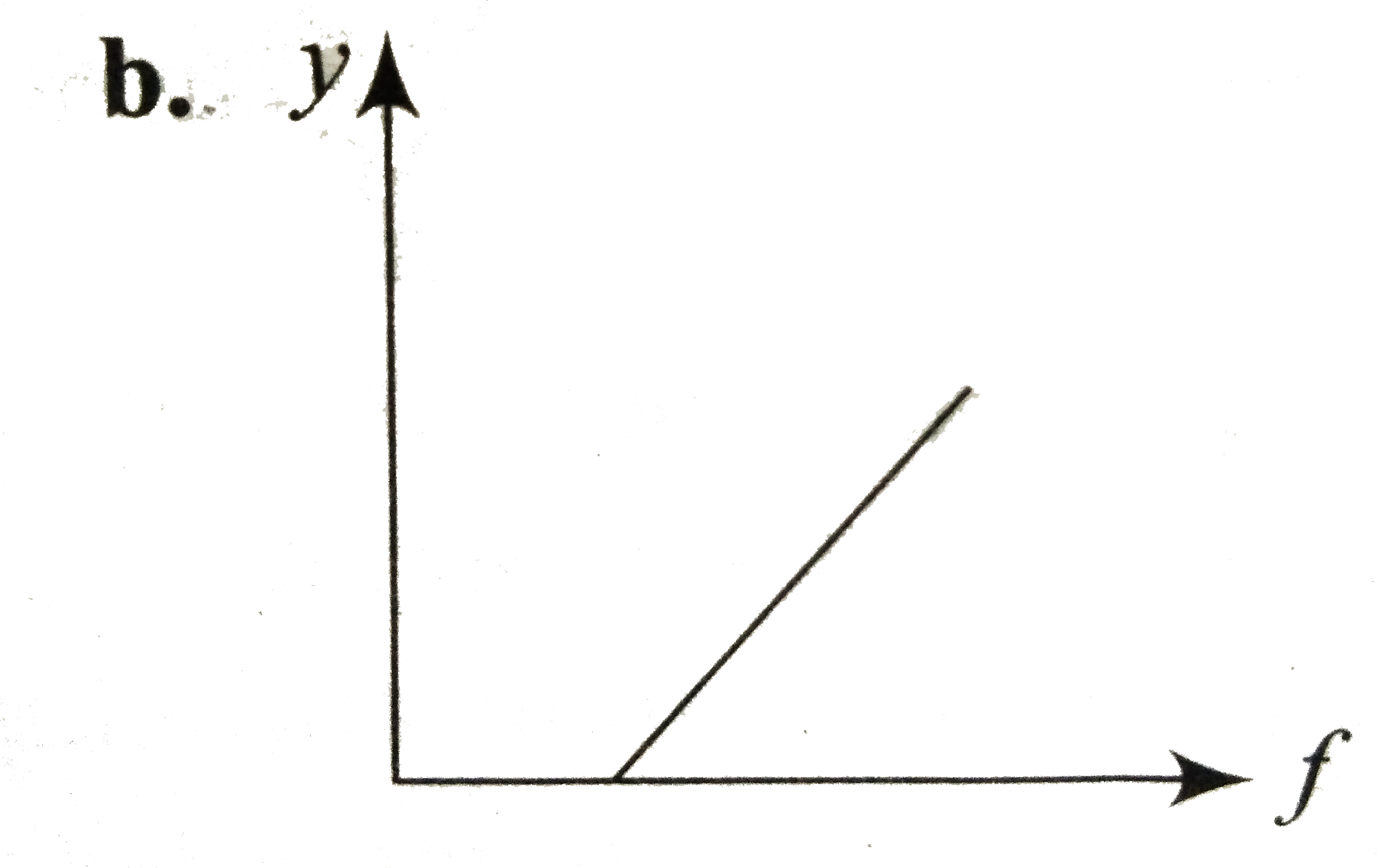
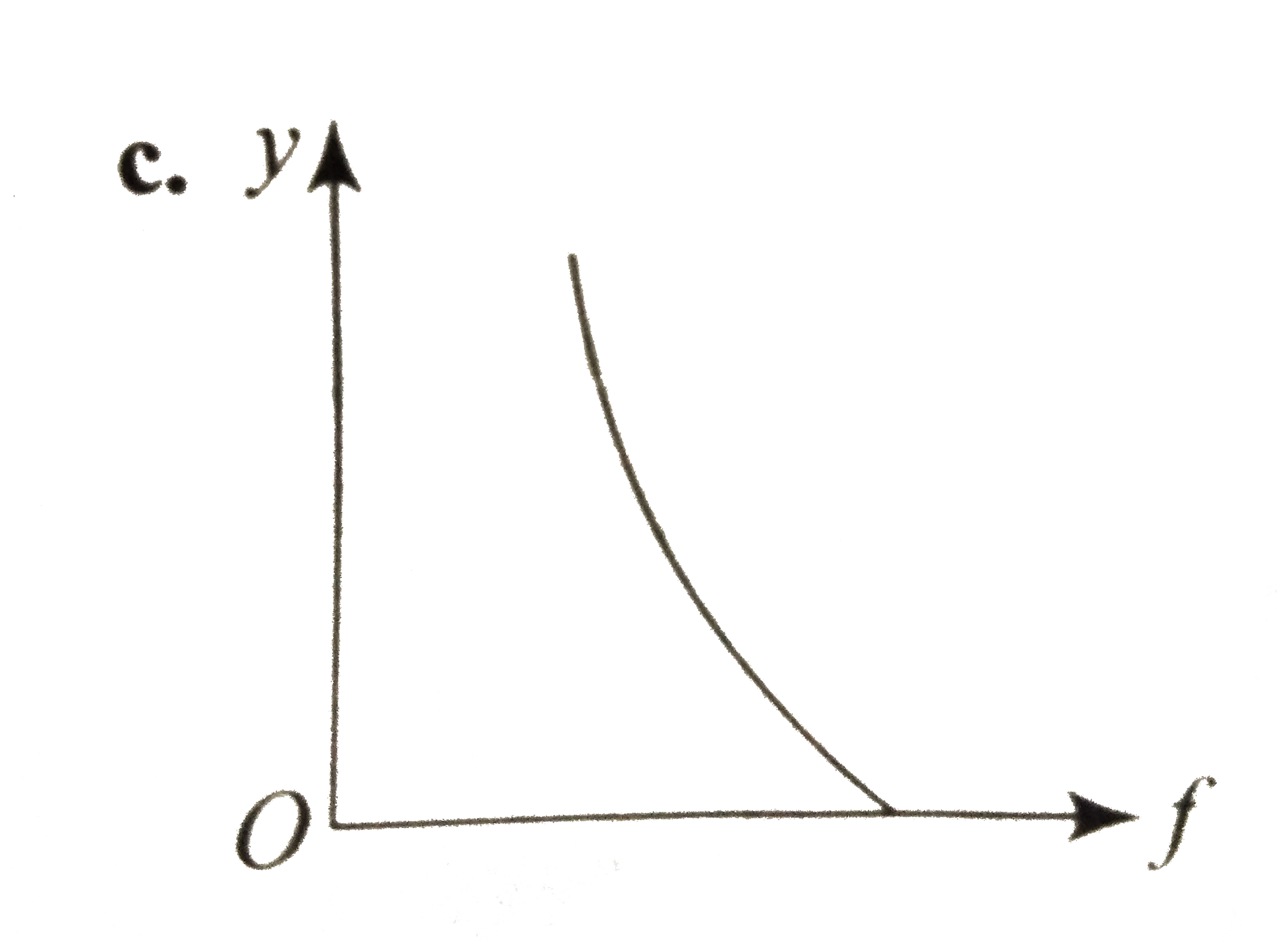
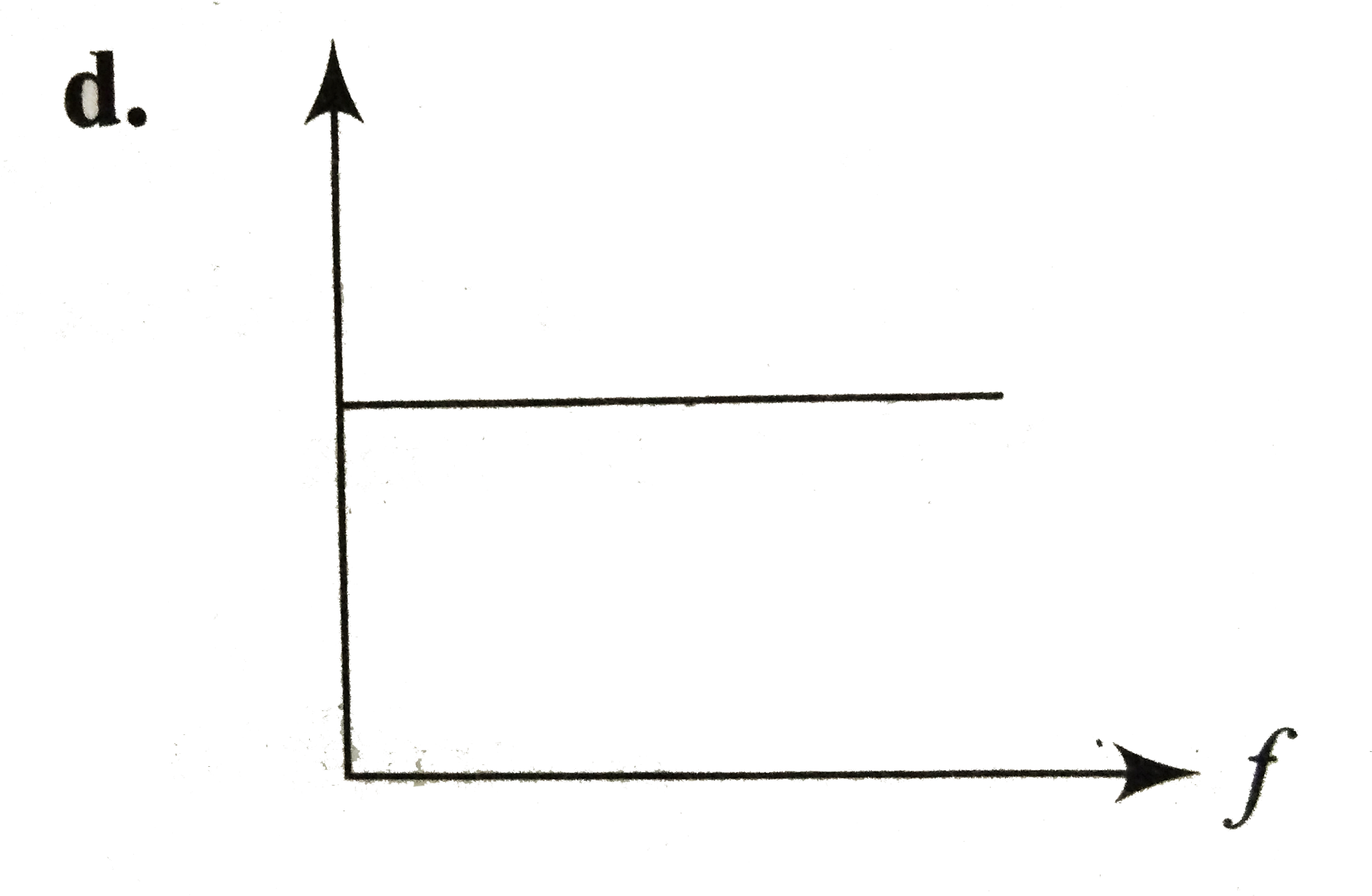
In an experiment on the photoelectric effect, an evecuated photocell with a pure metal cothode is used. Which graph best represents the variation of B, the minimum potential defference needed to prevent current from flowing, when x, the frequency of the incident light, is varied?

A

B

C

D

Text Solution

Verified by Experts

The correct Answer is:

B

By Einstein's particle (photon) theory, the maximum kinetic energy `E_(max)` of the emitted electrons from the cathode is proportional to the frequency f of the light. This is expressed in the Einstein's photoelectric equation below
`E_(max)=hf-phi=hf-hf_0`
`=h(f-f_0)`..(i)
where h is the Planck's constant, `phi_0` is the work function of the metal and is related to the threshold frequency `f_0` by `phi_0=hf_0`. It is the minimum amount of work of energy necessary to take a free electron out of the metal against the attractive forces of surrounding positive ions.
At a particular negative potential difference V applied to the anode A, the current becomes zero. This is value of the negative potential difference which just stops the electrons with maximum energy from reaching A. V is called the stopping potential . Therefore,
`eV=E_(max)` ..(ii)
From Eqs. (i) and (ii), we have
`eV=E_(max)=h(f-f_0)`
`V=(h)/(e)(f-f_0)` or `y=(h)/(e)(x-x_0)`
The variation of V (or y) is thus a straight line of gradient `(h)/(e)`, when it is plotted against f(or x) at `f_0`. It is best represented in graph b.
Promotional Banner

Topper's Solved these Questions

  • PHOTOELECTRIC EFFECT

    CENGAGE PHYSICS|Exercise Multiple Correct|10 Videos
  • PHOTOELECTRIC EFFECT

    CENGAGE PHYSICS|Exercise Linked Comprehension|44 Videos
  • PHOTOELECTRIC EFFECT

    CENGAGE PHYSICS|Exercise Subjective|16 Videos
  • NUCLEI

    CENGAGE PHYSICS|Exercise QUESTION BANK|59 Videos
  • RAY OPTICS

    CENGAGE PHYSICS|Exercise DPP 1.6|12 Videos

Similar Questions

Explore conceptually related problems

What is photoelectric effect? Explain experimentally the variation of photoelectric current with (i) the intensity of the incident light (ii) the potential difference between the plates and (iii) the frequency of the incident light and hence state the laws of photoelectric emission.

A point source of light is used in an experiment on photoelectric effect . Which of the following curves best represents the variation of photo current (i) with distance (d) of the source from the emitter ?

In an experiment on photoelectric effect the frequency f of the incident light is plotted against the stopping potential V_(0) . The work function of the metal is given by ( e is the electronic charge)

In a photoelectric experiment, a monochromatic light is incident on the metal plate A. It was observed that with V = 5 "volt" , the maximum kinetic energy of photoelectrons striking plate B was 1 eV . The polarity of the applied potential difference was as shown in figure (a). With polarity of the applied potential difference reversed (as shown in figure (b)) and frequency of incident light doubled, it was observed that in saturation state, the kinetic energy of electrons striking plate B ranged between 5 eV to 20 eV. Find the work function of metal used in plate A.

In an experiment on photoelectric effect, a student plots stopping potential V_(0) against reciprocal of the wavelength lamda of the incident light for two different metals A and B. These are shown in the figure Looking at the graphs, you can most appropriately say that :

Of the following statement about the photoelectric effect, which are true and which are false? (a) The greater the frequency of the incident light is, the greater is the stopping potential. (b) The greater the intensity of the incident light is, the greater is the cutoff frequency. (c) The greater the work function of the target material is, the greater is the stopping potential. (d) The greater the work function of the target material is, the greater is the cutoff frequency. (e) The greater the frequency of the incident light is, the greater is the maximum kinetic energy of the ejected electrons. (f) The greater the energy of the photons is, the smaller is the stopping potential.

CENGAGE PHYSICS-PHOTOELECTRIC EFFECT-Single Correct
  1. Electrons taveling at a velocity of 2.4xx10^(6) ms^(-1) enter a region...

    Text Solution

    |

  2. A surface irradiated with light lamda=480 nm gives out electrons with ...

    Text Solution

    |

  3. In an experiment on the photoelectric effect, an evecuated photocell w...

    Text Solution

    |

  4. A metal surface in an evacuated tube is illuminated with monochromatic...

    Text Solution

    |

  5. If stopping potentials corresponding to wavelengths 4000A and 4500A ar...

    Text Solution

    |

  6. The photoelectric threshold of a certain metal is 3000A. If the radiat...

    Text Solution

    |

  7. The frequency and the intensity of a beam of light falling on the surf...

    Text Solution

    |

  8. The frequency of incident light falling on a photosensitive metal plat...

    Text Solution

    |

  9. Lights of two different frequencies whose photons have energies 1 and ...

    Text Solution

    |

  10. A proton when accelerated through a potential difference of V volt has...

    Text Solution

    |

  11. Given that a photon of light of wavelength 10,000A has an energy equal...

    Text Solution

    |

  12. In the previous question, if the intensity of light is made 4I0, then ...

    Text Solution

    |

  13. if the intensity of light is made 4I0, then the saturation current wil...

    Text Solution

    |

  14. if the cathode and the anode are kept at the same potential, the emitt...

    Text Solution

    |

  15. if the wavelength is chaged to 4000A, then stopping potential will bec...

    Text Solution

    |

  16. A cesium photocell, with a steady potential difference of 60 V across ...

    Text Solution

    |

  17. If 5% of the energy supplied to a bulb is irradiated as visible light,...

    Text Solution

    |

  18. Which of the following graphs correctly represents the variation of pa...

    Text Solution

    |

  19. Five volt of stopping potential is needed for the photoelectrons emitt...

    Text Solution

    |

  20. The work function for tungsten and sodium are 4.5 eV and 2.3 eV respec...

    Text Solution

    |
