Home
Class 12
PHYSICS
Which of the following graphs correctly ...

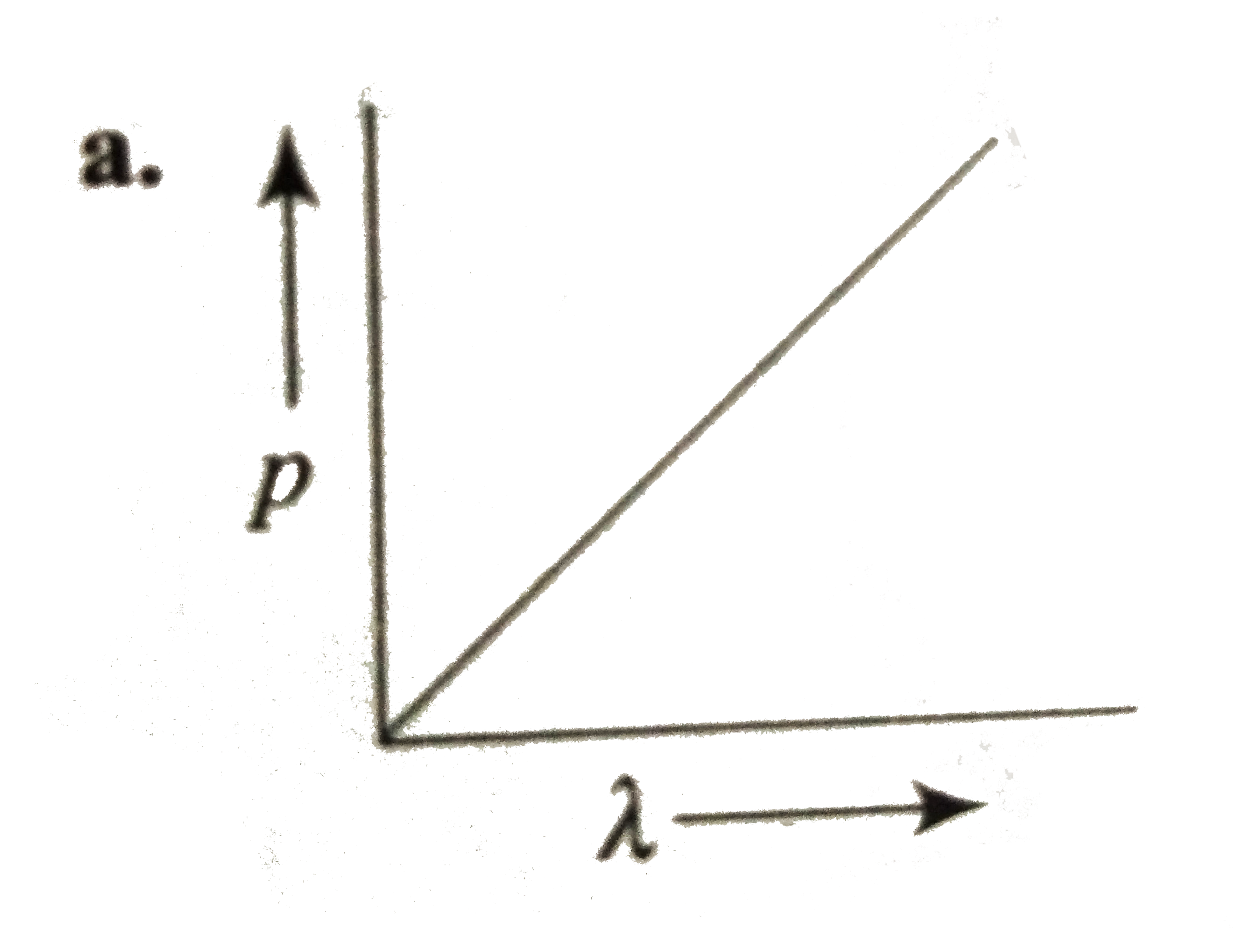
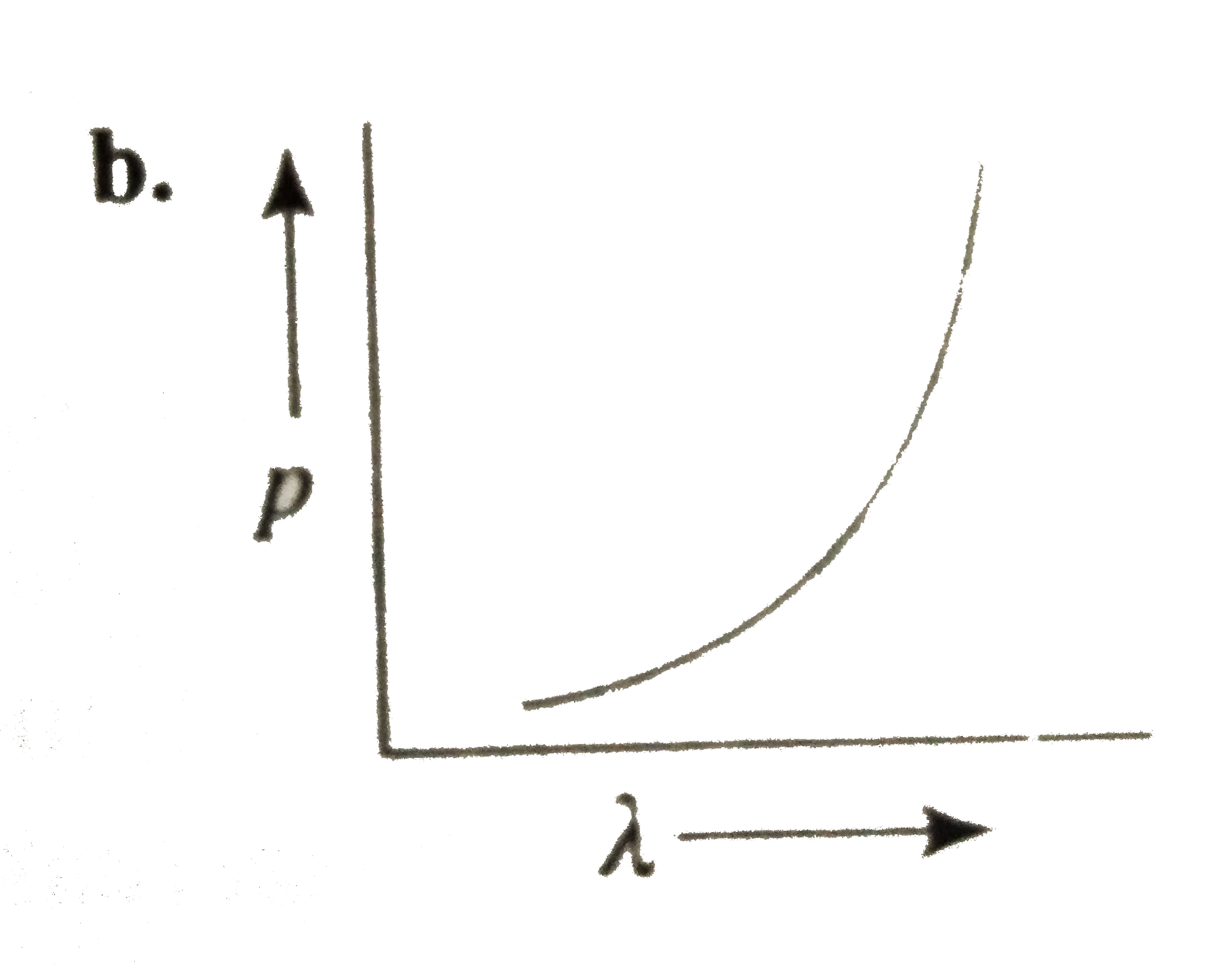
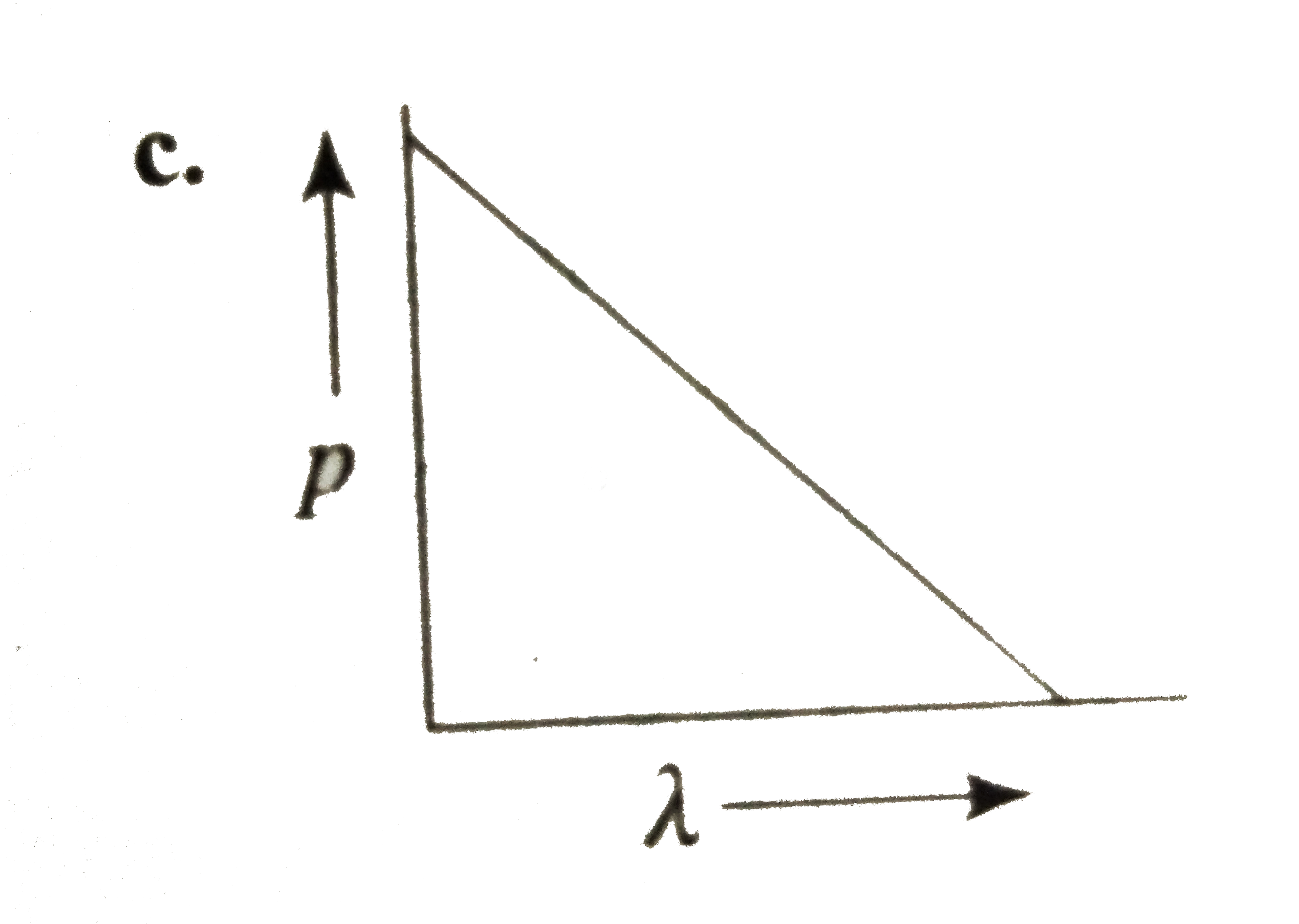
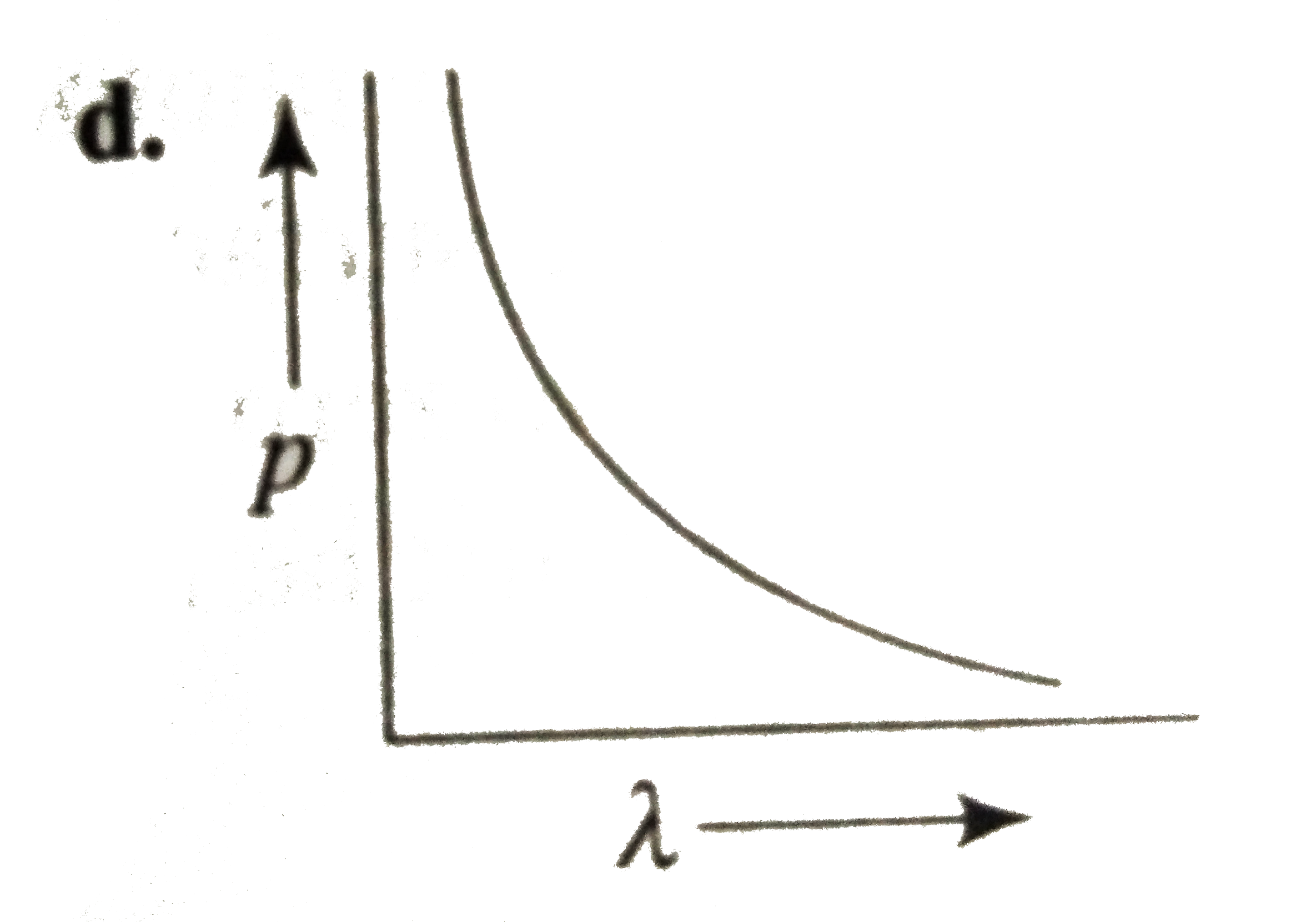
Which of the following graphs correctly represents the variation of particle momentum with associated de Broglie wavelength?

A

B

C

D

Text Solution

AI Generated Solution

The correct Answer is:

To solve the question regarding the variation of particle momentum with associated de Broglie wavelength, we need to understand the relationship between momentum (p) and wavelength (λ) as described by the de Broglie hypothesis. ### Step-by-step Solution: 1. **Understand de Broglie's Relation**: According to de Broglie’s hypothesis, the momentum (p) of a particle is inversely proportional to its wavelength (λ). This relationship can be expressed mathematically as: \[ p = \frac{h}{\lambda} \] where \( h \) is Planck's constant. 2. **Rearranging the Equation**: From the above equation, we can rearrange it to show the relationship between momentum and wavelength: \[ \lambda = \frac{h}{p} \] This indicates that as the momentum increases, the wavelength decreases, and vice versa. 3. **Graphical Representation**: The relationship \( p = \frac{h}{\lambda} \) can be interpreted as a hyperbolic relationship. If we plot momentum (p) on the y-axis and wavelength (λ) on the x-axis, we can see that the graph will be a rectangular hyperbola, as both p and λ cannot be zero. 4. **Characteristics of the Graph**: The graph will approach the axes but will never touch them, indicating that neither momentum nor wavelength can be zero. As momentum increases, the wavelength decreases, creating the hyperbolic shape. 5. **Conclusion**: The correct graph representing the variation of particle momentum with associated de Broglie wavelength is a rectangular hyperbola.

To solve the question regarding the variation of particle momentum with associated de Broglie wavelength, we need to understand the relationship between momentum (p) and wavelength (λ) as described by the de Broglie hypothesis. ### Step-by-step Solution: 1. **Understand de Broglie's Relation**: According to de Broglie’s hypothesis, the momentum (p) of a particle is inversely proportional to its wavelength (λ). This relationship can be expressed mathematically as: \[ p = \frac{h}{\lambda} \] ...
Promotional Banner

Topper's Solved these Questions

  • PHOTOELECTRIC EFFECT

    CENGAGE PHYSICS|Exercise Multiple Correct|10 Videos
  • PHOTOELECTRIC EFFECT

    CENGAGE PHYSICS|Exercise Linked Comprehension|44 Videos
  • PHOTOELECTRIC EFFECT

    CENGAGE PHYSICS|Exercise Subjective|16 Videos
  • NUCLEI

    CENGAGE PHYSICS|Exercise QUESTION BANK|59 Videos
  • RAY OPTICS

    CENGAGE PHYSICS|Exercise DPP 1.6|12 Videos

Similar Questions

Explore conceptually related problems

Which of following graphs correctly represents the variation of particle momentum with de-Broglie wavelength?

Which of the following figure represents the variation of particle momentum and the associated de - Broglie wavelength ?

Which of the following figure represent the veriation of perticle momentum and the associated de-Broglie wavelength ?

The given graph shows the variation of velocity with displacement. Which one of the graphs given below correctly represents the variation of acceleration with displacement ?

Which one of the following correctly represents the variation between linear momentum (P) and kinetic energy (E) ofa body?

The momentum of a particle associated with de-Broglie's wavelength of 6 Å is

Which of the following is correct regarding de-Broglie wavelength?

CENGAGE PHYSICS-PHOTOELECTRIC EFFECT-Single Correct
  1. A cesium photocell, with a steady potential difference of 60 V across ...

    Text Solution

    |

  2. If 5% of the energy supplied to a bulb is irradiated as visible light,...

    Text Solution

    |

  3. Which of the following graphs correctly represents the variation of pa...

    Text Solution

    |

  4. Five volt of stopping potential is needed for the photoelectrons emitt...

    Text Solution

    |

  5. The work function for tungsten and sodium are 4.5 eV and 2.3 eV respec...

    Text Solution

    |

  6. In a series of photoelectric emission experiments on a certain metal s...

    Text Solution

    |

  7. A point source causes photoelectric effect from a small metal plate. W...

    Text Solution

    |

  8. Let p and E denote the linear momentum and energy of a photon. If the ...

    Text Solution

    |

  9. Light from a hydrogen tube is incident on the cathode of a photoelectr...

    Text Solution

    |

  10. The photoelectric threshold for some material is 200 nm. The material ...

    Text Solution

    |

  11. The human eye can barely detect a yellow lings (lamda=6000A) that deli...

    Text Solution

    |

  12. X-rays are used to irradiate sodium and copper surfaces in two separat...

    Text Solution

    |

  13. An electron is accelerated through a potential difference of 200 volts...

    Text Solution

    |

  14. A photoelectric cell is connected to a source of variable potential di...

    Text Solution

    |

  15. Photoelectric work- function of a metal is 1 eV. Light of wavelength l...

    Text Solution

    |

  16. If a surface has a work function 4.0 eV, what is the maximum velocity ...

    Text Solution

    |

  17. An image of the sun is formed by a lens, of the focal length of 30 cm,...

    Text Solution

    |

  18. A modern 200 W sodium street lamp emits yellow light of wavelength 0.6...

    Text Solution

    |

  19. The work function of a metallic surface is 5.01 eV. The photoelectrons...

    Text Solution

    |

  20. An electron of mass me and a proton of mass mp are accelerated through...

    Text Solution

    |
