Home
Class 12
PHYSICS
In a photoelectric setup, a point source...

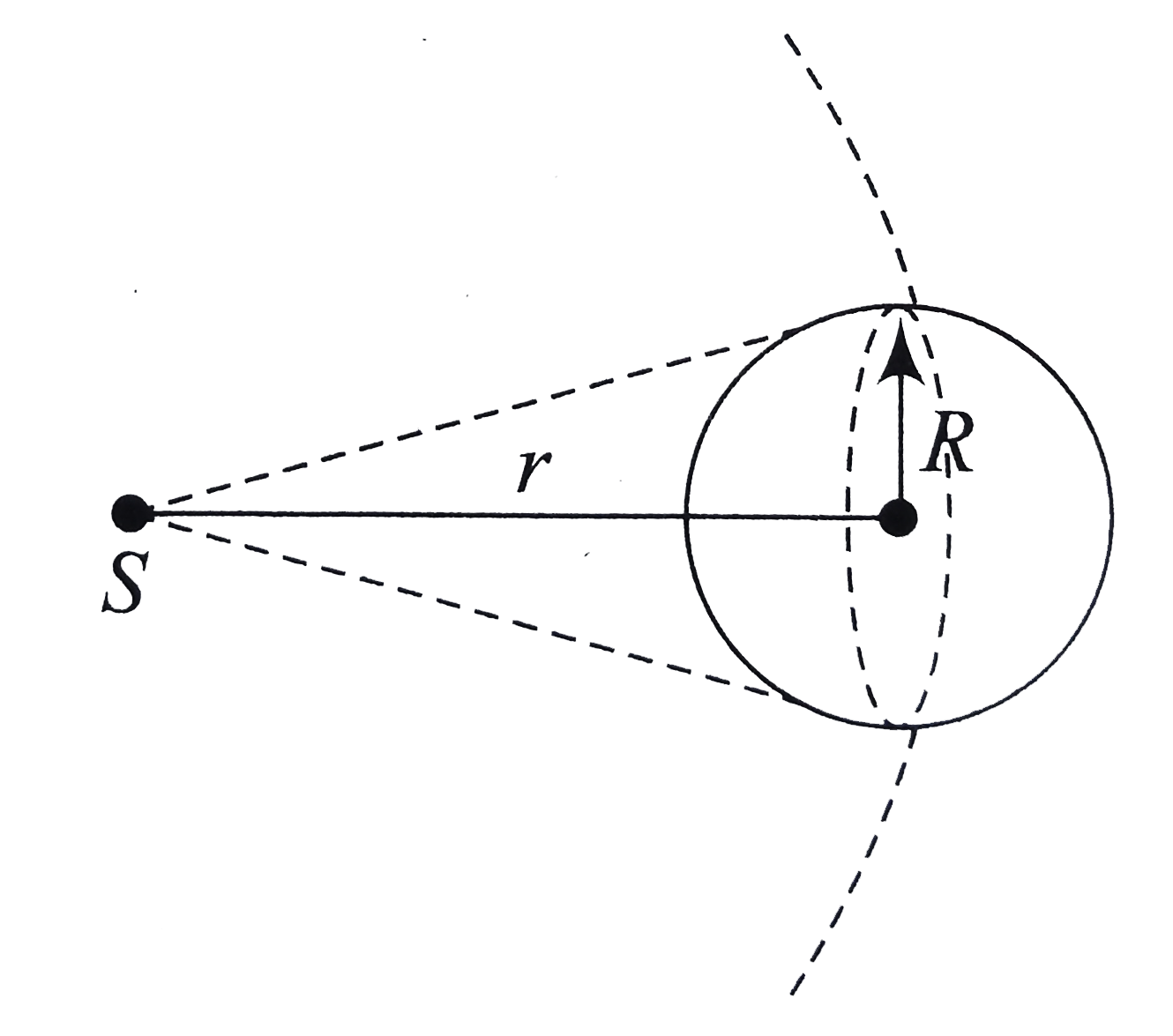
In a photoelectric setup, a point source of light of power `3.2xx10^(-3)` W emits monoenergetic photons of energy 5.0 eV. The source is located at a distance of 0.8 m from the center of a stationary metallic sphere of work function 3.0 eV and of radius `8.0xx10^(-3)`m. The efficiency of photoelectron emission is 1 for every `10^(6)` incident photons. Assume that the sphere is isolated and initially neutral and that photoelectrons are instantaneously swept away after emission.
Q. It is observed that photoelectron emission stops at a certain time t after the light source is switched on. It is due to the retarding potential developed in the metallic sphere due to lift over positive charged. The stopping potential (V) can be represented as

A

`2((KE_(max))/(e))`

B

`((KE_(max))/(e))`

C

`((KE_(max))/(3e))`

D

`((KE_(max))/(2e))`

Text Solution

Verified by Experts

The correct Answer is:
B


If P is the power of point source of light, the intensity at a distance r is
`I=(P)/(4pir^2)`
The energy intercepted by themetallic sphere is
`E=` intensity `xx` projected area of sphere `=(P)/(4pir^2)xxpiR^2`
If e is the energy of the single photon and `eta` the efficiency of the photon to liberate an electron, the number of ejected electrons is `eta(PR^2)/(4r^2r)=((10^(-6))(3.2xx10^(-3))(8xx10^(-3))^2)/(4xx(0.8)xx(5xx1.6xx10^(-19)))`
`=10^(5)` electron `s^(-1)`
The emission of electrons from a metallic sphere leaves it positively charged. As the potential of the charged sphere begins to rise, it attracts emitted electron. The emission of electrons will stop when the kinetic energy of the electrons if neutralised by the retarding potential of the sphere. So, we have
`eV=(KE_(max))`
`V=((KE_(max))/(e))`
From Einstein's photoelectric equation,
`KE_(max)=hv-phi=(5-3)=2 eV` The potential of a charged sphere is
`V=(1)/(4piepsi_0)(q)/(R)=(1)/(4piepsi_0)((n e)/(R))`
`(1)/(4piepsi_0)((n e)/(R))=2`
`n=(4piepsi_(0)2R)/(e)`
`(2xx8xx10^(-3))/(9xx10^(9)xx1.6xx10^(-19))=1.11xx10^(7)`
The photoelectric effect will stop when `1.11xx10^(7)` electrons have been emitted. The time taken by it to emit `1.11xx10^(7)` electrons,
`t=(1.11xx10^(7))/(10^(5))=111 s=1.85` min
Promotional Banner

Topper's Solved these Questions

  • PHOTOELECTRIC EFFECT

    CENGAGE PHYSICS|Exercise Integer|9 Videos
  • PHOTOELECTRIC EFFECT

    CENGAGE PHYSICS|Exercise Single Correct Answer Type|7 Videos
  • PHOTOELECTRIC EFFECT

    CENGAGE PHYSICS|Exercise Multiple Correct|10 Videos
  • NUCLEI

    CENGAGE PHYSICS|Exercise QUESTION BANK|59 Videos
  • RAY OPTICS

    CENGAGE PHYSICS|Exercise DPP 1.6|12 Videos
CENGAGE PHYSICS-PHOTOELECTRIC EFFECT-Linked Comprehension
  1. In a photoelectric effect experimetent, a metallic surface of work fun...

    Text Solution

    |

  2. In a photoelectric setup, a point source of light of power 3.2xx10^(-3...

    Text Solution

    |

  3. In a photoelectric setup, a point source of light of power 3.2xx10^(-3...

    Text Solution

    |

  4. in an experimental set up to study the photoelectric effect a point so...

    Text Solution

    |

  5. The incident intensity on a horizontal surface at sea level from the s...

    Text Solution

    |

  6. The incident intensity on a horizontal surface at sea level from the s...

    Text Solution

    |

  7. Light of intensity I falls along the axis on a perfectly refleccting r...

    Text Solution

    |

  8. Light of intensity I falls along the axis on a perfectly refleccting r...

    Text Solution

    |

  9. An experimental setup of verification of photoelectric effect is shown...

    Text Solution

    |

  10. An experimental setup of verification of photoelectric effect is shown...

    Text Solution

    |

  11. An experimental setup of verification of photoelectric effect is shown...

    Text Solution

    |

  12. An experimental setup of verification of photoelectric effect is shown...

    Text Solution

    |

  13. An experimental setup of verification of photoelectric effect is shown...

    Text Solution

    |

  14. Light having photon energy hupsilon is incident on a metallic plate ha...

    Text Solution

    |

  15. Light having photon energy hupsilon is incident on a metallic plate ha...

    Text Solution

    |

  16. Light having photon energy hupsilon is incident on a metallic plate ha...

    Text Solution

    |

  17. When light of sufficiently high frequency is incident on a metallic su...

    Text Solution

    |

  18. When light of sufficiently high frequency is incident on a metallic su...

    Text Solution

    |

  19. When light of sufficiently high frequency is incident on a metallic su...

    Text Solution

    |

  20. The energy reveived from the sun by the earth and surrounding atmosphe...

    Text Solution

    |

