Home
Class 12
PHYSICS
In a photoelectric experiment anode pote...

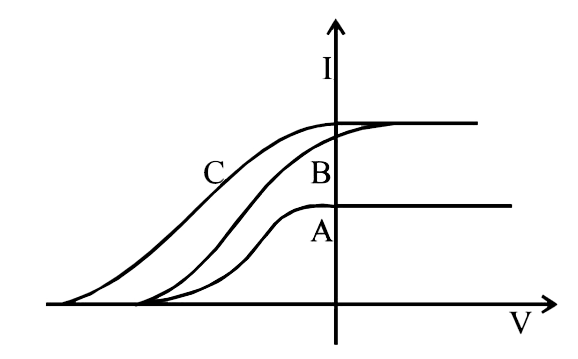
In a photoelectric experiment anode potential is ploted against plate current.

A

A nd B will have different while B and C will have different frequencies

B

B and C will have different intensities while A and C will have different frequencies

C

A and B will have different intensities while A and C will have equal frequencies

D

A and B will have equal intensities while B and C have different frequencies

Text Solution

Verified by Experts

The correct Answer is:

D

From the graph, it is clear that A and B have the same stopping potential and therefore the same frequency. Also, B and C have the same intensity.
Promotional Banner

Topper's Solved these Questions

  • PHOTOELECTRIC EFFECT

    CENGAGE PHYSICS|Exercise Multiple Correct Answers Type|7 Videos
  • PHOTOELECTRIC EFFECT

    CENGAGE PHYSICS|Exercise Linked Comprehension Type|3 Videos
  • PHOTOELECTRIC EFFECT

    CENGAGE PHYSICS|Exercise Integer|9 Videos
  • NUCLEI

    CENGAGE PHYSICS|Exercise QUESTION BANK|59 Videos
  • RAY OPTICS

    CENGAGE PHYSICS|Exercise DPP 1.6|12 Videos

Similar Questions

Explore conceptually related problems

In a photoelectric experiment anode potential is ploted againest plate currect.

In a photoelectric experiment, if stopping potential is applied, then photocurrent becomes zero. This means that:

In a photoelectric experiment, two metal pairs plates A and B are used for a given light intensity I and frequency f. work function of metal B is more than that of A. The correct variation of stopping potential difference versus frequency is given by:

In photoelectric experiment the plot between anode potential and photoelectric current is shown in figure 2.3.1. Which of the following is correct:

In a photoelectric experiment, a student plotted the graph of stopping potential (Vs) against the frequency of incident radiation (v). But he could not write the unit of the slope of the graph. What is the corrent unit ?

If in a photoelectric experiment, the stopping potential is 1.5 volts, what is the maximum kinetic energy of a photoelectrons?

In a photoelectric experiment the stopping potential for the incident light of wavelength 4000Å is 2 volt. If the wavelength be changed to 3000 Å, the stopping potential will be

In photoelectric effect, stopping potential depends on

In photoelectric effect, stopping potential depends on
