Home
Class 12
PHYSICS
Hydrogen is the simplest atom of nature....

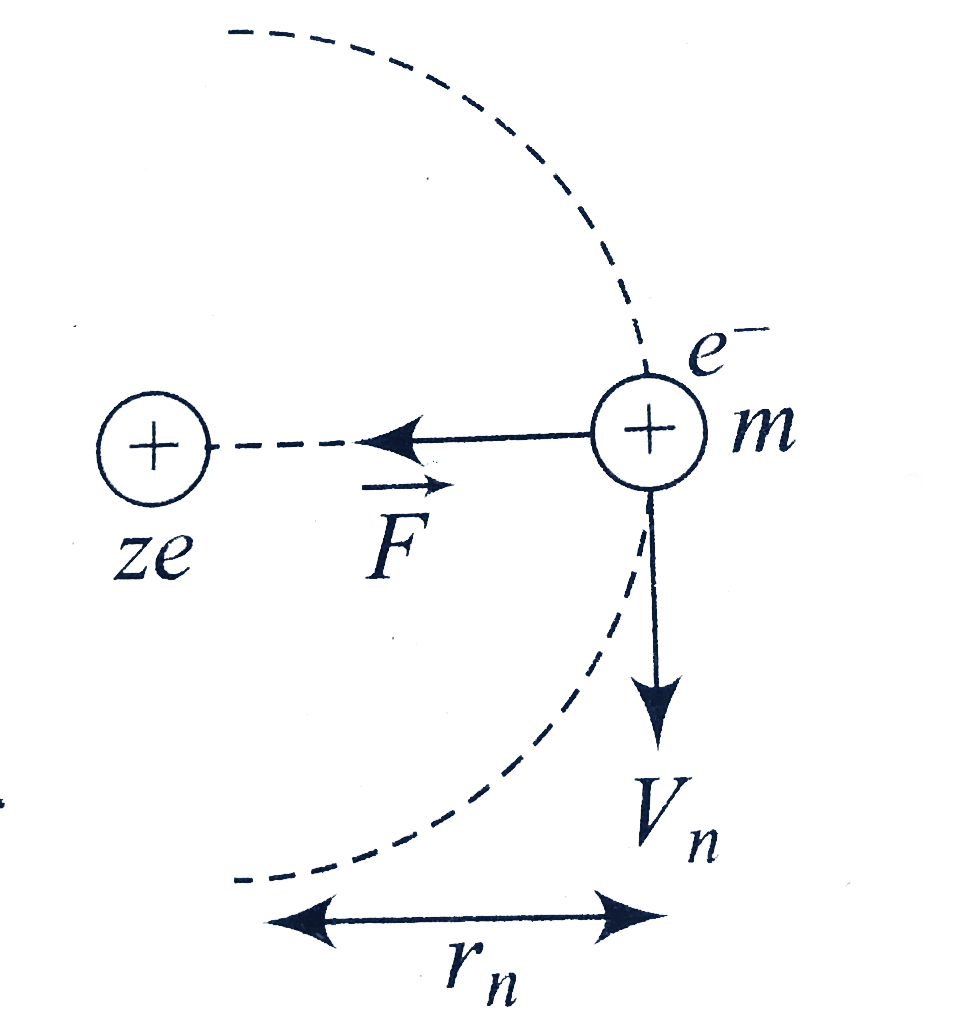
Hydrogen is the simplest atom of nature. There is one proton in its nucleus and an electron moves around the nucleus in a circular orbit. According to Niels Bohr's, this electron moves in a stationary orbit, if emits no electromagnetic radiation. The angular momentum of the electron is quantized , i.e., `mvr = (nh//2 pi)`, where `m =` mass of the electron , `v =`velocity of the electron in the orbit , `r =`radius of the orbit , and `n = 1, 2, 3`.... When transition takes place from `Kth` orbit to `Jth` orbit, energy photon is emitted. If the wavelength of the emitted photon is `lambda`.

we find that `(1)/(lambda) = R [(1)/(J^(2)) - (1)/(K^(2))]`, where `R` is
Rydberg's constant.
On a different planed, the hydrogen atom's structure was somewhat different from ours. The angular momentum of electron was `P = 2n (h//2 pi)`. i.e., an even multipal of `(h//2 pi)`.
Answer the following questions regarding the other planet based on above passage:
The minimum permissible radius of the orbit will be

Text Solution

Verified by Experts

The correct Answer is:

B

On other planet: `mvr = 2n (h)/(2 pi) implies v = (nh)/(pi mr)`
`(mv^(2))/( r) = (1)/(4 pi epsilon_(0)) (e^(2))/( r^(2)) implies (m n^(2) h^(2))/(n^(2) m^(2) r^(3)) = (1)/(4 pi epsilon_(0)) (e^(2))/( r^(2))`
Putting `n = 1, we get r = (4 pi epsilon_(0))/(m pi e^(2))`
Promotional Banner

Topper's Solved these Questions

  • ATOMIC PHYSICS

    CENGAGE PHYSICS|Exercise Linked Comprehension|62 Videos
  • ATOMIC PHYSICS

    CENGAGE PHYSICS|Exercise Integer|4 Videos
  • ATOMIC PHYSICS

    CENGAGE PHYSICS|Exercise Single Correct|187 Videos
  • ALTERNATING CURRENT

    CENGAGE PHYSICS|Exercise QUESTION BANK|65 Videos
  • ATOMS

    CENGAGE PHYSICS|Exercise QUESTION BANK|40 Videos

Similar Questions

Explore conceptually related problems

Hydrogen is the simplest atom of nature. There is one proton in its nucleus and an electron moves around the nucleus in a circular orbit. According to Niels Bohr's, this electron moves in a stationary orbit, if emits no electromagnetic radiation. The angular momentum of the electron is quantized , i.e., mvr = (nh//2 pi) , where m = mass of the electron , v = velocity of the electron in the orbit , r = radius of the orbit , and n = 1, 2, 3 .... When transition takes place from Kth orbit to Jth orbit, energy photon is emitted. If the wavelength of the emitted photon is lambda . we find that (1)/(lambda) = R [(1)/(J^(2)) - (1)/(K^(2))] , where R is Rydberg's constant. On a different planed, the hydrogen atom's structure was somewhat different from ours. The angular momentum of electron was P = 2n (h//2 pi) . i.e., an even multipal of (h//2 pi) . Answer the following questions regarding the other planet based on above passage: In our world, the velocity of electron is v_(0) when the hydrogen atom is in the ground state on the other planet should be

Hydrogen is the simplest atom of nature. There is one proton in its nucleus and an electron moves around the nucleus in a circular orbit. According to Niels Bohr's, this electron moves in a stationary orbit, if emits no electromagnetic radiation. The angular momentum of the electron is quantized , i.e., mvr = (nh//2 pi) , where m = mass of the electron , v = velocity of the electron in the orbit , r = radius of the orbit , and n = 1, 2, 3 .... When transition takes place from Kth orbit to Jth orbit, energy photon is emitted. If the wavelength of the emitted photon is lambda . we find that (1)/(lambda) = R [(1)/(J^(2)) - (1)/(K^(2))] , where R is Rydberg's constant. On a different planed, the hydrogen atom's structure was somewhat different from ours. The angular momentum of electron was P = 2n (h//2 pi) . i.e., an even multipal of (h//2 pi) . Answer the following questions regarding the other planet based on above passage: In our world, the ionization potential energy of a hydrogen atom is 13.6 eV . On the other planet, this ionization potential energy will be

The angular momentum of an electron in an orbit is quantized because:

The minimum orbital angular momentum of the electron in a hydrogen atom is

The angular momentum (L) of an electron in a Bohr orbit is gives as:

In Bohr's orbit angular momentum of an electron is proportional to

The orbital speed of an electron orbiting around the nucleus in a circular orbit of radius r is v. Then the magnetic dipole moment of the electron will be
