Home
Class 12
PHYSICS
A monochromatic beam of light having pho...

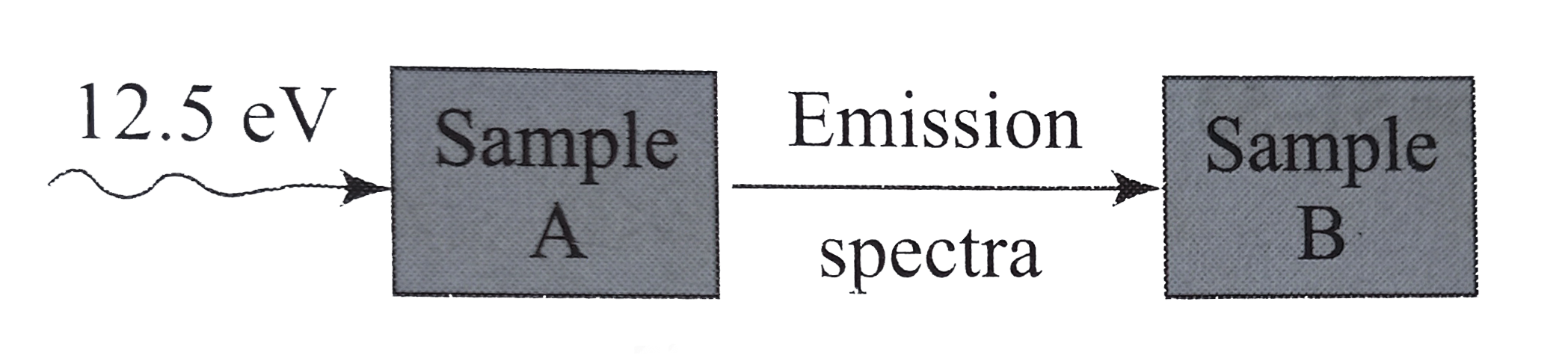
A monochromatic beam of light having photon energy `12.5 eV` is incident on a simple `A` of atomic hydrogen gas in which all almost are in the ground state. The emission spectra obtained from this sample is incident on another sample `B` of atomic hydrogen gas in which all atoms are in the first excited state.
Based on above information, answer the following question:
The atoms of sample `B`

A

will ionize when emission spectra of `A` is incident on `B`

B

may ionize when emission spectra of `A` is incident on `B`

C

will be excited to some higher state but won't ionize

D

None of above.

Text Solution

Verified by Experts

The correct Answer is:
D

As photon energy of incident light is not equal to energy difference between two energy state, that is why sample `A` does not absorbe any photon and therefore remain in ground state, and hence , no emission spectra. Thus sample `B` remain as it is, but it will be de-excite itself to ground state by emitting radiations of energy `10.2 eV`

when photon energy is replaced by electron beam, then atom of sample `A` can absorb either `10.2 eV` ("to reach" `1^(st)` excited state) of 12.1 eV (to reach `2^(nd)` excited state) In emission spectra `A` , we will have `3` time corresponding to `n = 2 to 1, n = 3 to 2 and n = 3 to1` having energies equal to `10.2 eV, 1.9 eV, 12.1 eV`, respectively
As least energy of this emission spectra is corresponding to transition from `n = 2` to `3` and sample B is in `1^(st)` excited state `B` can be excited to some higher energy level and if `B` absorbs energy corresponding to `n = 1` to `2` and `n = 1 to 3`, then it may ionize.
Promotional Banner

Topper's Solved these Questions

  • ATOMIC PHYSICS

    CENGAGE PHYSICS|Exercise Integer|4 Videos
  • ATOMIC PHYSICS

    CENGAGE PHYSICS|Exercise Fill In The Blanks|8 Videos
  • ATOMIC PHYSICS

    CENGAGE PHYSICS|Exercise Multiple Correct|13 Videos
  • ALTERNATING CURRENT

    CENGAGE PHYSICS|Exercise QUESTION BANK|65 Videos
  • ATOMS

    CENGAGE PHYSICS|Exercise QUESTION BANK|40 Videos

Similar Questions

Explore conceptually related problems

A monochromatic beam of light having photon energy 12.5 eV is incident on a simple A of atomic hydrogen gas in which all almost are in the ground state. The emission spectra obtained from this sample is incident on another sample B of atomic hydrogen gas in which all atoms are in the first excited state. Based on above information, answer the following question: The emission spectra of sample A

When a hydrogen atom is excited from ground state to first excited state then

A photon beam of energy 12.1eV is incident on a hydrogen atom. The orbit to which electron of H-atom be excited is

A photon of energy 12.09 eV is completely absorbed by a hydrogen atom initially in the ground state. The quantum number of excited state is

When a hydrogen atom is excited from ground state to first excited state, then

A: If a beam of photons of energy 10.0 eV each is incident on a sample of hydrogen gas containing all atoms in the ground state, then the beam of the photons is completely transmitted through the gas without absorption. R: The minimum energy required by an electron to make a transition to an excited state is 10.2 eV .

CENGAGE PHYSICS-ATOMIC PHYSICS-Linked Comprehension
  1. A monochromatic beam of light having photon energy 12.5 eV is incident...

    Text Solution

    |

  2. A monochromatic beam of light having photon energy 12.5 eV is incident...

    Text Solution

    |

  3. A monochromatic beam of light having photon energy 12.5 eV is incident...

    Text Solution

    |

  4. A single electron orbits a stationary nucleus of charge + Ze, where Z ...

    Text Solution

    |

  5. A single electron orbits a stationary nucleus of charge + Ze, where Z ...

    Text Solution

    |

  6. A single electron orbits a stationary nucleus of charge + Ze, where Z ...

    Text Solution

    |

  7. When high energetic electron beam , (i.e., cathode rays) strike the he...

    Text Solution

    |

  8. When high energetic electron beam , (i.e., cathode rays) strike the he...

    Text Solution

    |

  9. Light from a discharge tube containing hydrogen atoms falls on the sur...

    Text Solution

    |

  10. Light form a dicharge tube containing hydrogen atoms falls on the surf...

    Text Solution

    |

  11. Light from a discharge tube containing hydrogen atoms falls on the sur...

    Text Solution

    |

  12. The electron in a Li^(+ +) ion is the nth shell , n being very large. ...

    Text Solution

    |

  13. The electron in a Li^(+ +) ion is the nth shell , n being very large. ...

    Text Solution

    |

  14. The electron in a Li^(+ +) ion is the nth shell , n being very large. ...

    Text Solution

    |

  15. Two hydrogen-like atoms A and B are of different masses and each atom ...

    Text Solution

    |

  16. Two hydrogen-like atoms A and B are of different masses and each atom ...

    Text Solution

    |

  17. 1.8 g of hydrogen is excite by irradiation. The study of spectra indic...

    Text Solution

    |

  18. 1.8 g of hydrogen is excite by irradiation. The study of spectra indic...

    Text Solution

    |

  19. In a set of experiment on a hydrogen on a hypothetical one-electron at...

    Text Solution

    |

  20. In a set of experiment on a hydrogen on a hypothetical one-electron at...

    Text Solution

    |

