Home
Class 12
PHYSICS
Suppose a nucleus initally at rest unde...

Suppose a nucleus initally at rest undergoes `alpha` decay according to equation
`._(92)^(235)X rarr Y +alpha`
At `t=0`, the emitted `alpha`-partilces enter a region of space where a uniform magnetic field `vec(B)=B_(0) hat j` and elcertis field `vec(E)=E_(0) hati` exist. The `alpha`-prticles enters in the region with velocity `vec(V)=v_(0)hat j` from `x=0`. At time`t=sqrt3xx10^(6) (m_(0))/(q_(0)E_0)s`, the particle was observed to have speed twice the initial velocity `v_(0)`. Then, find (a) the velocity `v_(0)` of the `alpha`-particles,
(b) the initial velocity `v_(0)` of the `alpha`-particle, (c ) the binding energy per nucleon of the `alpha`-particle.
`["Given that" m(Y)=221.03 u,m(alpha)=4.003 u,m(n)=1.09u,m(P)=1.008u]`.

Text Solution

Verified by Experts

The correct Answer is:
`10^(7) ms^(-1)`

Charge on `alpha`-particle,`q_(alpha)=4 xx 1.6 xx10^(-19)C` and `1u=931 MeV//c^(2)`. Force acting on `alpha`- particle,
`vecF_(B)=q(vecvxxvecB)+q_(alpha)E_(0)hat i`
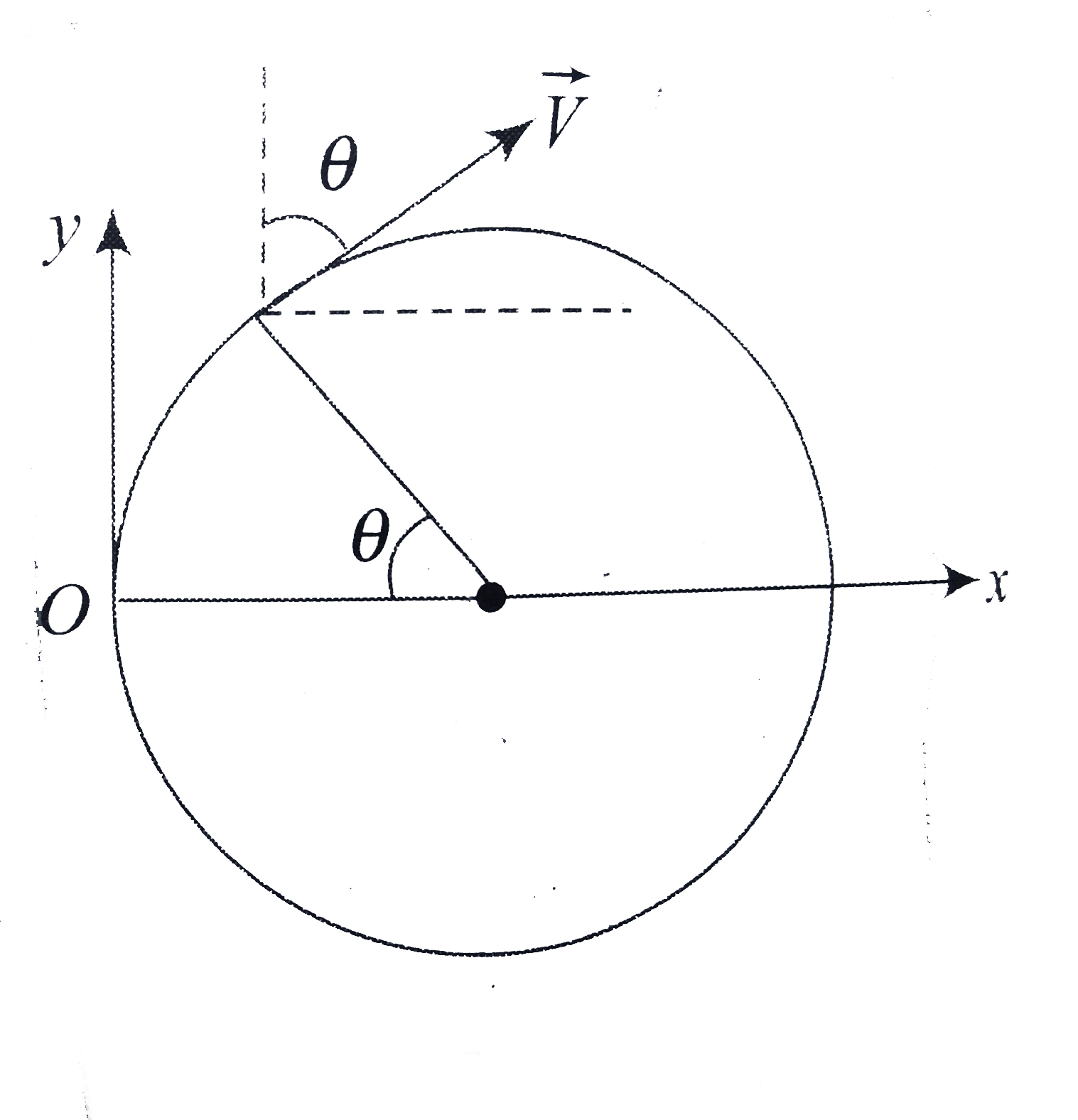
Hence, the particle will move in a circular path in `y_z`Plane . In the same time, it will move x-direction. Hence, resulting path will be a helical spiaral with increasing pitch. Thus,velocity of the circulating `alpha`-particles after time `t`.
`vecv_(0)=v_(0) cos theta hat j-v_(0) sin thetahat k`
Due to electric field present, the velocity of the `alpha`-particle will incerease along x-axis . Hence, velocity of `alpha` particle along x-axis,
`vec(v_x)=(q_(0) E_(0))/(m_(0))t hati`

Hence,velocity of `alpha`-particle,
`vecv=((q_(0)E_(0)t)/(m_(0)))hat i+v_(0) cos theta hat j-v_(0) sin theta hat k` (i)
`theta =omega t=(2 pit)/(T)`
where `T= (2pim)/(q_(alpha) B)`
Hence ,
`vecv=((q_(0)B_(0))/(m_(0)))t hat i+v_(0) cos ((2pi t)/(T)) hat j-v_(0) sin ((2pi)/(T)) hat k` (ii)`
Give, `|vecv|=2v_(0), at t=sqrt3xx10^(7) (m_(0))/(q_(0)E_(0))s`
`4v_(0)^(2)=(sqrt2xx10^(7))^(2)+v_(0)^(2)`
`because v_(0) =10^(7) m s^(-1)`
When an `alpha`-particle is emitted with velocity `v_(0)` from a stationery nucleus` X`, decay product (nucleus `Y`) recoils. Hence,
`m_(Y)V=m_(alpha)v_(0)`
`rArr V=(m_(alphav))/(m_(Y))=1.811xx10^(5) m s^(-1)`.
Promotional Banner

Topper's Solved these Questions

  • NUCLEAR PHYSICS

    CENGAGE PHYSICS|Exercise Single Correct Option|182 Videos
  • NUCLEAR PHYSICS

    CENGAGE PHYSICS|Exercise Linked Comprehension|29 Videos
  • NUCLEAR PHYSICS

    CENGAGE PHYSICS|Exercise Exercise 5.2|27 Videos
  • Moving charges and magnetism

    CENGAGE PHYSICS|Exercise Question Bank|20 Videos
  • NUCLEI

    CENGAGE PHYSICS|Exercise QUESTION BANK|59 Videos

Similar Questions

Explore conceptually related problems

An electron is projected wit velocity vec(v) = v_(0) hat(x) in an electric field vec(E) = E_(0) hat(y) . Trace the path followed by the electron :-

An alpha particle moving with the velocity vec v = u hat i + hat j ,in a uniform magnetic field vec B = B hat k . Magnetic force on alpha particle is

Electric field strength bar(E)=E_(0)hat(i) and bar(B)=B_(0)hat(i) exists in a region. A charge is projected with a velocity bar(v)=v_(0)hat(j) at origin , then

Electric field and magnetic field in a region of space are given by (Ē= E_0 hat j) . and (barB = B_0 hat j) . A charge particle is released at origin with velocity (bar v = v_0 hat k) then path of particle is

A particle of specific charge 'alpha' is projected from origin at t=0 with a velocity vec(V)=V_(0) (hat(i)-hat(k)) in a magnetic field vec(B)= -B_(0)hat(k) . Then : (Mass of particle =1 unit)

A conductor AB of length l moves in x y plane with velocity vec(v) = v_(0)(hat(i)-hat(j)) . A magnetic field vec(B) = B_(0) (hat(i) + hat(j)) exists in the region. The induced emf is

In a region of space , suppose there exists a uniform electric field vec(E ) = 10 hat(i) ( V /m) . If a positive charge moves with a velocity vec(v ) = -2 hat(j) , its potential energy

An electron of charge -e , mass m, enters a uniform magnetic field vec(B)= B hat(i) with an initial velocity vec(v) = v_(x) hat(i) + v_(y) hat(j) . What is the velocity of the electron after a time interval of t seconds?

A particle of specific charge alpha enters a uniform magnetic field B=-B_0hatk with velocity v=v_0hati from the origin. Find the time dependence of velocity and position of the particle.

CENGAGE PHYSICS-NUCLEAR PHYSICS-Subjective
  1. A radio nuclide with disintegration constant lambda is produced in a r...

    Text Solution

    |

  2. A stable nuclei C is formed from two radioactive nuclei A and B with d...

    Text Solution

    |

  3. Suppose a nucleus initally at rest undergoes alpha decay according to...

    Text Solution

    |

  4. Natural uranium is a mixture of three isotopes .92^234U, .92^235U and ...

    Text Solution

    |

  5. A nuclear reaction is given us P+^(15)N rarr (Z)^(A)X +n (a). Fin...

    Text Solution

    |

  6. .(235)^(239)Pu.(94) is undergoing alpha-decay according to the equatio...

    Text Solution

    |

  7. A tritrium gas target is bombared with a beam of monoenergetic protons...

    Text Solution

    |

  8. Consider a nuclear reaction A+B rarr C. A nucleus A moving with kinet...

    Text Solution

    |

  9. Find the Q value of the reaction N^(14)+alpha rarr O^(17) +P The m...

    Text Solution

    |

  10. A sample has two isotopes A^(150+) and B having masses 50 g and 30 g, ...

    Text Solution

    |

  11. The nucleus .^(23)Ne decays by beta-emission into the nucleus .^(23)N...

    Text Solution

    |

  12. A radioavtive source in the form of a metal sphere of daimeter 10^(-3...

    Text Solution

    |

  13. Find whether alpha- deacy or any of the beta- decay are allowed for .(...

    Text Solution

    |

  14. Show that (.(26)^(55)Fe) may electron capture, but not beta^(+) decay...

    Text Solution

    |

  15. A sample of .^(18)F is used internally as a medical diagnostic tool to...

    Text Solution

    |

  16. Find the binding energy of an alpha-particle from the following data....

    Text Solution

    |

  17. Assume that a neutron breaks into a proton and an electron . The energ...

    Text Solution

    |

  18. The binding energy of .(17)^(35 )Cl nncleus. Take atomic mass of .6^(1...

    Text Solution

    |

  19. Find the density of .(6)^(12)C nucleus. Take atomic mass of .(6)^(12)C...

    Text Solution

    |

  20. Calculate the binding energy per nucleon for .(10)^(20)Ne,.(26)^(56)F...

    Text Solution

    |

