Home
Class 12
PHYSICS
In Fig. what should be the speed of the ...

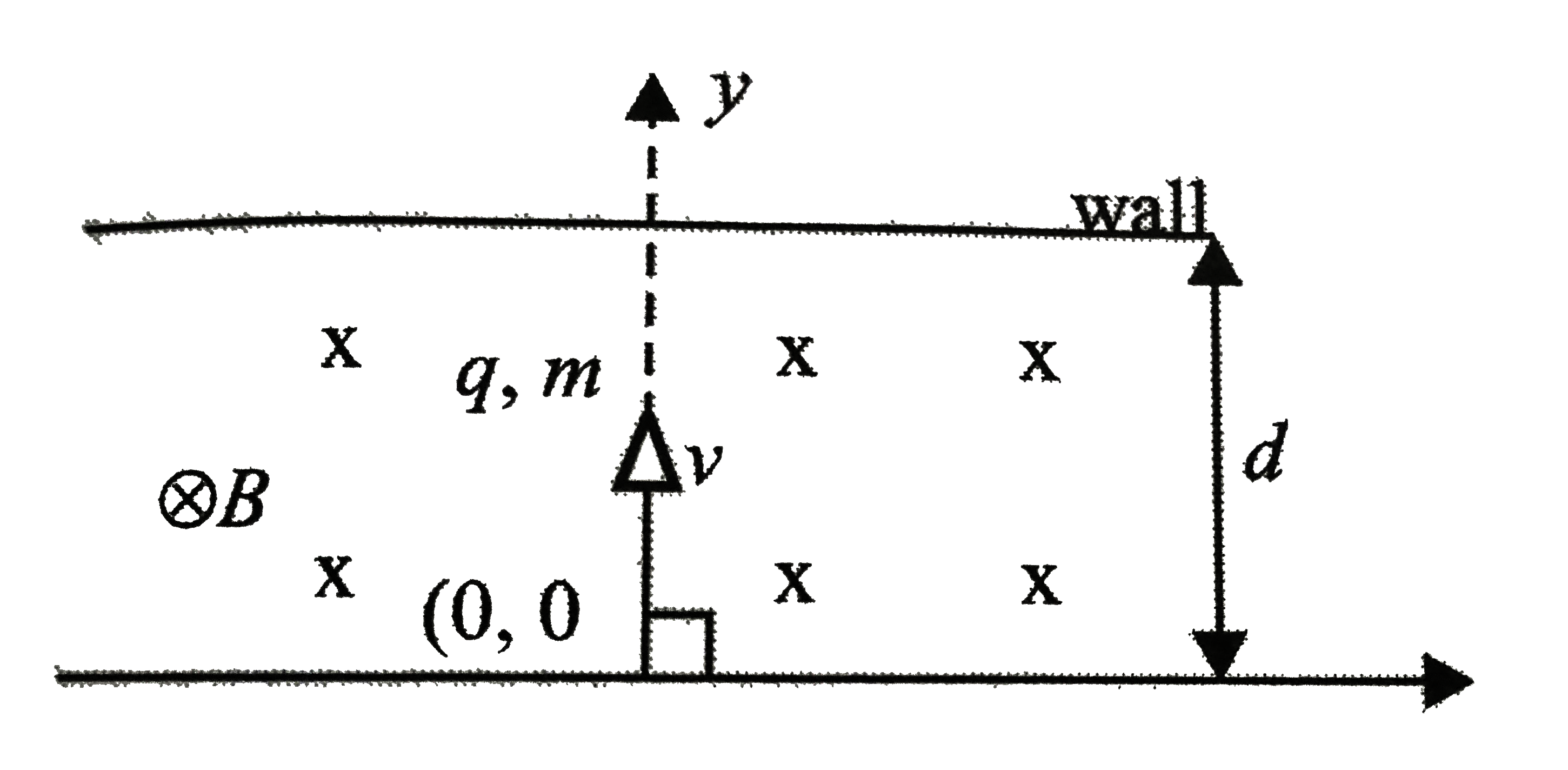
In Fig. what should be the speed of the charged particle so that it cannot collide with the upper wall? Also, find the coordinates of the point where the particle strikes the lower plate in the limiting case of velocity.

Text Solution

Verified by Experts
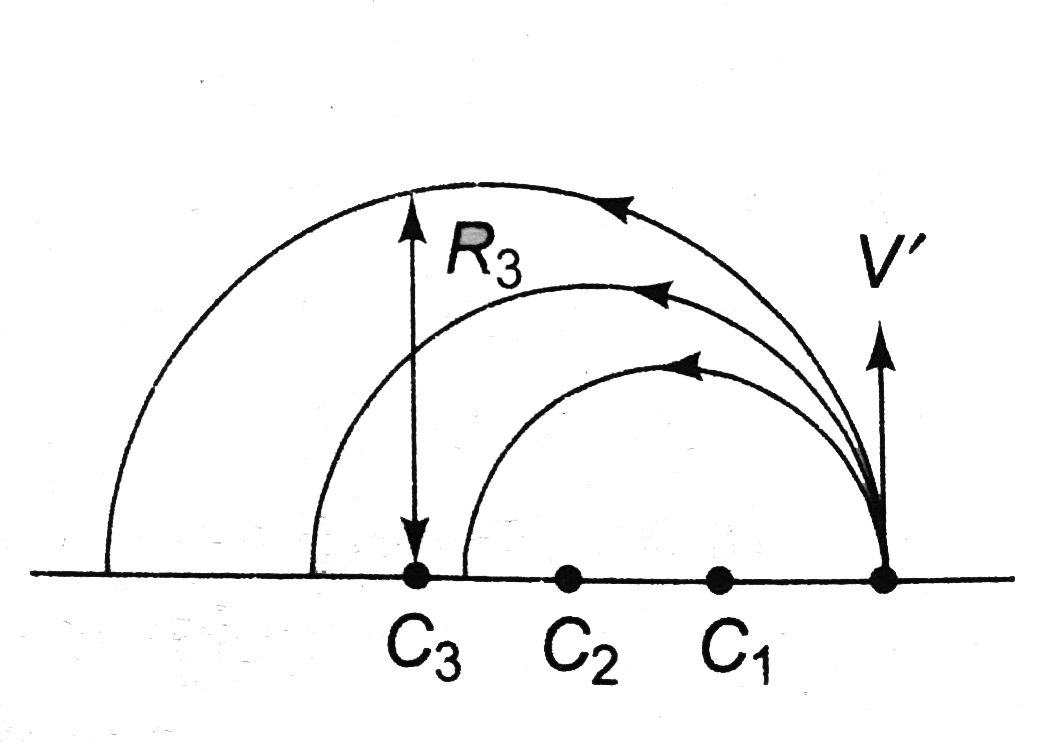
The path of the particle will be
circular, larger the velocity, larger
will be the radius.
For particle not to strike, `R lt d`
`:. (mv)/(qB)ltd implies vlt(qBd)/m`
For limiting case, `v=(qBd)/m, R=d`
`:.` Coordinate where the particle strikes `=(-2d,0,0)`

.
Promotional Banner

Topper's Solved these Questions

  • MAGNETIC FIELD AND MAGNETIC FORCES

    CENGAGE PHYSICS|Exercise Exercise 1.2|13 Videos
  • MAGNETIC FIELD AND MAGNETIC FORCES

    CENGAGE PHYSICS|Exercise Exercise1.3|14 Videos
  • MAGNETIC FIELD AND MAGNETIC FORCES

    CENGAGE PHYSICS|Exercise Solved Example|25 Videos
  • KINETIC THEORY

    CENGAGE PHYSICS|Exercise Question Bank|31 Videos
  • Magnetism and Matter

    CENGAGE PHYSICS|Exercise Question Bank|50 Videos

Similar Questions

Explore conceptually related problems

A particle of mass m and charge q is accelerated by a potential difference V volt and made to enter a magnetic field region at an angle theta with the field. At the same moment, another particle of same mass and charge is projected in the direction of the field from the same point. Magnetic field induction is B. What would be the speed of second particle so that both particles meet again and again after regular interval of time. Also, find the time interval after which they meet and the distance travelled by the second particle during that interval.

A particle is projected with a speed u at an angle theta to the horizontal. Find the radius of curvature. At the point where the particle is at a highest half of the maximum height H attained by it.

A charged particle is projected with a certain velocity between the plates with opposites charges. The magnetic field is also applied between the plates so that the particle moves undeflected and hits the plate A . The force experienced by the plate is F_(1) . Now if the particle is projected with double of the initial velocity with smaller conditions, the force experienced by the plate is F_(1)//F_(2) is :

A particles is projected horizontally with a speed v from the top of a plane inclined at an angle tehta to the horizontal as shown in the figure. (a) Hwo far from the point of projection will the particle strike the plane ? (b) Find the time taken by the particel to hit the plane. (c) What is the velocity of particle just before it hits the plane ?

A partacle is thrown in horizontal direction with speed u from a point P, the top of a tower shown in figure.1.49 at a vertical height h above the inclined plane of inclination theta . Find the speed with which the particle is thrown so that it strikes the plane normally. Also find the distance from the foot of the tower where the particle will strike.

In the figures shown, three particles are thrown from a tower of height 40 m as shown in figure. In each case find the time when the particles strike the ground and the distance of this point from foot of the tower. , , .

An electron is projected as shown with speed u . If electron just fails to strike the upper plate, find range. (distance from starting point at which electron strike the lower plate again). Consider only electric force.

Earth and moon centre distance is 'r'. From the mid point what should be the speed of the particle so that it can escape to infinity?

CENGAGE PHYSICS-MAGNETIC FIELD AND MAGNETIC FORCES-Exercise 1.1
  1. A positive charge particle of charge q and mass m enters into a unifor...

    Text Solution

    |

  2. Repeat above Question 3, if the charge is negative and the angle made ...

    Text Solution

    |

  3. A uniform mangetic field of strength B exists in a region of width d. ...

    Text Solution

    |

  4. In Fig. what should be the speed of the charged particle so that it ca...

    Text Solution

    |

  5. A charged particle enters a region which offers a resistance against i...

    Text Solution

    |

  6. An electron moves in a uniform magnetic field and follows a spiral pat...

    Text Solution

    |

  7. A charged particle moves in a gravity free space where an electric fie...

    Text Solution

    |

  8. A particle with charge -5.60 nC is moving in a uniform magnetic field ...

    Text Solution

    |

  9. A particle with charge 7.00 mu C is moving with velocity vec v =- (4xx...

    Text Solution

    |

  10. A particle with charge 6.40 xx 10^(-19) C travels in a circular orbit...

    Text Solution

    |

  11. Figure 1.31 shows the trace of the path of a charged particle in a bub...

    Text Solution

    |

  12. A particle of mass m and charge q is accelerated by a potential differ...

    Text Solution

    |

  13. A beam of equally charged particles after being accelerated through a ...

    Text Solution

    |

  14. A proton and an alpha particle are projected in a magnetic field which...

    Text Solution

    |

  15. A beam of singly ionized atoms of carbon (each charge +e) all have the...

    Text Solution

    |

  16. When a proton has a velocity vec v = (2hat i + 3 hat j) xx 10^6 ms^-1,...

    Text Solution

    |

  17. The force on a charged particle moving in a magnetic field can be comp...

    Text Solution

    |

  18. A particle of charge qgt0 is moving at speed v in the +z direction thr...

    Text Solution

    |

  19. Protons having a kinetic energy of 5 MeV are moving in the positive x-...

    Text Solution

    |

  20. Electrons in a beam are accelerated from rest through a potential diff...

    Text Solution

    |