Home
Class 12
PHYSICS
A beam of singly ionized atoms of carbon...

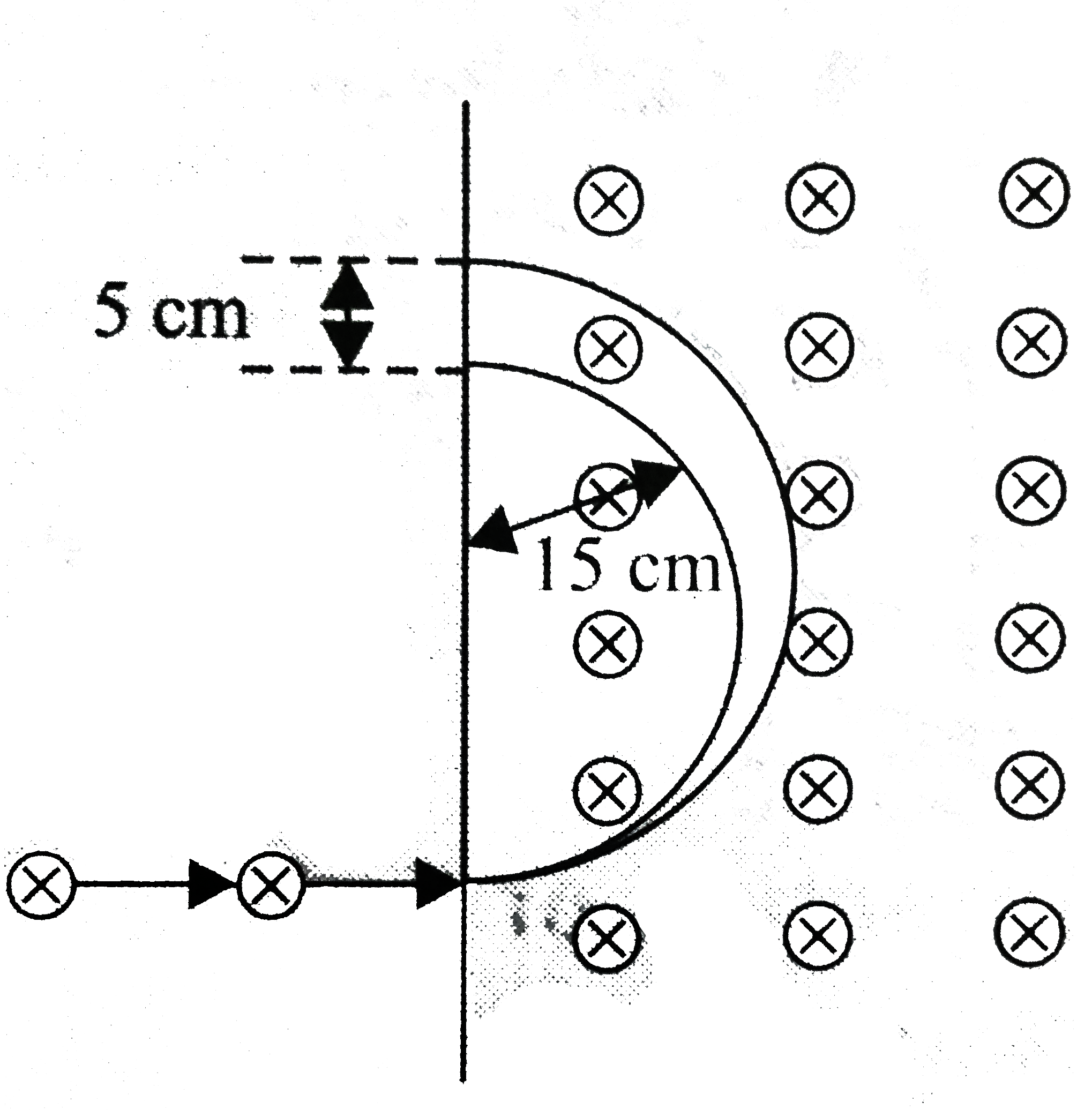
A beam of singly ionized atoms of carbon (each charge +e) all have the same speed enters a mass spectrometer, as shown in Fig. The ions strike the photographic plate in two different locations 5 cm apart. The `._12C_6` isotope traces a path of smaller radius, `15.0 cm`. What is the atomic mass number of other isotope ?
.

Text Solution

Verified by Experts

Let `R_1` be the radius of trajectory of the isotop `.^12C_6` and `R_2` that of the unknown isotope. The trajectory of the unknown isotope has a greater radius, and so the mass of the unknown isotop is greater than that of the `.^12C_6` isotop. From the figure provided in the question,
`d=2r=(2mv)/(qB)implies m prop d`
`(mA_2)/(mA_1)=(d_2)/(d_1)=(A_2)/12=35/30 implies A_2=14`
Thus, the unknown isotope is `.^14C_6`
Promotional Banner

Topper's Solved these Questions

  • MAGNETIC FIELD AND MAGNETIC FORCES

    CENGAGE PHYSICS|Exercise Exercise 1.2|13 Videos
  • MAGNETIC FIELD AND MAGNETIC FORCES

    CENGAGE PHYSICS|Exercise Exercise1.3|14 Videos
  • MAGNETIC FIELD AND MAGNETIC FORCES

    CENGAGE PHYSICS|Exercise Solved Example|25 Videos
  • KINETIC THEORY

    CENGAGE PHYSICS|Exercise Question Bank|31 Videos
  • Magnetism and Matter

    CENGAGE PHYSICS|Exercise Question Bank|50 Videos

Similar Questions

Explore conceptually related problems

In the game of billiards, all the balls have approximately the same mass, about 0.17 kg. In the figure, the cue ball strikes another ball such that it follows the path shown. The other ball has a speed of 1.5 m/s immediately after the collision. What is the speed of the cue ball after the collision?

The existence of negatively charged particle in an atom was shown by J.J. Thomson as a result of the studies of the passage of electricity through gases at extremely low pressure known as discharge tube experiments. When a high voltage of the order of 10,000 volts or more was impressed across the electrodes, some sort of invisible rays moved from the negative electrode to the positive electrode these rays are called as cathode rays. Cathode rays travel in straight path in absence of electrical and magnetic field . Cathode rays consist of material part and charged particles? Cathode rays produce X-rays and light is emitted when they strike on ZnS screen. Cathode rays penetrate through thin sheets of aluminium and other metals . They affect the photogenic plate and passes heating effect when they strike on metal foil. The raito of charge to mass i.e charge/mass is same for all the cathode rays irrespective of the gas used in the tube. The existence of positively charged particle in an atom was shown be E. Goldstein. He repeated the same discharge tube experiments by using a perforated cathode. It was observed that when a high potential difference was applied between the electrodes, not only cathode rays were produced but also a new type of rays were produced simultaneoulsy from anode moving towards cathode and passes through the holes or canal of the cathode. These termed as canal rays or anode rays. These rays travel in straight lines and consists of positively charged particles. These rays have kinetic energy and produces heating effect also. The e/m ratio of these rays is smaller than that of electrons. Unlike cathode rays, their e/m value is dependent upon the nature of the gas taken in the tube. These rays produced flashes of light on ZnS screen and can pass throughs thin metal foils. They can produce physical and chemical changes and are capable to produce ionisation in gases. For cathode rays the value of e/m:

The existence of negatively charged particle in an atom was shown by J.J. Thomson as a result of the studies of the passage of electricity through gases at extremely low pressure known as discharge tube experiments. When a high voltage of the order of 10,000 volts or more was impressed across the electrodes, some sort of invisible rays moved from the negative electrode to the positive electrode these rays are called as cathode rays. Cathode rays travel in straight path in absence of electrical and magnetic field . Cathode rays consist of material part and charged particles? Cathode rays produce X-rays and light is emitted when they strike on ZnS screen. Cathode rays penetrate through thin sheets of aluminium and other metals . They affect the photogenic plate and passes heating effect when they strike on metal foil. The raito of charge to mass i.e charge/mass is same for all the cathode rays irrespective of the gas used in the tube. The existence of positively charged particle in an atom was shown be E. Goldstein. He repeated the same discharge tube experiments by using a perforated cathode. It was observed that when a high potential difference was applied between the electrodes, not only cathode rays were produced but also a new type of rays were produced simultaneoulsy from anode moving towards cathode and passes through the holes or canal of the cathode. These termed as canal rays or anode rays. These rays travel in straight lines and consists of positively charged particles. These rays have kinetic energy and produces heating effect also. The e/m ratio of these rays is smaller than that of electrons. Unlike cathode rays, their e/m value is dependent upon the nature of the gas taken in the tube. These rays produced flashes of light on ZnS screen and can pass throughs thin metal foils. They can produce physical and chemical changes and are capable to produce ionisation in gases. Select the incorrect statement.

The existence of negatively charged particle in an atom was shown by J.J. Thomson as a result of the studies of the passage of electricity through gases at extremely low pressure known as discharge tube experiments. When a high voltage of the order of 10,000 volts or more was impressed across the electrodes, some sort of invisible rays moved from the negative electrode to the positive electrode these rays are called as cathode rays. Cathode rays travel in straight path in absence of electrical and magnetic field . Cathode rays consist of material part and charged particles? Cathode rays produce X-rays and light is emitted when they strike on ZnS screen. Cathode rays penetrate through thin sheets of aluminium and other metals . They affect the photogenic plate and passes heating effect when they strike on metal foil. The raito of charge to mass i.e charge/mass is same for all the cathode rays irrespective of the gas used in the tube. The existence of positively charged particle in an atom was shown be E. Goldstein. He repeated the same discharge tube experiments by using a perforated cathode. It was observed that when a high potential difference was applied between the electrodes, not only cathode rays were produced but also a new type of rays were produced simultaneoulsy from anode moving towards cathode and passes through the holes or canal of the cathode. These termed as canal rays or anode rays. These rays travel in straight lines and consists of positively charged particles. These rays have kinetic energy and produces heating effect also. The e/m ratio of these rays is smaller than that of electrons. Unlike cathode rays, their e/m value is dependent upon the nature of the gas taken in the tube. These rays produced flashes of light on ZnS screen and can pass throughs thin metal foils. They can produce physical and chemical changes and are capable to produce ionisation in gases. Which is not true with respect to cathode rays?

In a helium dilution refrigerator .^(3)He and .^(4)He are mixed in a special chamber to obtain extremely low temperature. A Bainbridge mass spectrometer is used to measure the ratio of the two isotopes (a) If the spectrometer were used with 100 V cm^(-1) between the plates and a magnetic field of 0.2 T, what would be the speed of an ion that can pass through the velocity filter? (b) If the velocity-filter exit slit were 1 mm wide, could this machine resolve the two isotopes ?

CENGAGE PHYSICS-MAGNETIC FIELD AND MAGNETIC FORCES-Exercise 1.1
  1. A positive charge particle of charge q and mass m enters into a unifor...

    Text Solution

    |

  2. Repeat above Question 3, if the charge is negative and the angle made ...

    Text Solution

    |

  3. A uniform mangetic field of strength B exists in a region of width d. ...

    Text Solution

    |

  4. In Fig. what should be the speed of the charged particle so that it ca...

    Text Solution

    |

  5. A charged particle enters a region which offers a resistance against i...

    Text Solution

    |

  6. An electron moves in a uniform magnetic field and follows a spiral pat...

    Text Solution

    |

  7. A charged particle moves in a gravity free space where an electric fie...

    Text Solution

    |

  8. A particle with charge -5.60 nC is moving in a uniform magnetic field ...

    Text Solution

    |

  9. A particle with charge 7.00 mu C is moving with velocity vec v =- (4xx...

    Text Solution

    |

  10. A particle with charge 6.40 xx 10^(-19) C travels in a circular orbit...

    Text Solution

    |

  11. Figure 1.31 shows the trace of the path of a charged particle in a bub...

    Text Solution

    |

  12. A particle of mass m and charge q is accelerated by a potential differ...

    Text Solution

    |

  13. A beam of equally charged particles after being accelerated through a ...

    Text Solution

    |

  14. A proton and an alpha particle are projected in a magnetic field which...

    Text Solution

    |

  15. A beam of singly ionized atoms of carbon (each charge +e) all have the...

    Text Solution

    |

  16. When a proton has a velocity vec v = (2hat i + 3 hat j) xx 10^6 ms^-1,...

    Text Solution

    |

  17. The force on a charged particle moving in a magnetic field can be comp...

    Text Solution

    |

  18. A particle of charge qgt0 is moving at speed v in the +z direction thr...

    Text Solution

    |

  19. Protons having a kinetic energy of 5 MeV are moving in the positive x-...

    Text Solution

    |

  20. Electrons in a beam are accelerated from rest through a potential diff...

    Text Solution

    |

