Home
Class 12
PHYSICS
A metal wire PQ of mass 10g lies at rest...

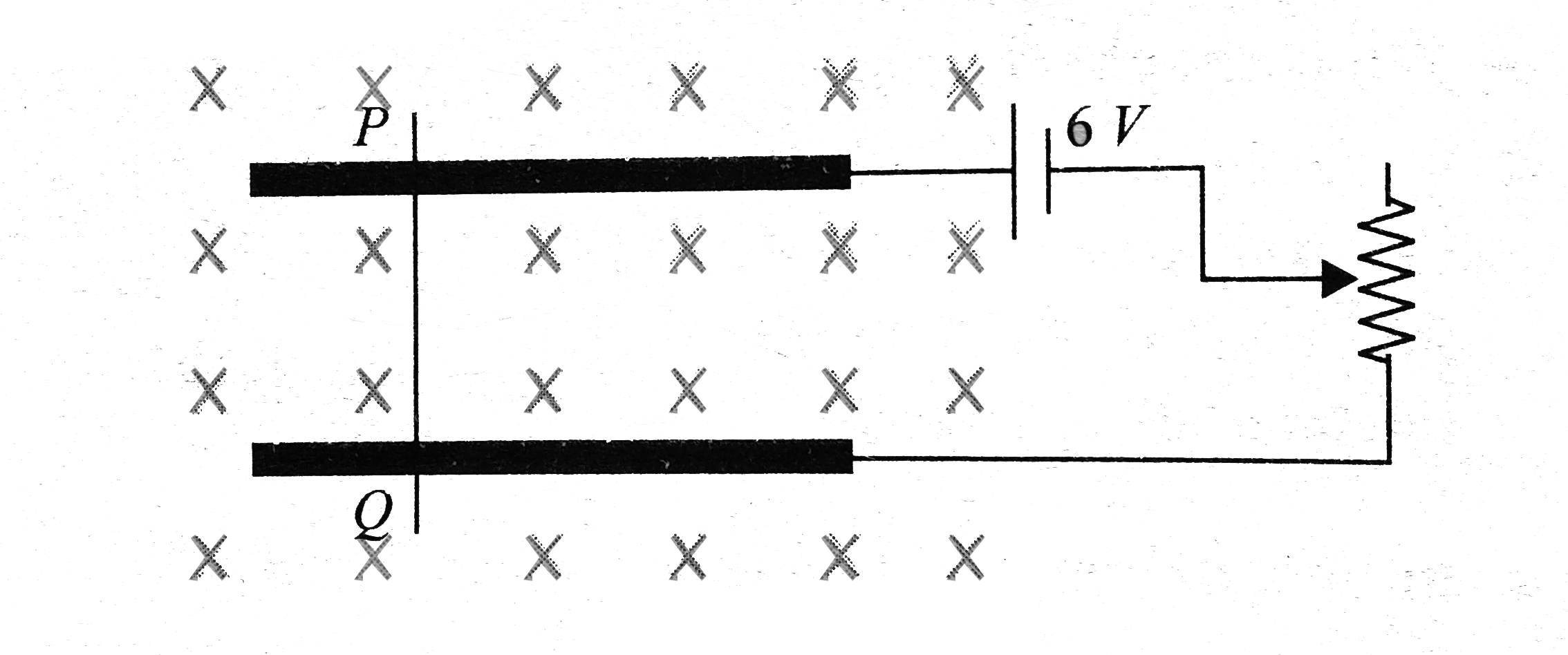
A metal wire PQ of mass 10g lies at rest on two horizontal metal rails separated by 5cm as shown in Fig. A vertically downward magnetic field of magnitude 0.80T exist in the space. The resistance of the circuit is slowly decreased and it is found that when the resistance goes below `20.0Omega` the wire PQ starts sliding on the rails. The coefficient of friction between wires and rails is found. The coefficient of friction between wires and rails is found to be `n//25`. find n

Text Solution

Verified by Experts

The correct Answer is:

3

`Ibl=mumg`
`implies 6/20xx0.8xx5/100=mu10/1000(10)`
`implies mu=0.12=3//25`
Promotional Banner

Topper's Solved these Questions

  • MAGNETIC FIELD AND MAGNETIC FORCES

    CENGAGE PHYSICS|Exercise Archives Fill In The Blank|6 Videos
  • MAGNETIC FIELD AND MAGNETIC FORCES

    CENGAGE PHYSICS|Exercise Archives True /false|4 Videos
  • MAGNETIC FIELD AND MAGNETIC FORCES

    CENGAGE PHYSICS|Exercise Exercises Linked Comprehension|28 Videos
  • KINETIC THEORY

    CENGAGE PHYSICS|Exercise Question Bank|31 Videos
  • Magnetism and Matter

    CENGAGE PHYSICS|Exercise Question Bank|50 Videos

Similar Questions

Explore conceptually related problems

A matel wire PQ of mass 10g lies at rest on two horizontal metal rails separated by 4.90 cm . A vertically downward magnetic field of magnitude 0.800 T exists in the space. The resistance of the circuit is slowly decreased and it is found that when the resistance goes below 20.0 Omega , the wire PQ starts sliding on the rails. Find the coefficient of friction.

A metal wire PQ of mass 10 gm lies on two horizontal metal rails separated by 4.90 cm (figure).A vertically downward magnetic field of magnitude 0.800 T exists in the space.The resistance of the circuit is slowly decreased and it is found that when the resistance goes below 20.0 Omega the wire PQ starts sliding on the rails.Find the coefficient of friction.Neglect magnetic force acting on wire PQ due to metal rails (g=9.8 m//g^(2))

A metal wire of mass m slides without friction on two horizontal rails spaced distance d-apart as shown in figure. The rails are situated in a uniform magnetic field B, directed vertically upwards, and a battery is sending a current I through them. Find the velocity of the wire as a function of time, assuming it to be at rest initially.

A conducting wire ab of length l resistance r and mass m starts sliding down at t=0 on a smooth, vertical thick pair of connected rails as shown. The terminal speed of the wire is

A conducting wire xy of lentgh l and mass m is sliding without friction on vertical conduction rails ab and cd as shown in figure. A uniform magnetic field B exists perpendicular to the plane of the rails, x moves with a constant velocity of

A semicircular wire of radius 5.0 cm carries a current of 5.0 A. A magnetic field B of magnitude 0.50 T exists along the perpendicular to the plane of the wire. Find the magnitude of the magnetic force acting on the wire.

A uniform wire of mass m and length I can freely slide on a pair of parallel, frictionless, horizontal rails placed in a vertical constant magnetic field B (as shown in figure ). The rails are connected by a capacitor of capacitance C. The electric resistance of the circuit is zero. A constant horizontal force F acts on the middle point of wire begining t = 0 ,and the wire is at rest t = 0. At t= 0 , acceleration of wire is

A metallic rod of mass m and resistance R is sliding over the 2 conducting frictionless rails as shown in Fig. An infinitely long wire carries a current I_(0) . The distance of the rails from the wire are b and a respectively. Find the value of F if the rod slides with constant velocity
