Home
Class 12
PHYSICS
A conducting rod of length l slides at c...

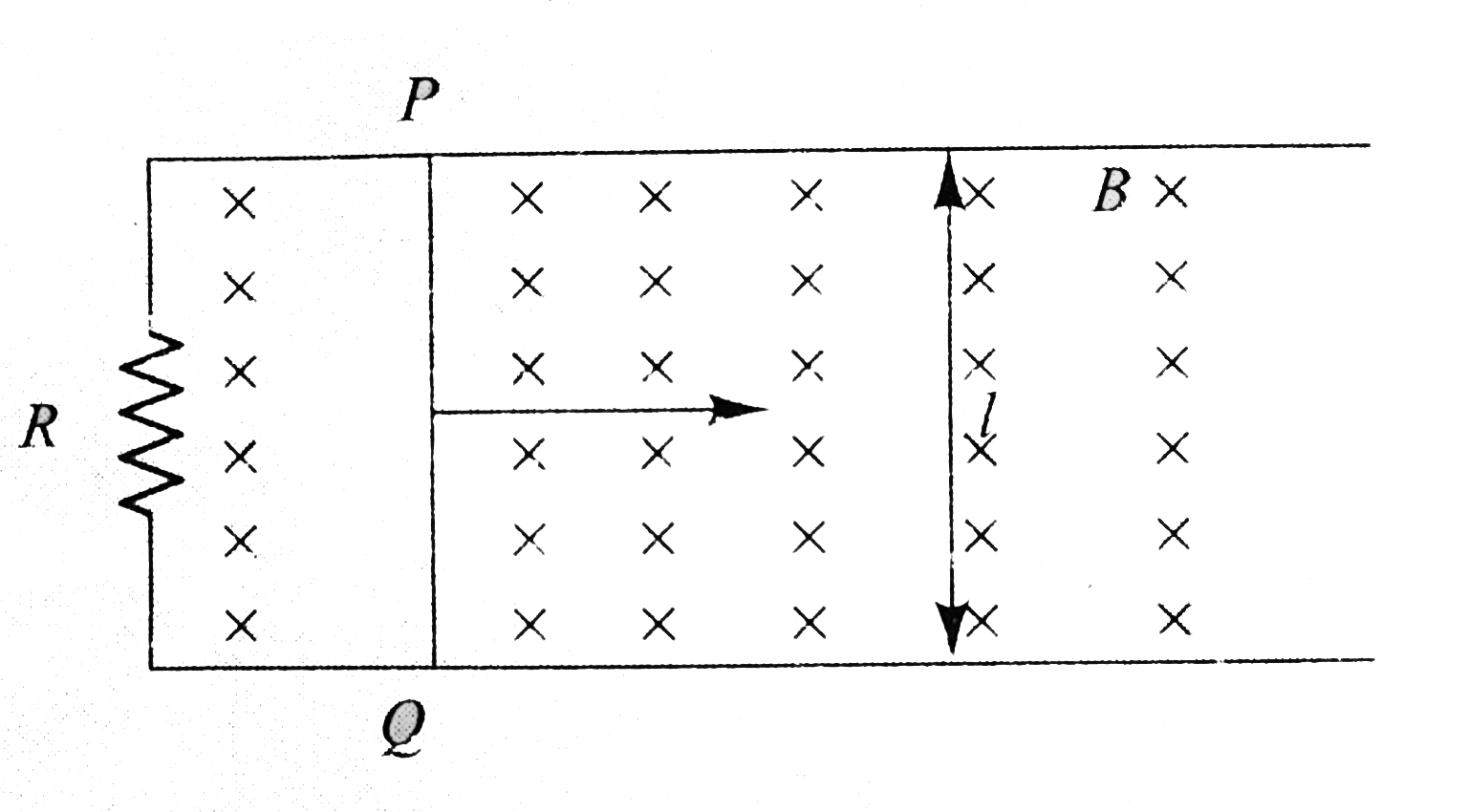
A conducting rod of length `l` slides at constant velocity `v` on two parallel conducting rails, placed in a uniform and constant magnetic field `B` perpendicular to the plane of the rails as shown in Fig.3.49. A resistance `R` is connected between the two ends of the rails.

(a) Idenify the cause which produces change in magnetic flux.
(b) Identify the direction of current in the loop.
( c) Determine the emf induced in the loop.
(d) Compute the electric power dissipated in the resistor.
(e) Calcualte the mechenical power required to pull the rod at a cinstant velovity.

Text Solution

Verified by Experts
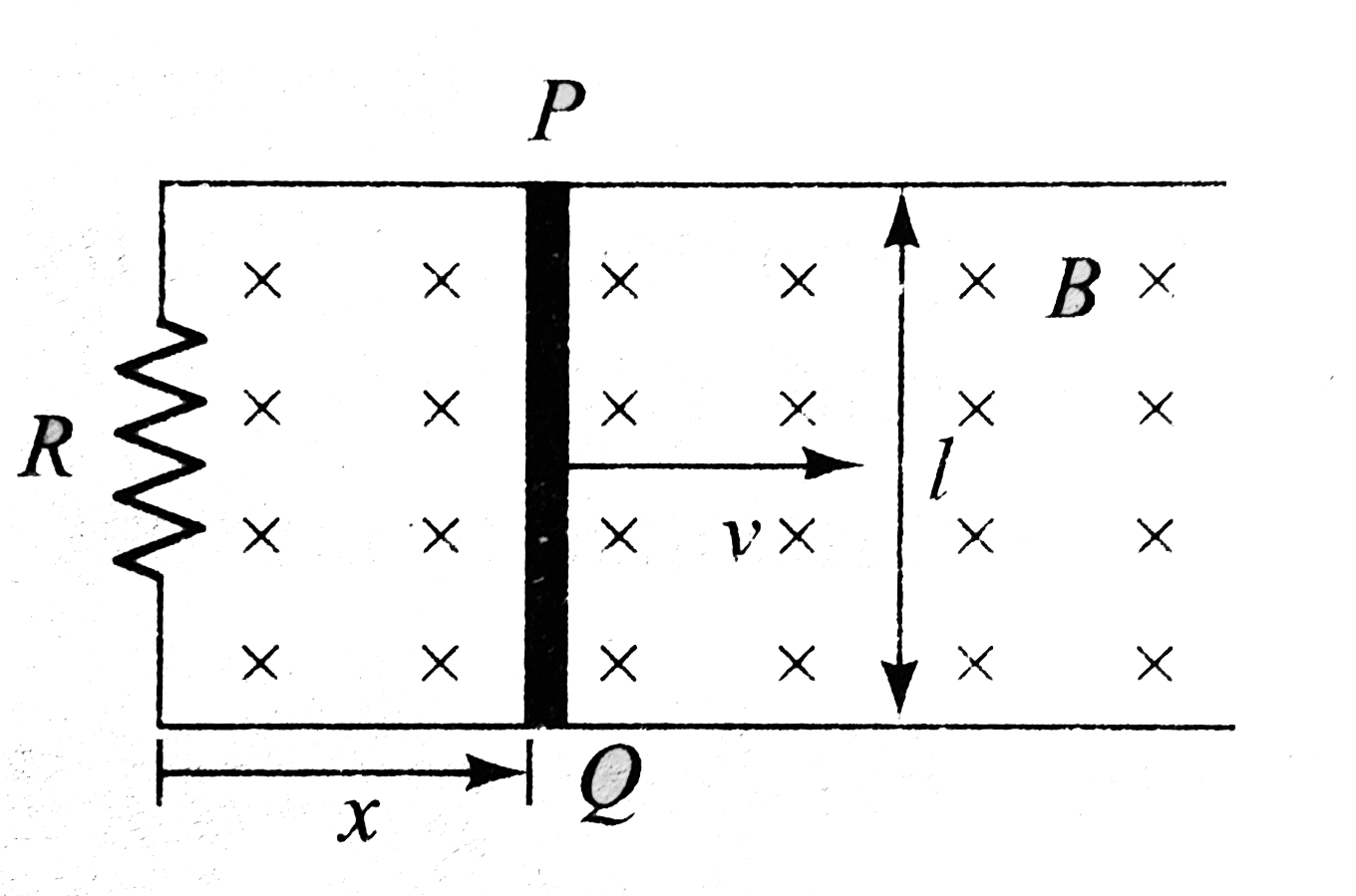
(a) The change in area produces the magnetic flux.
(b) The direction of current in the loop is aniclockwise. As the rod moves toward right, the number of crosses in the loop increases with time and to oppose the increasing number of crosses in the loop, the current in the loop must be anticlockwise.

( c) According to Faraday's law
`|epsilon| = (dphi_(B))/(dt) = (d)/(dt)(Blx) = Bl(dx)/(dt) = Blv`.
(d) The magnitude of current is `I = (epsilon)/(R) = (Blv)/R`.
The electric power dissipated in the resistor is
`P_(ele) = I^(2)R = (B^(2)l^(2)v^(2))/(R)`
(e) The mechenical power is `P_(mech) = F_(ext)v`.
The external force is equal and opposite to Ampere's force:
`F_(ext) = -F_(Ampere)`
Ampere's force is given by
`F_(Ampere) = intIdvec(l) xx B` or `F_(Ampere) = BIl`
Now, `P_(mech) = (BIl)v`.
Substituting the value of `I`, we get `P_(mech) = (B^(2)l^(2)v^(2))/(R)`.
We see that machanicale power is same as electric power. it means mechanical power supplied to the rod is dissipated in the form of heat through resistor.
Promotional Banner

Topper's Solved these Questions

  • ELECTROMAGNETIC INDUCTION

    CENGAGE PHYSICS|Exercise Solved Example|5 Videos
  • ELECTROMAGNETIC INDUCTION

    CENGAGE PHYSICS|Exercise Exercise 3.1|15 Videos
  • ELECTROMAGENTIC INDUCTION

    CENGAGE PHYSICS|Exercise QUESTION BANK|40 Videos
  • ELECTRON,PHONTS,PHOTOELECTRIC EFFECT & X-RAYS

    CENGAGE PHYSICS|Exercise dpp 3.3|15 Videos

Similar Questions

Explore conceptually related problems

A conducting rod of length is moved at constant velocity v_(0) on two parallel, conducting, smooth, fixed rails, that are placed in a uniform constant magnetic field B perpendicular to the plane for the rails as shown in Fig. A resistance R is connected between the two ends of the rails. Then which of the following is/are correct:

A conducting wire xy of lentgh l and mass m is sliding without friction on vertical conduction rails ab and cd as shown in figure. A uniform magnetic field B exists perpendicular to the plane of the rails, x moves with a constant velocity of

Figure shows a wire sliding on two parallel, conducting rails placed at a separation L . A magnetic field B exists in a direction perpendicular to the plane of the rails. What force is necessary to keep the wire moving at a constant velocity V ?

A constant force is being applied on a road of length 'l' kept at rest on two parallel conducting rails connected at ends by resistance R in uniform magnitic field B shown.

A small conducting rod of length l, moves with a uniform velocity v in a uniform magnetic field B as shown in fig __

Figure shows a wire of resistance R sliding on two parallel, conducting fixed thick rails placed at a separation l. A magnetic fild B exist in a direction perpendicular to the plane of the rails. The wire is moving with a constant velocity v. Find current through the wire

Consider parallel conducting rails separated by a distance l. There exists a uniform magnetic field B perpendicular to the plane of the rails as shown in Fig. Two conducting wires each of length l are placed so as to slide on parallel conducting rails. One of the wires is given a velocity v_(0) parallel to the rails. Till steady state is achieved, loss in kinetic energy of the system is

Two idential conductors P and Q are placed on two frictionless rails R and S in a uniform magnetic field directed into the plane. If P is moved in the direction shown in figure with a constant speed, then rod Q

A conducting bar mass m and length l moves on two frictionless parallel conducting rails in the presence of a uniform magnetic field B_(0) directed into the paper. The bar is given an initial velocity v_(0) to the right and is released at t = 0 . The velocity of the bar as a function of time is given by

