Home
Class 12
PHYSICS
A thin non-conducting ring of mass m car...

A thin non-conducting ring of mass `m` carrying a charge `q` can freely rotate about its axis. At `t = 0`, the ring was at rest and no magnetic field was present. Then suddenly a magnetic field `B` was set perpendicular to the plane. Find the angular velocity acquired by the ring.

Text Solution

Verified by Experts
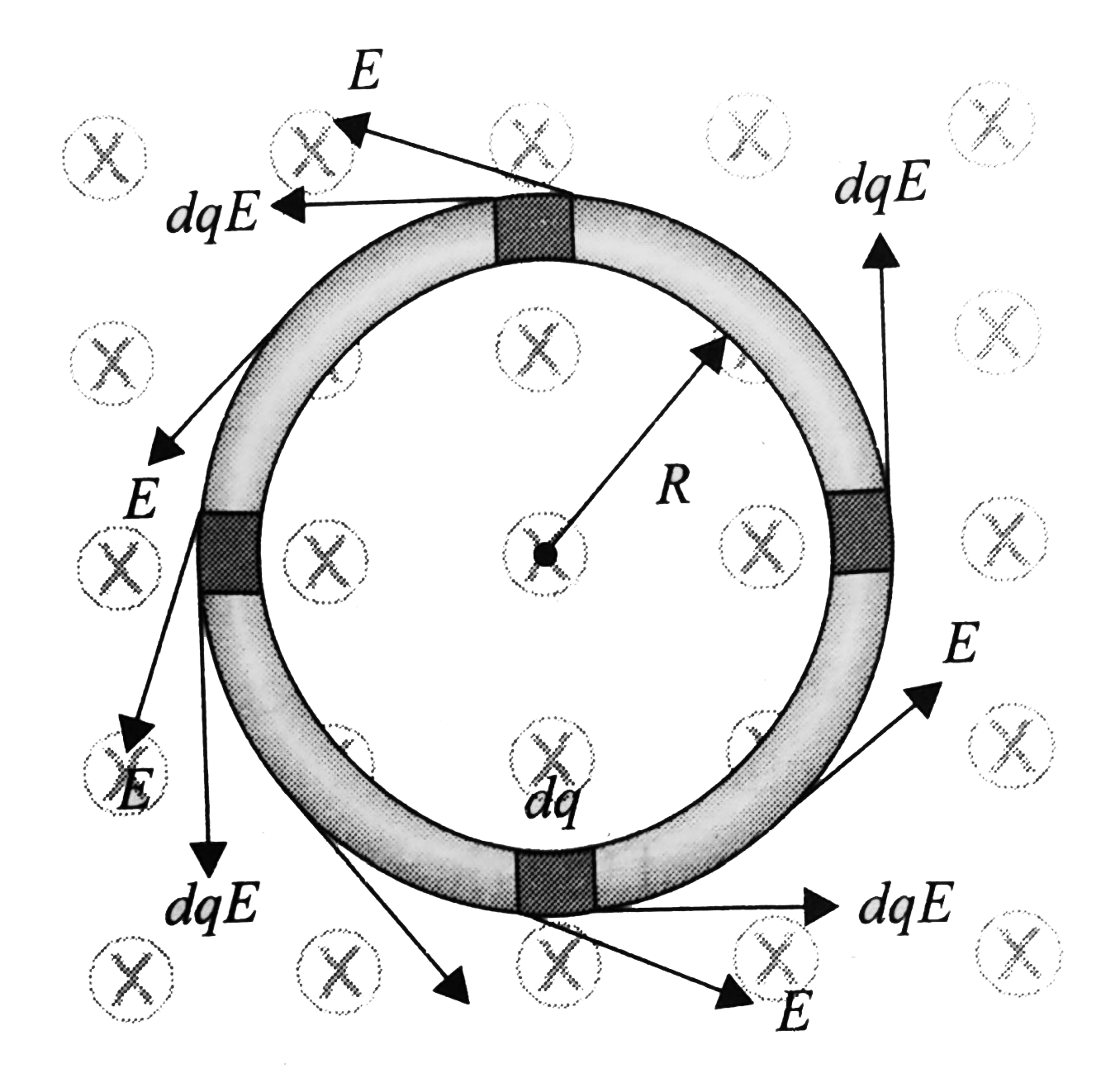
Due to the sudden chrage in flux, an electirc field is set up and the ring experiences an impulsive torque and suddenly acquires an angular velocity.
`E = (r )/(2)(dB)/(dt)`

Force experiences by an element of ring `dF = dqE`
Torque experiences by this element of ring `dtau = dFr = dq Er`
Total torque experienced by ring: `tau = qEr`
angular impulse experienced
`L = int tau dt = (qr^(2))/(2) int(dB)/(dt)dt = (qr^(2))/(2)B`
`L = Iomega` `rarr` `mr^(2)omega = (qr^(2))/(2)B` `rarr` `omega = (qB)/(2m)`
Promotional Banner

Topper's Solved these Questions

  • ELECTROMAGNETIC INDUCTION

    CENGAGE PHYSICS|Exercise Solved Example|5 Videos
  • ELECTROMAGNETIC INDUCTION

    CENGAGE PHYSICS|Exercise Exercise 3.1|15 Videos
  • ELECTROMAGENTIC INDUCTION

    CENGAGE PHYSICS|Exercise QUESTION BANK|40 Videos
  • ELECTRON,PHONTS,PHOTOELECTRIC EFFECT & X-RAYS

    CENGAGE PHYSICS|Exercise dpp 3.3|15 Videos

Similar Questions

Explore conceptually related problems

A thin non-conducting ring of mass m carrying a charge q can freely rotate about its axis. At the initial moment, the ring was at rest and no magnetic field was present. Then a uniform magnetic field was switched on, which was perpendicular to the plane of the ring and increased with time according to a certain law: (dB)/(dt) = k . Find the angular velocity omega of the ring as a function of k .

A thin non-conducting ring of mass m carrying a charge q can freely rotate about its axis. At the initial moment the ring was at rest and no magnetic field was present. Then a practically unifrom magnetic field was switched on, which was perpendicular to the planeof the ring and increased with time according to a certain law B (t) , Find the angluar velocity omega of the ring as a function of the induction B(t) .

A thin non-conducting ring mass m , radius a , carrying a charge q can rotate freely about its own axis which is vertical. At the initial moment the ring was at rest and no magnetic field was present. At instant t = 0 , a uniform magnetic field is switched on which is vertically downwards and increase with time according to the law B = B_(0)t . Neglecting magnetism induced due to totational motion of the ring. Now answer the following questions. The power developed by the forces acting on the ring, as a function of time :

A thin non-conducting ring mass m , radius a , carrying a charge q can rotate freely about its own axis which is vertical. At the initial moment the ring was at rest and no magnetic field was present. At instant t = 0 , a uniform magnetic field is switched on which is vertically downwards and increase with time according to the law B = B_(0)t . Neglecting magnetism induced due to totational motion of the ring. Now answer the following questions. The angular acceleration of the ring and its direction of rotation as seen from above: if E is induced e.m.f

A thin non conducting ring of mass m , radius a carrying a charge q can rotate freely about its own axis which is vertical. At the initial moment, the ring was at rest in horizontal position and no magnetic field was present. At instant t=0 , a uniform magnetic field is switched on which is vertically downward and increases with time according to the law B=B_0t . Neglecting magnetism induced due to rotational motion of ring. Angular acceleration of ring is

A thin non conducting ring of mass m , radius a carrying a charge q can rotate freely about its own axis which is vertical. At the initial moment, the ring was at rest in horizontal position and no magnetic field was present. At instant t=0 , a uniform magnetic field is switched on which is vertically downward and increases with time according to the law B=B_0t . Neglecting magnetism induced due to rotational motion of ring. Find intantaneous power developed by electric force acting on the ring at t=1 s

A thin non conducting ring of mass m , radius a carrying a charge q can rotate freely about its own axis which is vertical. At the initial moment, the ring was at rest in horizontal position and no magnetic field was present. At instant t=0 , a uniform magnetic field is switched on which is vertically downward and increases with time according to the law B=B_0t . Neglecting magnetism induced due to rotational motion of ring. The magnitude of an electric field on the circumference of the ring is

A thin non conducting ring of mass m , radius a carrying a charge q can rotate freely about its own axis which is vertical. At the initial moment, the ring was at rest in horizontal position and no magnetic field was present. At instant t=0 , a uniform magnetic field is switched on which is vertically downward and increases with time according to the law B=B_0t . Neglecting magnetism induced due to rotational motion of ring. The magnitude of induced emf of the closed surface of ring will be

A ring of mass m, radius r having charge q uniformly distributed over it and free to rotate about its own axis is placed in a region having a magnetic field B parallel to its axis. If the magnetic field is suddenly switched off, the angular velocity acquired by the ring is:

A thin non conducting horizontal disc of mass m having total charge q distributed uniformly over its surface, can rotate freely about its own axis. Initially when the disc is stationery a magnetic field B directed perpendicular to the plane is switched on at t=0 . Find the angular velocity omega acquired by disc as a function of time, if B=kt , where t is time.

