Home
Class 12
PHYSICS
CDEF is a fixed conducting smooth frame ...

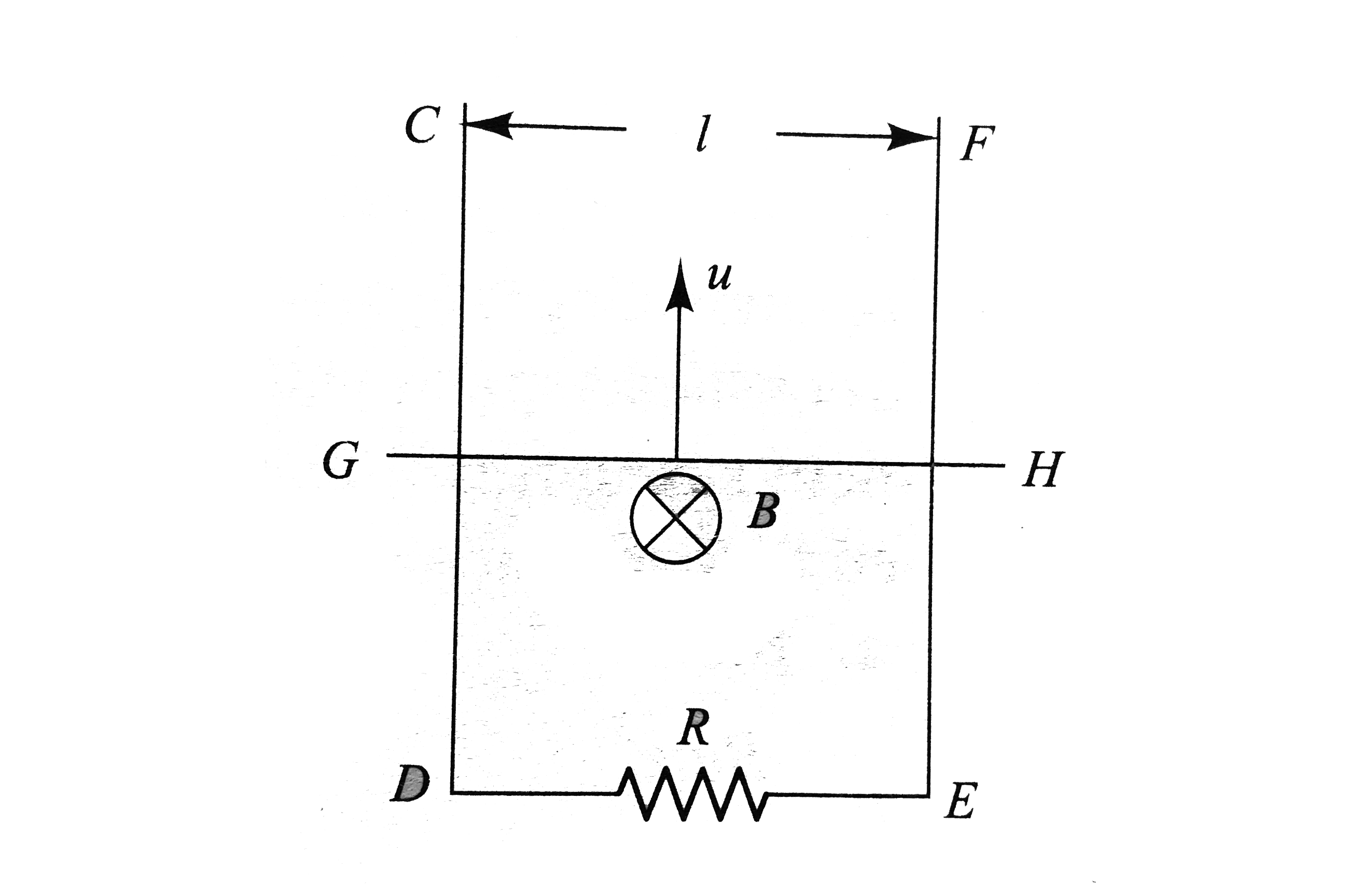
`CDEF` is a fixed conducting smooth frame in vertical plane. A conducting uniform rod `GH` of mass `m` can move vertically and smoothly without losing contact with the frame. `Gh` always remains horizontal and is given velocity `u` upward and released. Taking the acceleration due to gravity as `g` and present other than `R`. Find out the time tasken by the rod to reach the highest point.

Text Solution

Verified by Experts

The correct Answer is:
`(mR)/(B^(2)l^(2))1n((mgR + B^(2)l^(2)u)/(mg R))`

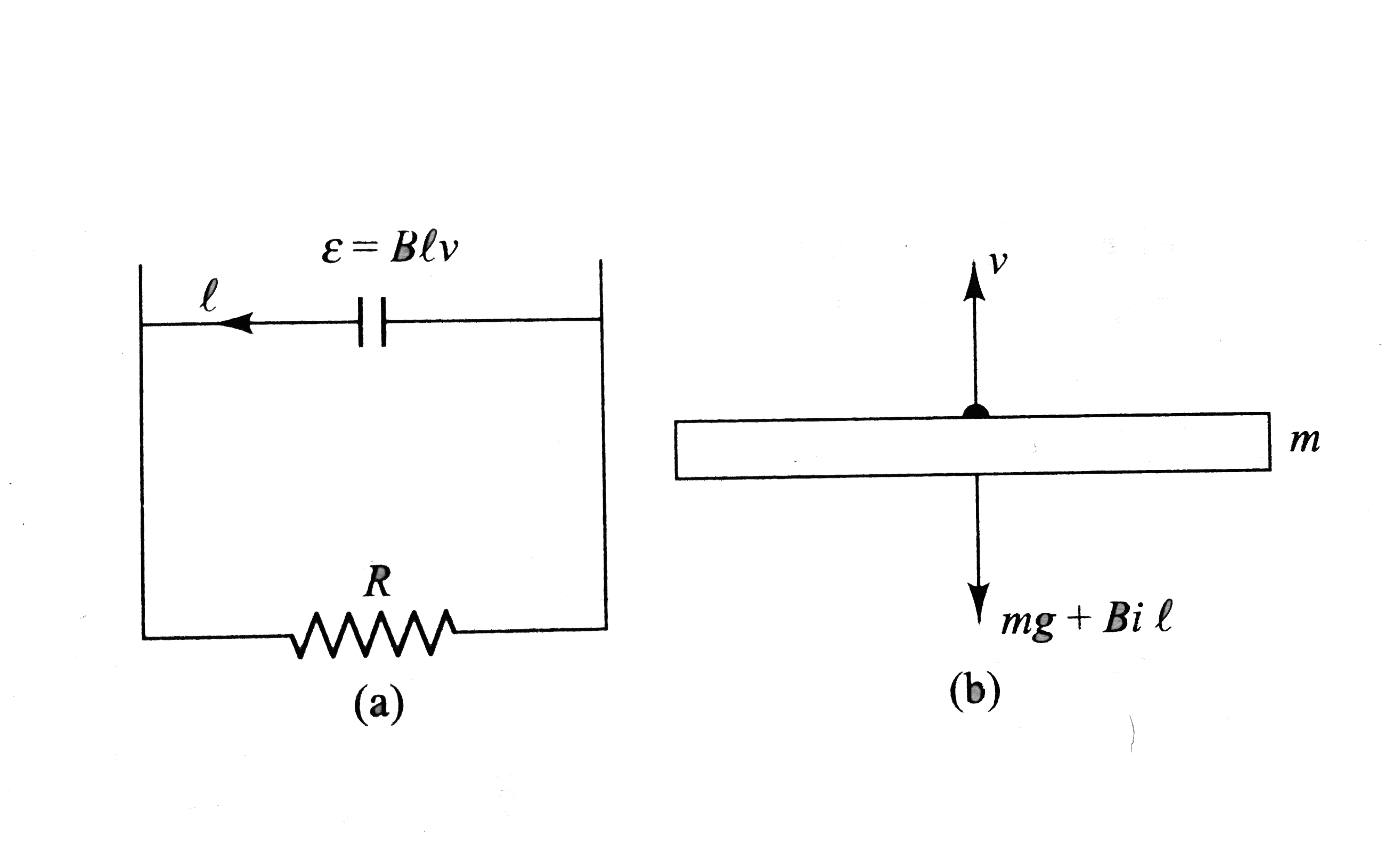
Let `v` be the speed of the rod at any time. Then the equivalent and free body diagrams of rod are shown in . Applying Newton's second law to the rod,
,
`(mdv)/(dt) = -(mg + Bil)`
where `i = (Blv)/(R)`
From equation (i) and (ii)
`(mdv)/(dt) = -(mg + (B^(2)l^(2)v^(2))/(R))`
Integrating over proper limits we get,
`int_(u)^(0)(mdv)/(mg + (B^(2)l^(2)v)/(R)) = int_(0)^(t)-dt`
`rarr` `t = (mR)/(B^(2)l^(2))1n((mgR + B^(2)l^(2)u)/(mgR))`
Promotional Banner

Topper's Solved these Questions

  • ELECTROMAGNETIC INDUCTION

    CENGAGE PHYSICS|Exercise Exercises Single Correct|79 Videos
  • ELECTROMAGNETIC INDUCTION

    CENGAGE PHYSICS|Exercise Exercises Multiple Correct|23 Videos
  • ELECTROMAGNETIC INDUCTION

    CENGAGE PHYSICS|Exercise Exercise 3.2|27 Videos
  • ELECTROMAGENTIC INDUCTION

    CENGAGE PHYSICS|Exercise QUESTION BANK|40 Videos
  • ELECTRON,PHONTS,PHOTOELECTRIC EFFECT & X-RAYS

    CENGAGE PHYSICS|Exercise dpp 3.3|15 Videos

Similar Questions

Explore conceptually related problems

In the figure, CDEF is a fixed conducting smooth frame in vertical plane.A conducting uniform rod GH of mass m=1 g can move vertically and smoothly without losing contact with the frame. GH always remains horizontal.It is given velocity u=1m//s upwards and released.Taking the acceleration due to gravity as g and assuming that no resistance is present other than R .Time taken by rod to reach the highest point is equal to (ln10)/x second.Find out value of x .

A uniform rod of mass M and length L is hinged at its lower end on a table. The rod can rotate freely in vertical plane and there is no friction at the hinge. A ball of mass M and radius R = (L)/(3) is placed in contact with the vertical rod and a horizontal force F is applied at the upper end of the rod. (a) Find the acceleration of the ball immediately after the force starts acting. (b) Find the horizontal component of hinge force acting on the rod immediately after force F starts acting.

Read the given passage and answer the following questions. A body is thrown vertically up with a velocity u as shown in the figure. It passes through points P and Q in its upward journey and reaches the maximum height at point R. Here (PQ)/(PR)=7/16 , OP = (2u^2)/45 , and take g=10 m//s^2 Find the time taken by the particle to reach highest point R.

A conducting frame abcd is kept in a vertical plane. A conducting rod of of mass m and length l can slide smoothly on it remaining always horizontal. The resistance of the loop is negligible and inductance is constant having value L . The rod is left from rest and allowed to fall under gravity and inductor has no initial current. A magnetic field of constant magnitude Bis present throughout the loop pointing inwards. Determine (a) position of the rod as a function of time assuming initial position of the rod to be x=0 and vertically downward as the positive x-axis. (b) the maximum current in the circuit. (c) maximum velocity of the rod

A uniform rod of mass m and length l can rotate in vertical plane about a smooth horizontal axis hinged at point H . Find angular acceleration alpha of the rod just after it is released from initial position making an angle of 37^@ with horizontal from rest?

A uniform rod of mass m and length l can rotate in a vertical plane abota smooth horizontal axis hinged at point H . Find the force exerted by the hinge just after rod is released from rest, from initial horizontal position?

L is a smooth conducting loop of radius l=1.0 m & fixed in a horizontal plane.A conducting rod of mass m=1.0 kg and length slightly greater than l higed at the centre of the loop can rotate in the horizontal plane such that the free end slides on the rim of the loop.There is a uniform magnetic field of strength B=1.0 T directed vertically downward.The rod is rotated with angular velocity omega_(0)=1.0 rad//s and left.The fixed end of the rod and the rim of the loop are connected through a battery of e.m.f E a resistance R=1 Omega , and initially uncharged capacitor of capacitance C=1.0 F in series.Find (i)the time dependence of e.m.f M such that the current I_(0)=1.0 A in the circuit is contant. (ii)energy supplied by the battery by the time rod stops.

A uniform rod of mass m and length l can rotate in a vertical plane about a smooth horizontal axis point H . a. Find angular acceleration alpha of the rod. just after it is released from initial horizontal position from rest'? b. Calculate the acceleration (tangential and radial) , point A at this moment.

A uniform rod of mass m and length l can rotate freely on a smooth horizontal plane about a vertical axis hinged at point H. A point mass having same mass m coming with an initial speed u perpendicular to the rod, strikes the rod in-elastically at its free end. Find out the angular velocity of the rod just after collision?

