Home
Class 12
PHYSICS
A conducting wire of length l and mass m...

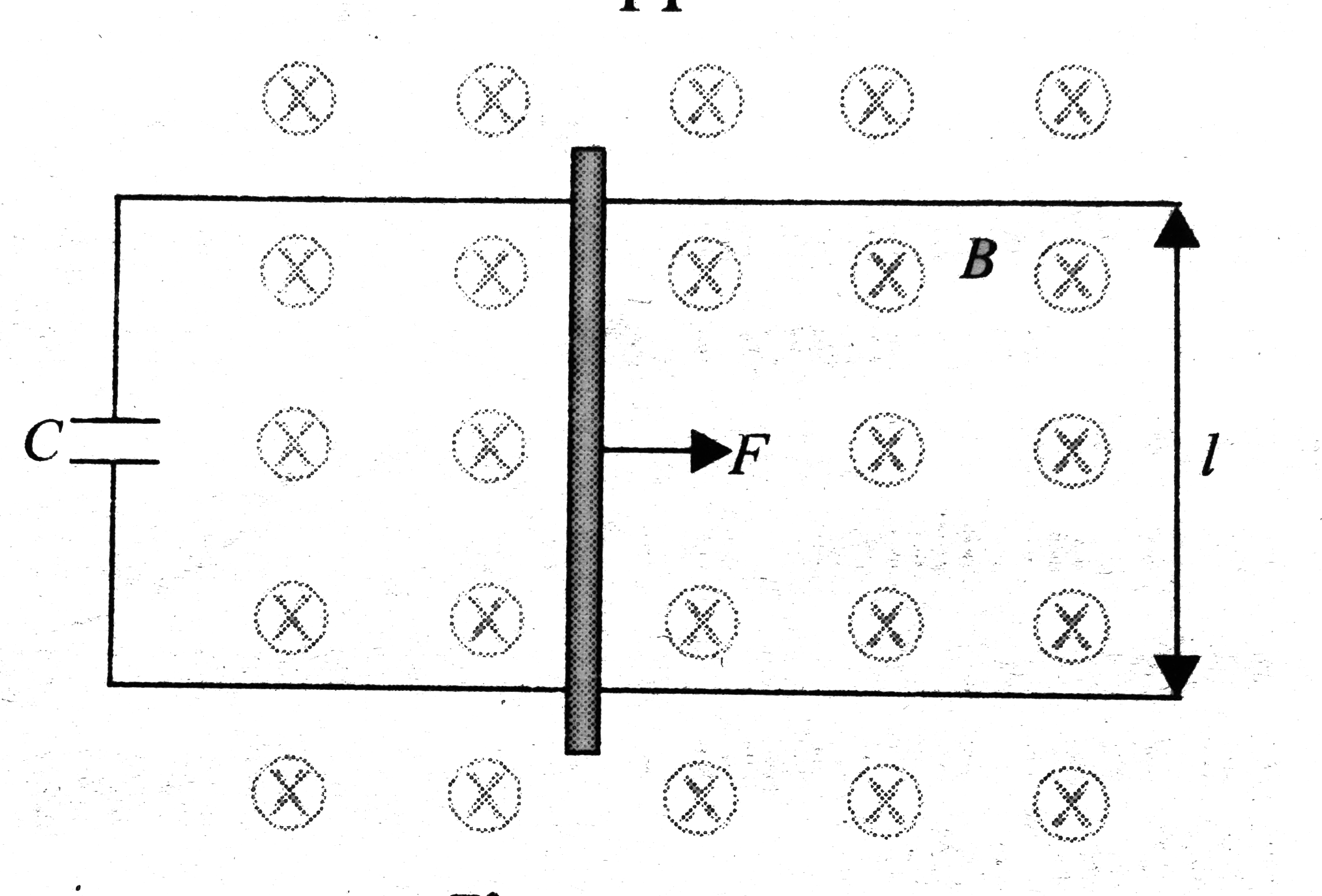
A conducting wire of length `l` and mass `m` can slide without friction on two parallel rails and is connected to capacitance `C`. The whole system lies in amagnetic field `B` and a constant force `F` is applied to the rod . Then

A

(a) the rod moves with constant velocity.

B

(b) the rod moves with an acceleration of `(F)//(m + B^(2)l^(2)C)`.

C

(c ) there is constant charge on the capacitor.

D

(d) charge on the capacitor increases with time.

Text Solution

Verified by Experts

The correct Answer is:

B, D

(b, d):
`I = (dq)/(dt) = (d)/(dt)(CvBl) = CBl(dv)/(dt) = Cbla`
`:.` `F - CB^(2)l^(2)a = ma`
`rarr` `a = (F)/(M + B^(2)l^(2)C)`
`rarr` emf increases
`rarr` charge increases.
Promotional Banner

Topper's Solved these Questions

  • ELECTROMAGNETIC INDUCTION

    CENGAGE PHYSICS|Exercise Exercises Asserton - Reasoning|8 Videos
  • ELECTROMAGNETIC INDUCTION

    CENGAGE PHYSICS|Exercise Exercises Linked Comprehension|36 Videos
  • ELECTROMAGNETIC INDUCTION

    CENGAGE PHYSICS|Exercise Exercises Single Correct|79 Videos
  • ELECTROMAGENTIC INDUCTION

    CENGAGE PHYSICS|Exercise QUESTION BANK|40 Videos
  • ELECTRON,PHONTS,PHOTOELECTRIC EFFECT & X-RAYS

    CENGAGE PHYSICS|Exercise dpp 3.3|15 Videos

Similar Questions

Explore conceptually related problems

A conductor of length l and mass m can slide without any friction along the two vertical conductors connected at the top through a capacitor. A uniform magnetic field B is set up _|_ to the plane of paper. The acceleration of the conductor

A conducting wire xy of lentgh l and mass m is sliding without friction on vertical conduction rails ab and cd as shown in figure. A uniform magnetic field B exists perpendicular to the plane of the rails, x moves with a constant velocity of

Figure shows a wire ab of length L and resistance R which can slide on a smooth pair of rails. I_(g) is current generator which supplies a constant current i in the circuit. If the wire ab slide at a speed v towards right, find the potential difference below a and b (b) The current generator I_(g) show in the figure sends a constant current i through the circiut. The wire ab has a length L and mass m and can slide on the smooth horizontal rails connect to I_(g) . The entire system lies in a vertical magnetic field B . Find the velocity of the wire as a function of time. (c) The system containing the rails and the wire of the previous part is kept vertically in a uniform horizontal magnetic field B that is perpendicular to the plane of the rails (figure). If is found that the wire stays in equilibrium. If th ewire ab is replaced by another wire of double its mass, how long will lit take in falling through a distance equal to its length? The current generator I_(g) shown in figure sends a constant current i through the circuit. The wire cd is fixed and wire ab is made to slide on the smooth, thick rails with a constant velocity v toward right. Each of these wires has resistance r . Find the current through the wire cd .

A wire cd of length l and mass m is sliding without friction on conducting rails ax and by as shown. The verticle rails are connected to each other with a resistance R between a and b . A uniform magnetic field B is applied perpendicular to the plane abcd such that cd moves with a constant velocity of

The long, horizontal pair of rails shown in the figure is connected using resistance R. The distance between the rails is l, the electrical resistance of the rails is negligible. A conducting wire of mass m and length l can slide without friction on the pair of rails, in a vertical, homogeneous magnetic field of induction B. A force of magnitude F_(0) is exerted for sufficiently long time onto the conducting wire, so that the speed of the wire becomes nearly constant. The force F_(0) is now removed at a certain point P What distance (inm) does the conducting wire cover on rails from point P before stopping? (Given F_(0)=20N, m=1.6 gm, R= 0.01 Omega l=19 cm, B=0.1 T)

A wire of length l , mass m and resistance R slides without any friction down the parallel conducting rails of negligible resistance . The rails are connected to each other at the bottom by a resistanceless rail parallel to the wire so that the wire and the rails form a closed rectangualr conducting loop. The plane of the rails makes an angle theta with the horizontal and a uniform vertical magnetic field of the inducetion B exists throughout the rregion. Find the steady state velocity of the wire.

Two long fixed parallel vertical conducting rails AB and CD are separated by a distance L. They are connected by resistance R and a capacitance C at two ends as shown in the figure. There is a uniform magnetic field B directed horizon- tally into the plane of the figure. A horizontal metallic bar of length L and mass m can slide without friction along the rails. The bar is released from rest at t = 0. Neglect resistance of bar and rails and also neglect the self inductance of the loop. (a) Find the maximum speed acquired by the bar after it is released. (b) Find the speed of the bar as a function of time t.

A metal wire of mass m slides without friction on two horizontal rails spaced distance d-apart as shown in figure. The rails are situated in a uniform magnetic field B, directed vertically upwards, and a battery is sending a current I through them. Find the velocity of the wire as a function of time, assuming it to be at rest initially.

CENGAGE PHYSICS-ELECTROMAGNETIC INDUCTION-Exercises Multiple Correct
  1. A circular loop of radius r, having N turns of a wire, is placed in a ...

    Text Solution

    |

  2. A uniform circular loop of radius a and resistance R palced perpendicu...

    Text Solution

    |

  3. A conducting wire of length l and mass m can slide without friction on...

    Text Solution

    |

  4. A conducting rod of length l is hinged at point O. It is free to rotat...

    Text Solution

    |

  5. A conducting rod of length is moved at constant velocity v(0) on two p...

    Text Solution

    |

  6. In the figure shown 'R' is a fixed conducting fixed ring of negligible...

    Text Solution

    |

  7. An infinite current-carrying conductor is placed along the z-axis and ...

    Text Solution

    |

  8. A disc of radius R is rolling without sliding on a horizontal surface ...

    Text Solution

    |

  9. A conducting loop rotates with constant angular velocity about its fix...

    Text Solution

    |

  10. A bar magnet is moved between two parallel circular loops A and B with...

    Text Solution

    |

  11. A bar magnet moves toward two idential parallel circular loops with a...

    Text Solution

    |

  12. A highly conducting ring of radius R is perpendicular to and concentri...

    Text Solution

    |

  13. The acceleration of the charge on the gap faces will cease when the to...

    Text Solution

    |

  14. In the figure shown , the wires P(1)Q(1) and P(2)Q(2) are made to slid...

    Text Solution

    |

  15. A small magnet M is allowed to fall through a fixed horizontal conduct...

    Text Solution

    |

  16. The counductor AD moves to the right in a uniform magnetic field direc...

    Text Solution

    |

  17. The magnitude of the earth's magnetic field at the north pole is B(0) ...

    Text Solution

    |

  18. A vertical conducting ring ogradius R falls vertically in a horizontal...

    Text Solution

    |

  19. A flat coil, C, of n turns, area A and resistance R, is placed in a un...

    Text Solution

    |

  20. In the above problem. The plane of the coil is initially kept parallel...

    Text Solution

    |
