Home
Class 12
PHYSICS
Following experiment was performed by J....

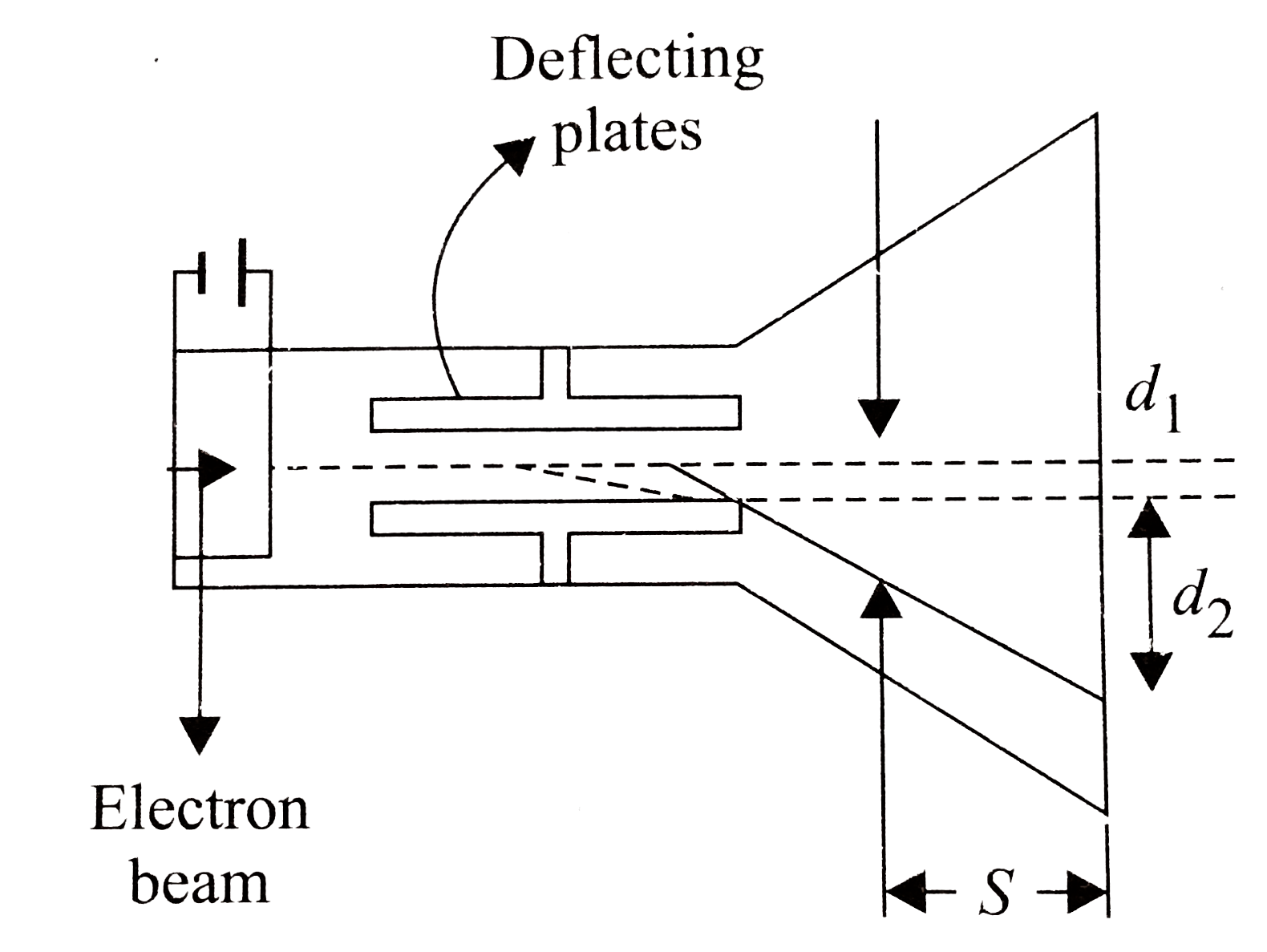
Following experiment was performed by J.J. Thomson in order to measure ratio of charge e and mass m of electron.

Electrons emitted from a hot filament are accelerated by a potential difference V. As the electrons pass through deflecting plates, they encounter both electric and magnetic fields. the entire region in which electrons leave the plates they enters a field free region that extends to fluorescent screen. The entire region in which electrons travel is evacuated.
Firstly, electric and magnetic fields were made zero and position of undeflected electron beam on the screen was noted. The electric field was turned on and resulting deflection was noted. Deflection is given by `d_(1) = (eEL^(2))/(2mV^(2))` where L = length of deflecting plate and v = speed of electron.
In second part of experiment, magnetic field was adjusted so as to exactly cancel the electric force leaving the electron beam undeflected. This gives eE = evB. Using expression for ` d_(1)` we can find out `(e)/(m) = (2d_(1)E)/(B^(2)L^(2))`
If the electron is deflected downward when only electric field is turned on, in what direction do the electric and magnetic fields point in second part of experiment

A

The electric field point to the top, while the magnetic field point into the page

B

The electric field point to the top, while the magnetic field point out of page

C

Electric field points to the bottom, while the magnetic field point out of pate

D

Electric field points to the bottom, while the magnetic field points into the page

Text Solution

Verified by Experts

The correct Answer is:

B

Since electrons are deflected downward, hence electric field must be upward. The magnetic force in order to cancel the electric force must point upward. From right hand rule, magnetic field must point out of page. Hence choice (b) is correct.
Promotional Banner

Topper's Solved these Questions

  • MISCELLANEOUS VOLUME 5

    CENGAGE PHYSICS|Exercise Integer|12 Videos
  • MISCELLANEOUS VOLUME 5

    CENGAGE PHYSICS|Exercise Multiple Correct|34 Videos
  • MISCELLANEOUS VOLUME 3

    CENGAGE PHYSICS|Exercise True and False|3 Videos
  • Moving charges and magnetism

    CENGAGE PHYSICS|Exercise Question Bank|20 Videos
CENGAGE PHYSICS-MISCELLANEOUS VOLUME 5-Linked Comprehension
  1. Magnetic force on a charged particle is given by vec F(m) = q(vec(v) x...

    Text Solution

    |

  2. Magnetic force on a charged particle is given by vec F(m) = q(vec(v) x...

    Text Solution

    |

  3. Following experiment was performed by J.J. Thomson in order to measure...

    Text Solution

    |

  4. Following experiment was performed by J.J. Thomson in order to measure...

    Text Solution

    |

  5. Following experiment was performed by J.J. Thomson in order to measure...

    Text Solution

    |

  6. In uniform magnetic field, if angle between vec(v) and vec(B) is 0^(@)...

    Text Solution

    |

  7. In uniform magnetic field, if angle between vec(v) and vec(B) is 0^(@)...

    Text Solution

    |

  8. In uniform magnetic field, if angle between vec(v) and vec(B) is 0^(@)...

    Text Solution

    |

  9. A straight segment OC(of length L meter) of a circuit carrying a curre...

    Text Solution

    |

  10. A straight segment OC(of length L meter) of a circuit carrying a curre...

    Text Solution

    |

  11. Four long wires each carrying current I as shown in Fig. are placed a...

    Text Solution

    |

  12. Four long wires each carrying current I as shown in Fig. are placed a...

    Text Solution

    |

  13. Consider the situation shown Fig. There present a magnetic field B = 1...

    Text Solution

    |

  14. Consider the situation shown in . The wires P1Q1 and P2 Q2 are made ...

    Text Solution

    |

  15. Suppose the 19 Omega resistor of the previous problem is disconnected....

    Text Solution

    |

  16. Suppose the 19 Omega resistor of the previous problem is disconnected....

    Text Solution

    |

  17. Consider the situation shown in . The wire PQ has a negligible resist...

    Text Solution

    |

  18. Consider the situation shown in . The wire PQ has a negligible resist...

    Text Solution

    |

  19. A square wire loop with 2 m sides is perpendicular to a uniform magnet...

    Text Solution

    |

  20. A square wire loop with 2 m sides is perpendicular to a uniform magnet...

    Text Solution

    |
