Home
Class 11
PHYSICS
A train approaching a railway crossing a...

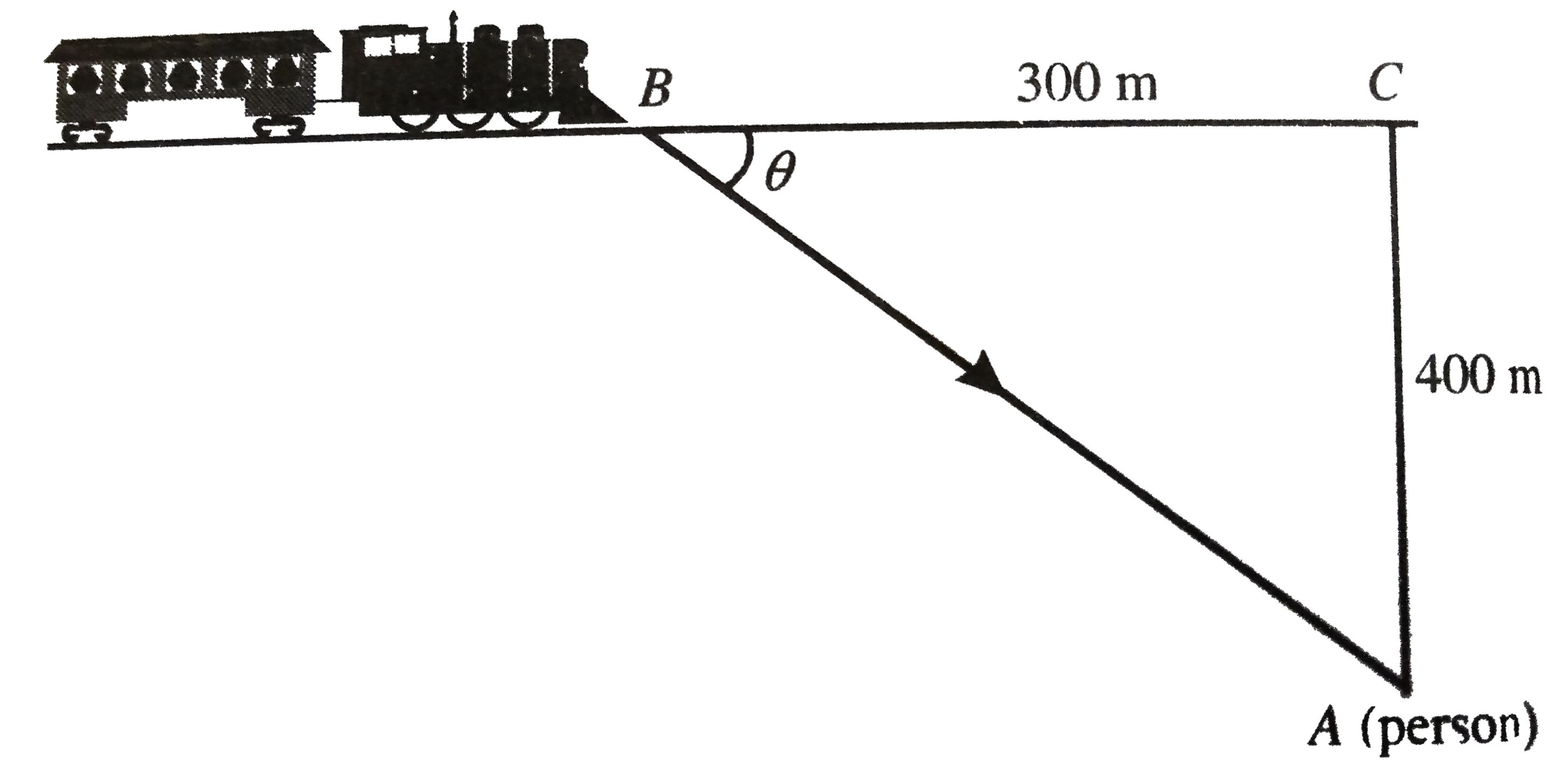
A train approaching a railway crossing at a speed of `120 kmh^-1` sounds a short whistle at frequency 640 Hz when it is 300 m away from the crossing. The speed of sound in air is `340 ms^-1`. What will be the frequency heard by a person standing on a road perpendicular to the track through the crossing at a distance of 400 m from the crossing ?

A

720 Hz

B

920 Hz

C

580 Hz

D

680 Hz

Text Solution

Verified by Experts

The correct Answer is:
D


The observer A is at rest with respect to the air and the source is travelling at a velocity of 120 km/s, i.e. `((100)/(3))(m)/(s)`. As is clear from the figure, the person receives the sound of the whistle in direction BA making an angle `theta` with the track where `costheta=(300)/(500)=(3)/(5)`. The component of the velocity of the source (i.e., of the train) along the direction AB is `((100)/(3))xx((3)/(5))(m)/(s)=20(m)/(s)`. As the source is approaching the person with this component, the frequency heard by the observer is `n'=(v)/(v-ucostheta)n=(340)/(340-20)xx640Hz=680Hz`
Promotional Banner

Topper's Solved these Questions

  • SOUND WAVES AND DOPPLER EFFECT

    CENGAGE PHYSICS|Exercise Examples|56 Videos
  • SOUND WAVES AND DOPPLER EFFECT

    CENGAGE PHYSICS|Exercise Exercise 6.1|56 Videos
  • RIGID BODY DYNAMICS 2

    CENGAGE PHYSICS|Exercise Interger|2 Videos
  • SUPERPOSITION AND STANDING WAVES

    CENGAGE PHYSICS|Exercise Comprehension Type|5 Videos

Similar Questions

Explore conceptually related problems

A train approaching a crossing at a speed of 100 km/h sounds a whistle 400 Hz when it is 1.5 km from the crossing. There is no wind and the speed of sound in air is 340 m/s. What frequency is heard by an observer 1.0 km on the strainght road from the crossing at right angles.

A locomotive approaching a crossing at a speed of 20 ms^(-1) sounds a whistle of frequency 640 Hz when 1 km from the crossing. There is no wind and the speed of sound in air is 330 ms^(-1) . What frequency is heard by an observer sqrt(3) km on the straight road from the crossing at right angle :-

A locomotive approaching a crossing at a speed of 80 mi/h sounds a whistle of frequency 400 Hz when 1 mi from the crossing. There is no wind, and the speed of sound in air is 0.200mi/s. What frequency is heard by an observer 0.60 mi from the crossing on the straight road which crosses the railroad at right angles?

A car approaching a crossing C at a speed of 20 m//s sounds a horn of frequency 500 H_(Z) when 80 m from the crossing . Speed of sound in air is 330 m//s . What frequency is heard by an observer (at rest) 60m from the crossing on the straight road which crosses car road at right angles ?

A car is approching a railway crossing at a speed of 72 kmph . It sounds a horn, when it is 800 m away, at 600 Hz . If the velocity of sound in air is 330 ms^(-1) . The apparent frequency as received by a man at rest near the railway track perpendicular to the road at a distance of 600 m from the crossing the

A train approaching a railway platform with a speed of 20 m s^(-1) starts blowing the whistle. Speed of sound in air is 340 m s^(-1) . If the frequency of the emitted sound from the whistle is 640 Hz, the frequency of sound as heard by person standing on the platform

A train approaching a hill at a speed of 60 km//hour sounds a whistle of frequency 600Hz when it is distance of 1km from the hill. Wind is blowing in the direction of the train with a speed of 60 km//h Find the frequency of the whistle heard by an observer on the hill:speed of sound in air 1200km/h)

CENGAGE PHYSICS-SOUND WAVES AND DOPPLER EFFECT-Integer
  1. A train approaching a railway crossing at a speed of 120 kmh^-1 sounds...

    Text Solution

    |

  2. The average power transmitted across a cross section by two sound wave...

    Text Solution

    |

  3. Loudness of sound from an isotropic point source at a distace of 70cm ...

    Text Solution

    |

  4. Two sound sources are moving away from a stationary observer in opposi...

    Text Solution

    |

  5. The resultant loudness at a point P is n dB higher than the loudness o...

    Text Solution

    |

  6. The average power transmitted across a cross section by two sound wave...

    Text Solution

    |

  7. Loudness of sound from an isotropic point source at a distace of 70cm ...

    Text Solution

    |

  8. Two sound sources are moving away from a stationary observer in opposi...

    Text Solution

    |

  9. The resultant loudness at a point P is n dB higher than the loudness o...

    Text Solution

    |

  10. The average power transmitted across a cross section by two sound wave...

    Text Solution

    |

  11. Loudness of sound from an isotropic point source at a distace of 70cm ...

    Text Solution

    |

  12. Two sound sources are moving away from a stationary observer in opposi...

    Text Solution

    |

  13. The resultant loudness at a point P is n dB higher than the loudness o...

    Text Solution

    |

  14. The average power transmitted across a cross section by two sound wave...

    Text Solution

    |

  15. Loudness of sound from an isotropic point source at a distace of 70cm ...

    Text Solution

    |

  16. Two sound sources are moving away from a stationary observer in opposi...

    Text Solution

    |

  17. The resultant loudness at a point P is n dB higher than the loudness o...

    Text Solution

    |

