Home
Class 11
PHYSICS
The only possibility of heat flow in a t...


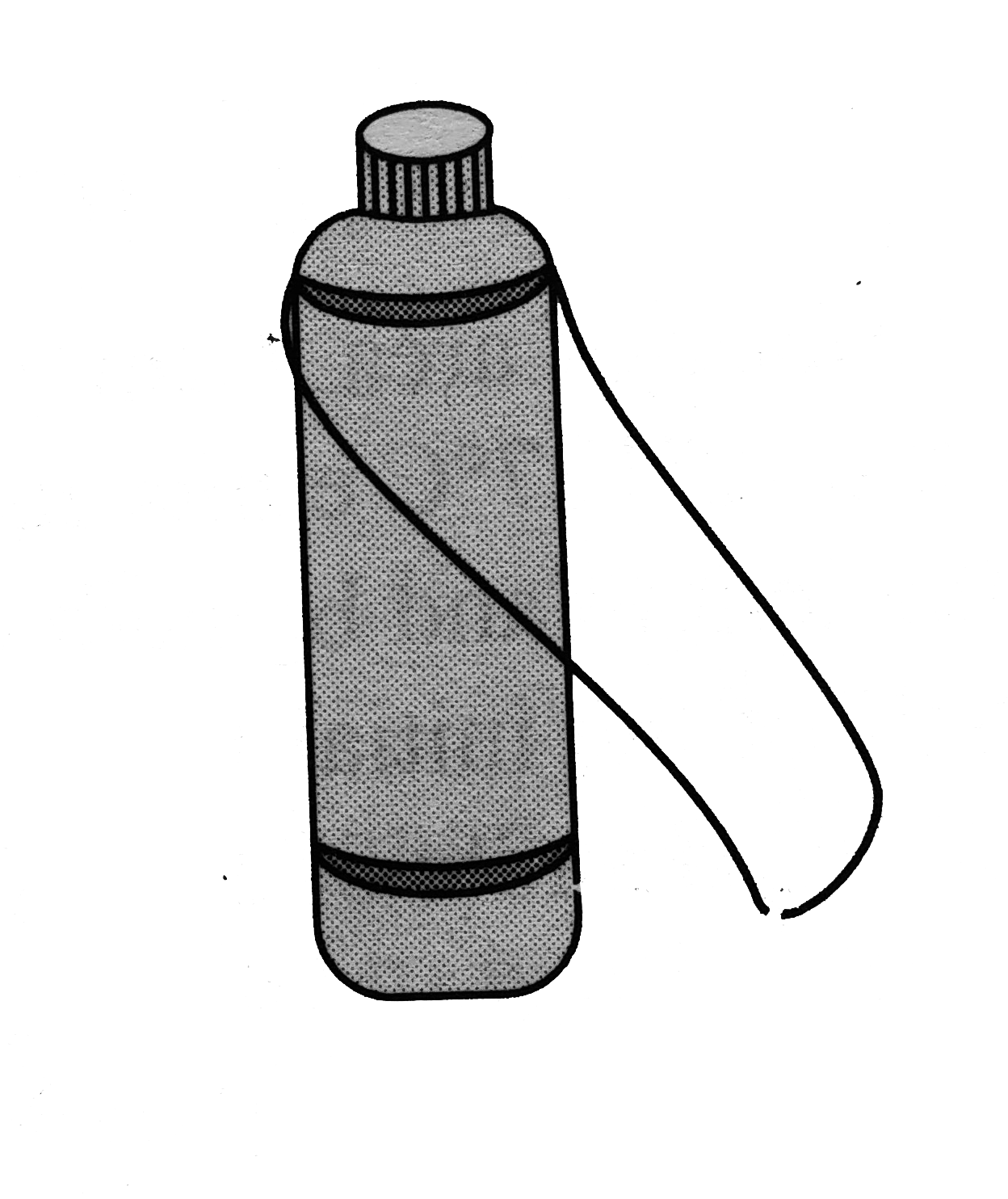
The only possibility of heat flow in a thermos flask is through its cork which is `75cm^2` in area and 5 cm thick its thermal conductivity is `0.0075 cal//cm-s-^@C`. The outside temperature is `40^@C` and latent heat of ice is `80 cal//g`. Time taken by 500 g of ice at `0^@C` in the flask to melt into water at `0^@C` is `

A

2.47 h

B

4.27 h

C

7.42 h

D

4.72 h

Text Solution

Verified by Experts

The correct Answer is:

A

`mL=(KaDeltathetat)/(Deltax)`
`implies=500xx80=(0.0075xx75xx(40-0)t)/(5)`
`impliest=8.9xx10^3s=2.47h`
Promotional Banner

Topper's Solved these Questions

  • CALORIMETRY

    CENGAGE PHYSICS|Exercise Multiple Correct|25 Videos
  • CALORIMETRY

    CENGAGE PHYSICS|Exercise Comprehension|30 Videos
  • CALORIMETRY

    CENGAGE PHYSICS|Exercise Subjective|25 Videos
  • BASIC MATHEMATICS

    CENGAGE PHYSICS|Exercise Exercise 2.6|20 Videos
  • CENTRE OF MASS

    CENGAGE PHYSICS|Exercise INTEGER_TYPE|1 Videos

Similar Questions

Explore conceptually related problems

The only possibility of heat flow in a thermos flask is through its cork which is 75 cm^(2) in area and 5 cm thick. Its thermal conductivity is 0.0075 cal//cm sec^(@)C . How lolng will 500 g of ice at 0^(@)C in thermos flask will is 40^(@)C and latent heat of ise is 80 cal.//gram .

The entropy change in melting 1g of ice at 0^@C . (Latent heat of ice is 80 cal g^(-1) )

The water of mass 75 g at 100^(@)C is added to ice of mass 20 g at -15^(@)C . What is the resulting temperature. Latent heat of ice = 80 cal//g and specific heat of ice = 0.5 .

Calculate change in entropy when 5g of pure ice melts to form water at 0^(@)C Given latent heat of ice is 80cal//g at 0^(@)C .

Find the heat required to convert 20 g of iceat 0^(@)C into water at the same temperature. ( Specific latent heat of fusion of ice =80 cal//g )

20 g of steam at 100^@ C is passes into 100 g of ice at 0^@C . Find the resultant temperature if latent heat if steam is 540 cal//g ,latent heat of ice is 80 cal//g and specific heat of water is 1 cal//g^@C .

What amount of ice will remains when 52 g ice is added to 100 g of water at 40^(@)C ? Specific heat of water is 1 cal/g and latent heat of fusion of ice is 80 cal/g.

50 g of steam at 100^@ C is passed into 250 g of at 0^@ C . Find the resultant temperature (if latent heat of steam is 540 cal//g , latent heat of ice is 80 cal//g and specific heat of water is 1 cal//g -.^@ C ).

There is ice formation on a tank of water of thickness 10 cm.How much time it will take to have a layer of 0.1 cm below it ?The outer temperature is -5^(@)C , the thermal conductivity of ice is 0.005 calcm^(-1) ""^(@)C^(-1) and latent heat of ice is 80cal//g and the density of ice is 0.91 gcm^(-3) :

150 g of ice is mixed with 100 g of water at temperature 80^(@)C . The latent heat of ice is 80 cal/g and the specific heat of water is 1 cal//g-.^(@)C . Assuming no heat loss to the environment, the amount of ice which does not melt is –

CENGAGE PHYSICS-CALORIMETRY-Single Correct
  1. Six identical cunducting rods are joined as shown in Fig. Points A and...

    Text Solution

    |

  2. An ice box used for keeping eatables cool has a total wall area of 1m^...

    Text Solution

    |

  3. The only possibility of heat flow in a thermos flask is through its co...

    Text Solution

    |

  4. Certain substance emits only the wavelengths lamda1,lamda2,lamda3 and ...

    Text Solution

    |

  5. Figure. Shows two air filled bulbs connected by a U-tube partly filled...

    Text Solution

    |

  6. A black body at 200 K is found to emit maximum energy at a wavelength ...

    Text Solution

    |

  7. The energy spectrum f a black body exhibits a maximum around a wavelen...

    Text Solution

    |

  8. The wavelength of maximum energy released during an atomic axplosion w...

    Text Solution

    |

  9. The rectangular surface of area 8 cm xx 4 cm of a black body at temper...

    Text Solution

    |

  10. A solid copper cube of edges 1 cm is suspended in an evacuated enclosu...

    Text Solution

    |

  11. A sphere, a cube and a thin circular pate are heated to the same tempe...

    Text Solution

    |

  12. A sphere and a cube of same material and same volume are heated up to ...

    Text Solution

    |

  13. A substance cools from 75^@C to 70^@C in T1 minute, from 70^@C to 65^@...

    Text Solution

    |

  14. A liquid takes 5 minutes to cool from 80^@C to 50^@C . How much time w...

    Text Solution

    |

  15. A body takes T minutes to cool from 62^@C to 61^@C when the surroundin...

    Text Solution

    |

  16. The rates of cooling of two different liquids put in exactly similar c...

    Text Solution

    |

  17. Hot water cools from 60^@C to 50^@C in the first 10 min and to 42^@C i...

    Text Solution

    |

  18. There are two thin spheres A and B of the same material and same thick...

    Text Solution

    |

  19. As shown in Fig. AB is rod of length 30 cm and area of cross section 1...

    Text Solution

    |

  20. Two rods are joined between fixed supports as shown in the figure. Con...

    Text Solution

    |
