Home
Class 11
PHYSICS
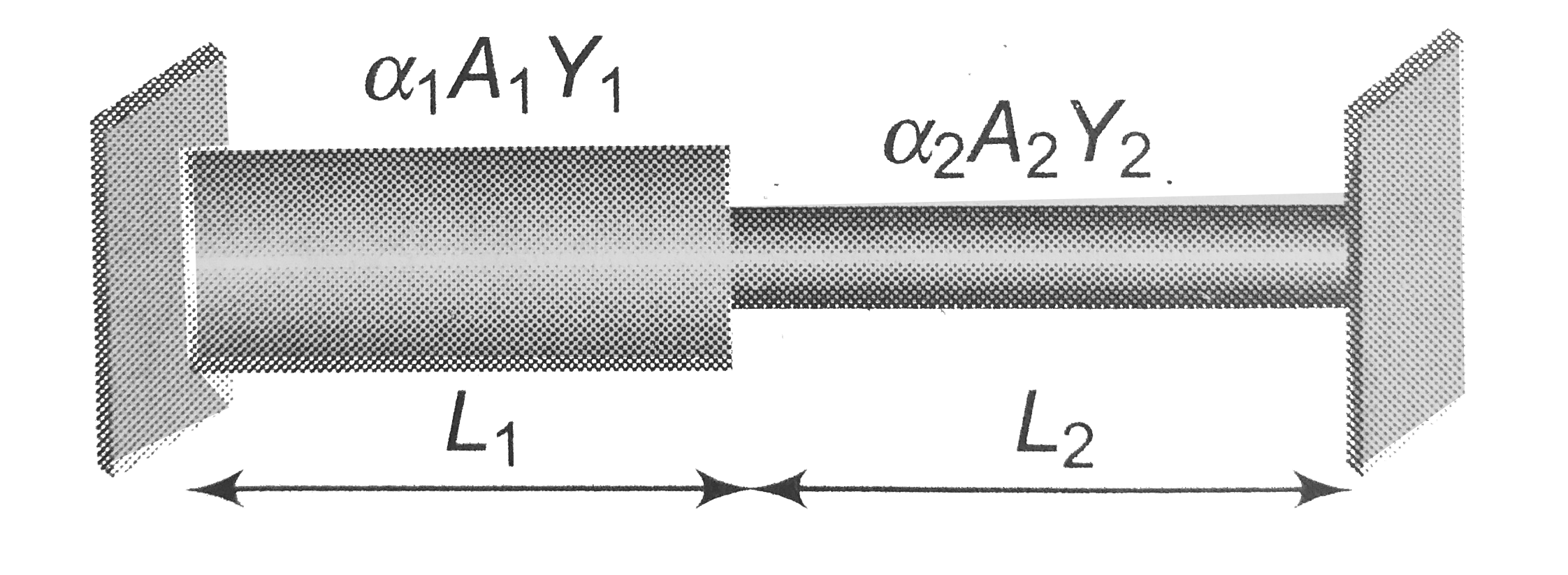
Two rods are joined between fixed suppor...

Two rods are joined between fixed supports as shown in the figure. Condition for no change in the length of individual rods with the increase of temperature will be
`"(" alpha_(1), alpha_(2)=` linear expansion coefficient
`A_(1), A_(2)=` Area of rods
`Y_(1), Y_(2)=` Young modulus `")"`

A

`(A_1)/(A_2)=(alpha_1y_1)/(alpha_2y_2)`

B

`(A_1)/(A_2)=(L_1alpha_1y_1)/(L_2alpha_2y_2)`

C

`(A_1)/(A_2)=(L_2alpha_2y_2)/(L_1alpha_1y_1)`

D

`(A_1)/(A_2)=(alpha_2y_2)/(alpha_1y_1)`

Text Solution

Verified by Experts

The correct Answer is:

D

since tension in the two rods will be same,
`A_1Y_1alpha_1Deltatheta=A_2Y_2alpha_2Deltatheta`
`A_1Y_1alpha_1=A_2Y_2alpha_2`
Promotional Banner

Topper's Solved these Questions

  • CALORIMETRY

    CENGAGE PHYSICS|Exercise Multiple Correct|25 Videos
  • CALORIMETRY

    CENGAGE PHYSICS|Exercise Comprehension|30 Videos
  • CALORIMETRY

    CENGAGE PHYSICS|Exercise Subjective|25 Videos
  • BASIC MATHEMATICS

    CENGAGE PHYSICS|Exercise Exercise 2.6|20 Videos
  • CENTRE OF MASS

    CENGAGE PHYSICS|Exercise INTEGER_TYPE|1 Videos

Similar Questions

Explore conceptually related problems

The variation of lengths of two moles rods A and B with change in temperature is shown in figure . The ratio of (alpha_(a))/(alpha_(B)) is :-

Two rods AB and BC of equal cross-sectional area are joined together and clamped between two fixed supports as shown in the figure. For the rod AB and road BC lengths are l_(1) and l_(2) coefficient of linear expansion are alpha_(1) and alpha_(2) , young's modulus are Y_(1) and Y_(2) , densities are rho_(1) and rho_(2) respectively. Now the temperature of the compound rod is increased by theta . Assume of that there is no significant change in the lengths of rod due to heating. then the time taken by transverse wave pulse to travel from end A to other end C of the compound rod is directly proportional to

Two metal rods are fixed end to end between two rigid supports as shown in figure. Each rod is of length l and area of cross-section is A . When the systeam is heated up,datermine the condition when the juncation between rods does not shift ? ( Y_(1) and Y_(2) are Young's modulus of materials of rods, alpha_(1) and alpha_(2) are coefficients of linear expansion)

Two metal rods are fixed end to end between two rigid supports, as shown in figure. Each rod is of length 'l' and area of cross-section is A. When the system is heated up, determine the conditioin whenthe juction between rods does not shift. [Given, Y_(1) and Y_(2) are Young's modulus of materials of the rods, alpha_(1) and alpha_(2) are coefficient at linear expansion.

Two rods of different materials having coefficient of thermal expansion alpha_(1), alpha_(2) and young's modulii Y_(1) ,Y_(2) respectively are fixed between two rigid massive walls. The rods are heated such that they undergo the same increase in temperature. There is no bending of rods. If alpha_(1) :alpha_(2)=2 : 3 , the thermal stresses developed in the two rods are equal provided Y_(1) : Y_(2) is equal to

Two rods of equal cross sections, one of copper and the other of steel, are joined to form a composite rod of length 2.0 m at 20^@C , the length of the copper rod is 0.5 m. When the temperature is raised to 120^@C , the length of composite rod increases to 2.002m. If the composite rod is fixed between two rigid walls and thus not allowed to expand, it is found that the lengths of the component rods also do not change with increase in temperature. Calculate Young's moulus of steel. (The coefficient of linear expansion of copper, alpha_c=1.6xx10^(-5@)C and Young's modulus of copper is 1.3xx10^(13)N//m^(2) ).

The coefficient of linear expansion of a rod is alpha and its length is L. The increase in temperature required to increase its legnth by 1% is

CENGAGE PHYSICS-CALORIMETRY-Single Correct
  1. There are two thin spheres A and B of the same material and same thick...

    Text Solution

    |

  2. As shown in Fig. AB is rod of length 30 cm and area of cross section 1...

    Text Solution

    |

  3. Two rods are joined between fixed supports as shown in the figure. Con...

    Text Solution

    |

  4. A rod of length l and cross sectional area A has a variable conductivi...

    Text Solution

    |

  5. A black body emits radiation at the rate P when its temperature is T. ...

    Text Solution

    |

  6. A solid metallic sphere of diameter 20 cm and mass 10 kg is heated to ...

    Text Solution

    |

  7. The coefficient of linear expansion of an in homogeneous rod change li...

    Text Solution

    |

  8. A wire is made by attaching two segments together end to end. One segm...

    Text Solution

    |

  9. Heat is required to change 1 kg of ice at -20^@C into steam. Q1 is the...

    Text Solution

    |

  10. A block of wood is floating in water at 0^@ C. The temperature of wate...

    Text Solution

    |

  11. An incandescent lamp consumint P=54W is immersed into a transparent ca...

    Text Solution

    |

  12. A thread of liquid is in a uniform capillary tube of length L. As meas...

    Text Solution

    |

  13. A brass wire 2 m long at 27^@C is held taut with negligible tension be...

    Text Solution

    |

  14. A mass m of lead shot is placed at the bottom of a vertical cardboard ...

    Text Solution

    |

  15. An iron rocket fragment initially at -100^@C enters the earth's atmosp...

    Text Solution

    |

  16. A liquid of density 0.85 g//cm^(3) flows through a calorimeter at the ...

    Text Solution

    |

  17. An iron ball (coefficient of linear expansion=1.2xx(10^(-5)//^(@)C) ha...

    Text Solution

    |

  18. A flask of mercury is sealed off at 20^@C and is completely filled wit...

    Text Solution

    |

  19. The densities of wood and benzene at 0^(@)C are 880 kg//m^(3) and 900 ...

    Text Solution

    |

  20. An iron rod and another of brass, both at 27^@C differ in length by 10...

    Text Solution

    |
