Home
Class 11
PHYSICS
Explain whether (a) T(2) gt T(1), (b) P(...

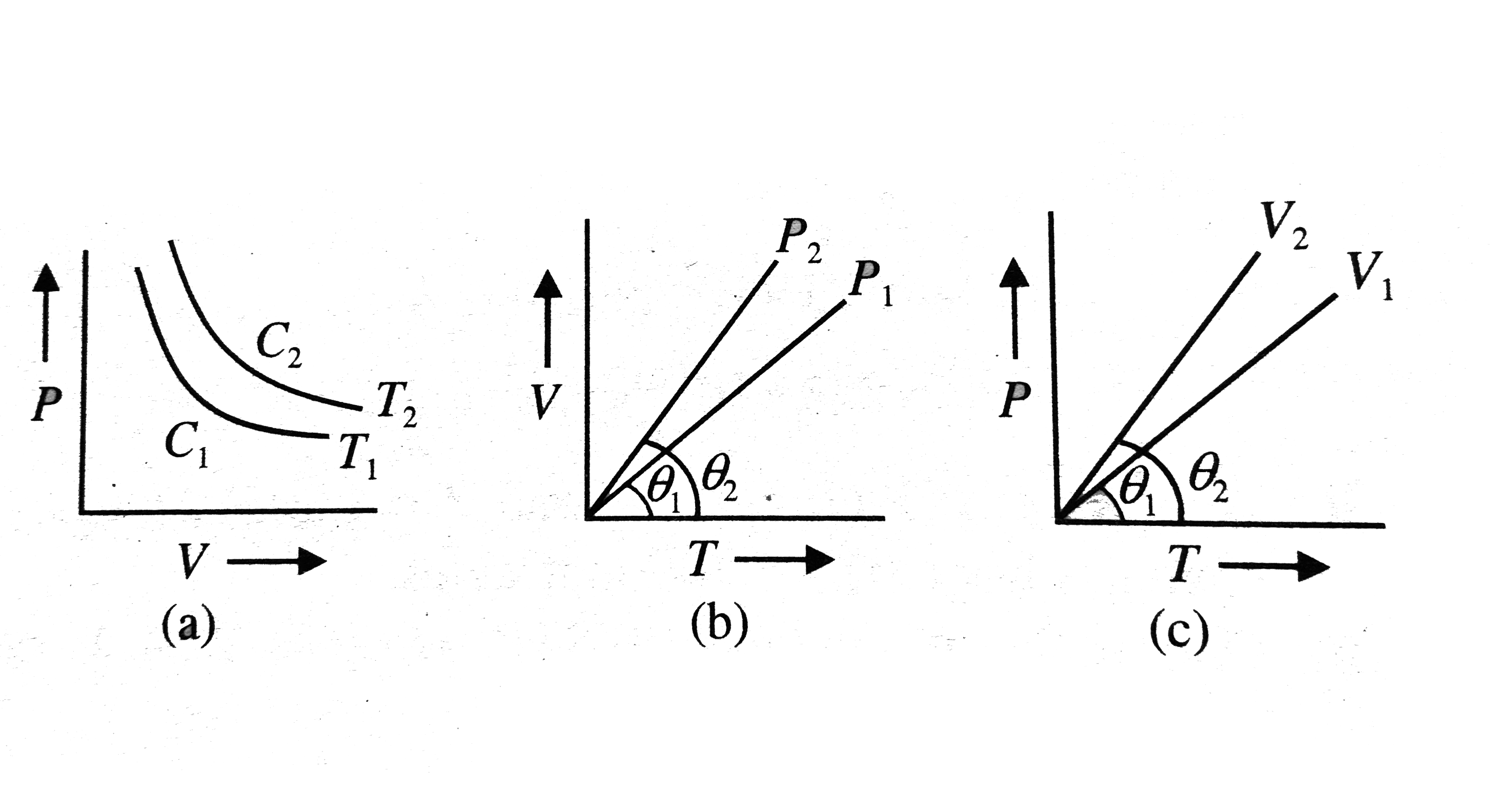
Explain whether (a) `T_(2) gt T_(1)`, (b) `P_(2) gt P_(1)` and (c ) `V_(2) gt V_(1)` or otherwise in Fig., which represent in isothermal, isobaric, and isochoric processes for the same mass of an ideal gas, respedtively.

Text Solution

Verified by Experts

As the given curve is rectangular hyperbols, its equation will be
`PV = C` as `xy = `constant.
So, gas equation `PV = mu RT` in the light of above yields
`T = (PV)/(mu R) = (C )/(mu R)`
Now from Fig. `C_(2), C_(1)` (as for same `x, y_(2) gt y_(1)), T_(2) gt T_(1)`.
(b) As the given curve is a straight line passing through the origin with positive slope is equaiton will be
`V = (tan theta) T` (as `y = mx)`
So the gas equation `PV = mu T` in the light of above yields
`P = (mu RT)/(V) = (mu RT)/(T tan theta) = (mu R)/(tan theta)`
Now as form Fig. we get, `theta_(2) gt theta_(1)`, i.e., `tan theta_(2) gt tan theta_(1)`, so `P_(2) lt P_(1)`.
(c ) As the given curve is a straight line passing through the origin with positive slope, its equation will be
`P = T tan theta` (as `y = mx)`
So gas equation `PV = (mu RT)/(P) = (mu RT)/(T tan theta) = (mu R)/(tan theta)`
Now as from Fig. we get, `theta_(2) gt theta_(1) , tan theta_(2) gt tan theta_(1)`, so `V_(2) lt V_(1)`.
Promotional Banner

Topper's Solved these Questions

  • KINETIC THEORY OF GASES AND FIRST LAW OF THERMODYNAMICS

    CENGAGE PHYSICS|Exercise Solved Examples|14 Videos
  • KINETIC THEORY OF GASES AND FIRST LAW OF THERMODYNAMICS

    CENGAGE PHYSICS|Exercise Exercise 2.1|20 Videos
  • KINETIC THEORY OF GASES

    CENGAGE PHYSICS|Exercise Compression|2 Videos
  • LINEAR AND ANGULAR SIMPLE HARMONIC MOTION

    CENGAGE PHYSICS|Exercise Multiple Correct Answer Type|9 Videos

Similar Questions

Explore conceptually related problems

Explain whether (i) T_2gtT_1 (ii) P_2gtP_1 and (iii) V_2gtV_1 for given mass of gas.

The plots between P and V which represent isochoric and isobaric process respectively:

The pressure-volume of varies thermodynamic process is shown in graphs: Work is the mole of transference of energy. It has been observed that reversible work done by the system is the maximum obtainable work. w_(rev) gt w_(irr) The works of isothermal and adiabatic processes are different from each other. w_("isothermal reversible") = 2.303 nRT log_(10) ((V_(2))/(V_(1))) = 2.303 nRT log_(10)((P_(2))/(P_(1))) w_("adiabatic reversible") = C_(V) (T_(1)-T_(2)) If w_(1),w_(2),w_(3) and w_(4) are work done in isothermal, adiabatic, isobaric, and isochoric reversible processes, respectively then the correct sequence (for expansion) would be

Draw the approximate plots of isochoric, isobaric, isothermal, and adiabatic processes for the case of an ideal gas, using the following variables : (a) p, T : (b) V , T .

Straight line on (p - T) graph for an ideal gas represents isochoric process. If p prop T, V = constant .

A gas has been subjected to isochoric-isobaric processes 1-2-3-4-1 see Fig. Plot this process on T - V and P - T diagrams.

A gas has been subjected to an isothermal-isochromic cycle 1-2-3-4-1 see Fig. Represent the same cycle on P - V and P - T diagrams.

Assertion: When ideal gas expand from P_(1), V_(1), T_(1), to P_(2), V_(2), T_(2) two steps, and work done is high in which number of steps are high Reason: Work is path function

For an ideal gas, an illustratio of three different paths A(B+C) and (D+E) from an initial state P_(1), V_(1), T_(1) to a final state P_(2), V_(2),T_(1) is shown in the given figure. Path A represents a reversible isothermal expansion form P_(1),V_(1) to P_(2),V_(2) , Path (B+C) represents a reversible adiabatic expansion (B) from P_(1),V_(1),T_(1)to P_(3),V_(2),T_(2) followed by reversible heating the gas at constant volume (C) from P_(3),V_(2),T_(2) to P_(2),V_(2),T_(1) . Path (D+E) represents a reversible expansion at constant pressure P_(1)(D) from P_(1),V_(1),T_(1) to P_(1),V_(2),T_(3) followed by a reversible cooling at constant volume V_(2)(E) from P_(1),V_(2),T_(3) to P_(2),V_(2),T_(1) . What is q_(rev) , for path (B +C) ?

For an ideal gas, an illustratio of three different paths A(B+C) and (D+E) from an initial state P_(1), V_(1), T_(1) to a final state P_(2), V_(2),T_(1) is shown in the given figure. Path A represents a reversible isothermal expansion form P_(1),V_(1) to P_(2),V_(2) , Path (B+C) represents a reversible adiabatic expansion (B) from P_(1),V_(1),T_(1)to P_(3),V_(2),T_(2) followed by reversible heating the gas at constant volume (C) from P_(3),V_(2),T_(2) to P_(2),V_(2),T_(1) . Path (D+E) represents a reversible expansion at constant pressure P_(1)(D) from P_(1),V_(1),T_(1) to P_(1),V_(2),T_(3) followed by a reversible cooling at constant volume V_(2)(E) from P_(1),V_(2),T_(3) to P_(2),V_(2),T_(1) . What is DeltaS for path (D +E) ?
