Home
Class 11
PHYSICS
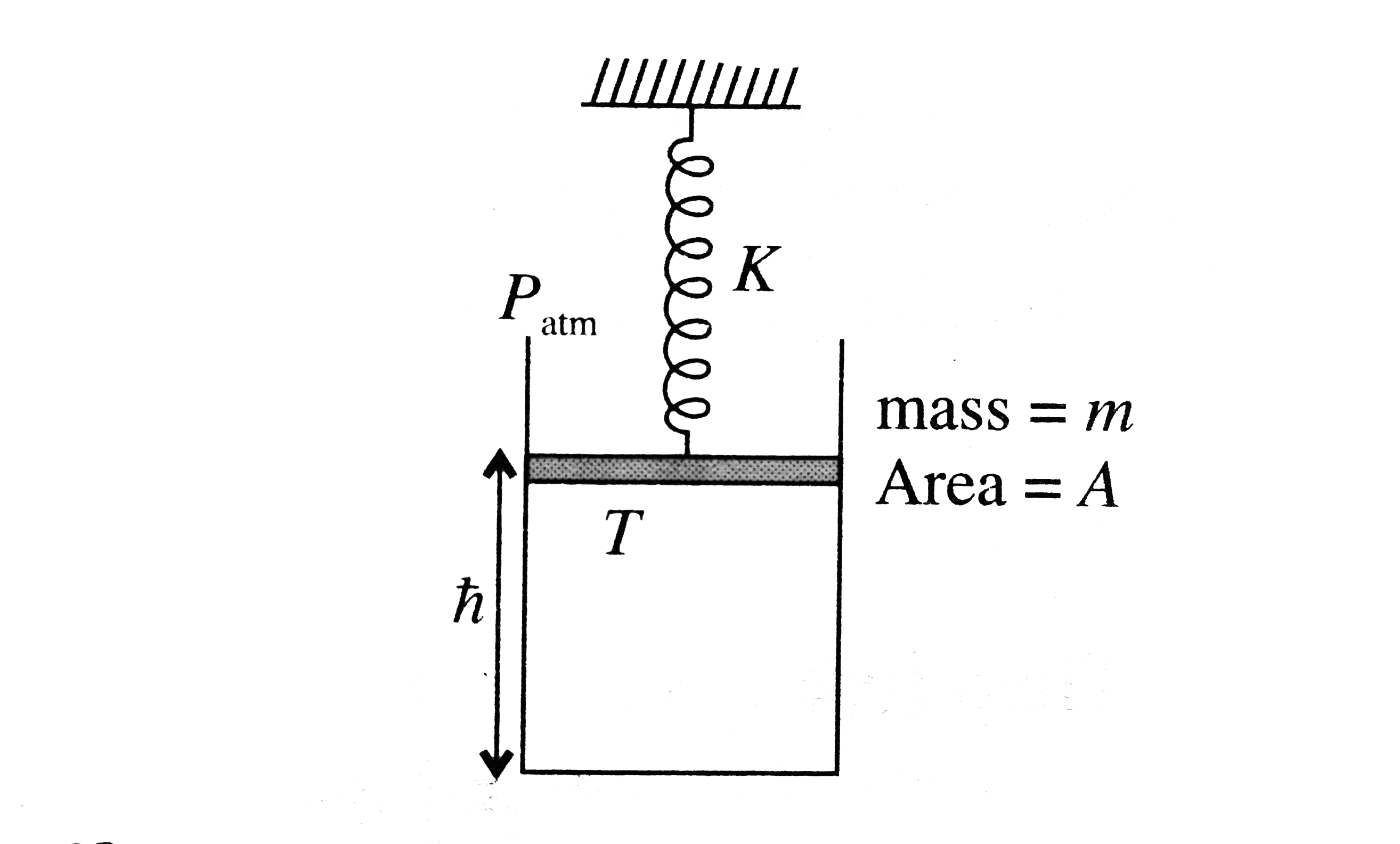
A non conducting piston of mass m and ar...

A non conducting piston of mass m and area of cross section A is placed on a non conducting cylinder as shown in figure. Temperature, spring constant, height of the piston are given by T,K,h respectively. Initially spring is relaxed and piston is at rest. Find
(a) Number of moles
(b) Work done by gas to displaced the piston by distance d when the gas is heated slowly.
(c ) Find the final temperature

Text Solution

Verified by Experts

a. `PV = nRT implies (P_(atm) + (mg)/(A)) Ah = nRT`
`implies n = ((P_("atm") + (mg)/(A))Ah)/(RT)`
b. 1st method : Applying newton's law on the piston
`mg + P_("atm")A + Kx = P_("gas")A`
`W_("gas") = int_(0)^(d) P_(g)A dx = int_(0)^(d) (mg + P_("atm")A + Kx) dx`
`implies W_("gas") = mgd + P_("atm")dA + (1)/(2) Kd^(2)`
2nd method : Applying work energy theorem on the pistion
`W_("all") = Delta KE`
c. Since pistons moves slowly therefore `Delta KE = 0`
`W_("gravity") + W_("gas") + W_("atm") + W_("spring") = 0`
`- mgd + W_("gas") + (- P_("atm")Ad) + [-((1)/(2) Kd^(2) - 0)] = 0`
`implies W_("gas") = mgd + P_("atm")dA + (1)/(2) Kd^(2)`
Promotional Banner

Topper's Solved these Questions

  • KINETIC THEORY OF GASES AND FIRST LAW OF THERMODYNAMICS

    CENGAGE PHYSICS|Exercise Solved Examples|14 Videos
  • KINETIC THEORY OF GASES AND FIRST LAW OF THERMODYNAMICS

    CENGAGE PHYSICS|Exercise Exercise 2.1|20 Videos
  • KINETIC THEORY OF GASES

    CENGAGE PHYSICS|Exercise Compression|2 Videos
  • LINEAR AND ANGULAR SIMPLE HARMONIC MOTION

    CENGAGE PHYSICS|Exercise Multiple Correct Answer Type|9 Videos

Similar Questions

Explore conceptually related problems

Method 3 of W Mass of a piston shown in Fig. is m and area of cross-section is A. Initially spring is in its natural length. Find work done by the gas.

2 moles of a diatomic gas are enclosed in a cylinder piston arrangment. The area of cross section and mass of the piston are 1 cm^(2) and 1 kg respectively. A heater is supplying heat to the gas very slowly. Find heat supplied (in joule) by the heater is the piston moves through a distance of 10 cm. .

A gas is filled in the cylinder shown in fig. The two pistons are joined by a string. If the gas is heated, the right piston will

A non - conducting piston of mass m and are S_(0) divides a non - conducting, closed cylinder as shown in the figure. A piston having mass m is connected with the top wall of the cylinder by a spring of force constant k. The top part is evacuated and the bottom part is evacuated and the bottom part contains an ideal gas at a pressure P_(0) in the equilibrium position. Adiabatic exponent gamma and in equilibrium length of each part is l. (neglect friction). Find the angular frequency for small oscillation.

A smooth piston of mass m area of cross - section A is in equilibrium in a gas jar when the pressure of the gas is P_(0) . Find the angular frequency of oscillation of the piston, assuming adiabatic Change of state of the gas.

Consider a vertical tube open at both ends. The tube consistss of two parts, each of different cross sections and each part having a piston which can move smoothly in respective tubes. The two piston which can move smoothly in respective tube wire. The piston are joined together by an inextensible wire. The combined mass of the two piston is 5 kg and area of cross section of the upper piston is 10 cm^(2) greater than that of the lower piston. Amount of gas enclosed by the pistons is 1 mol . When the gas is heated slowly, pistons move by 50 cm . Find the rise in the temperature of the gas in the form X//R K , where R is universal gas constant. Use g = 10 m//s^(2) and outside pressure = 10^(5) N//m^(2)) .

An ideal gas at NTP is enclosed in an adiabatic vertical cylinder havin an area of cross section A=27 cm^(2) between two light movable pistons as shown in figure. Spring with force constant K=37-- N//m is in a relaxed state initially. Now the lower position is moved upwards a distance h//2 , h being the initial length of gas column . It is observed that the upper piston moves up by a distance h//16 . Final temperature of gas 4//3 xx 273 K . Take gamma for the gas to be 3//2 . When the lower pistone is moved upwards a distance h//2 , the compression.

The cylinder shown in the figure has conducting walls and temperature of the surrounding is T, the pistonj is initially in equilibrium, the cylinder contains n moles of a gas, Now the piston is displaced slowly by an external agent to make the volume double of the initial. Find work done by external agent in term of n, R, T

A cylindrical tube ofuniform cross sectional area A is fitted with two frictionless pistons, as shown in figure-2.46. The pistons are connected to each other by a metallic wire. Initially the pressure of the gas is equal to atmospheric pressure P_0 and temperature is T^0 . If the temperature of the gas is increased to 2T_0 , find the tension in the wire.
