Home
Class 11
PHYSICS
Consider the cyclic process ABCA on a sa...

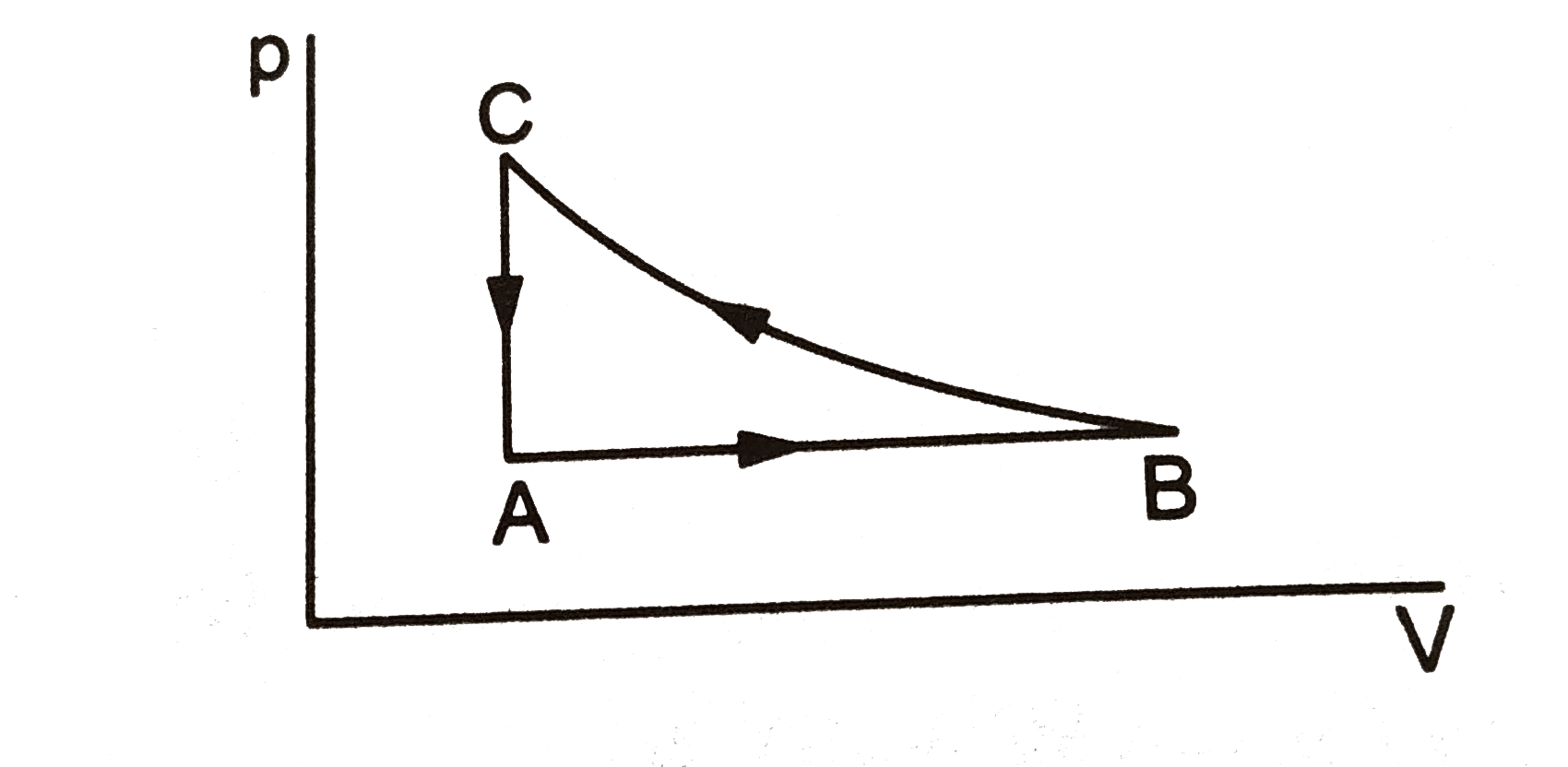
Consider the cyclic process `ABCA` on a sample of `2.0 mol` of an ideal gas as shown in the figure. Temperature of the gas at `A` and `B` are `300 K` and `500 K` respectively. A total of `1200 J` heat is withdrawn from the sample in the process. Find the work done by the gas in part `BC`. take `R=8.3 JK^(-1) mol^(-1)`

Text Solution

Verified by Experts
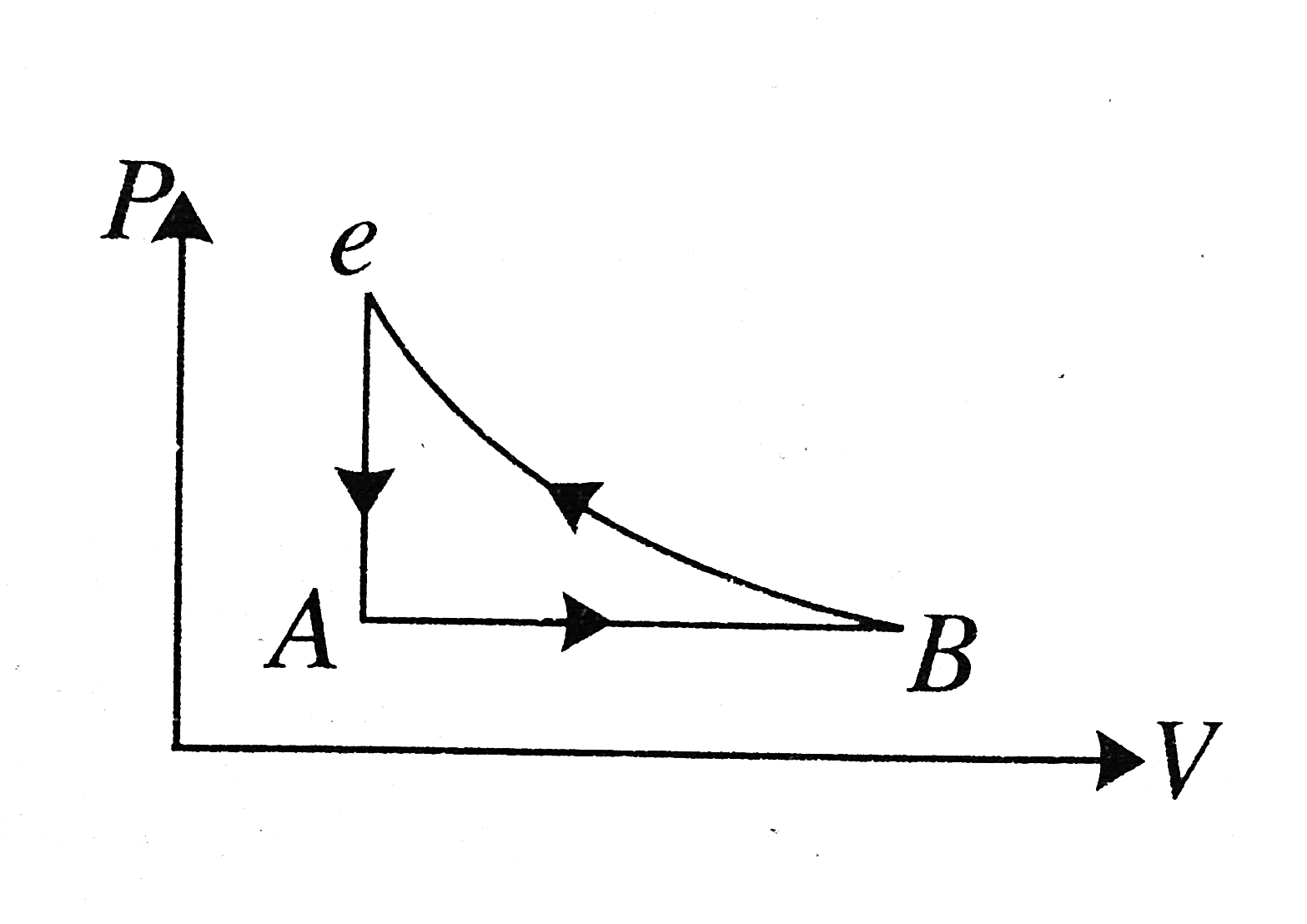
The change in internal energy during the cyclic process is zero. Hence, the heat supplied to the gas is equal to the work done by it Hence,
`W_(AB) + W_(BC) + W_(CA) = - 1200 J`
The work done during the process AB is
`W_(AB) = P_(A) (V_(B) - B_(A))`
`nRT (T_(B) - T_(A))`
`= (2.0 mol) (8.3 J//mol - K) (200 K)`
`= 3320 J`
The work done by the gas during the process CA is zero as the volume remains constant. From (i).
`3320 J + W_(BC) = - 1200 J`
or `W_(BC) = - 4520 J - - 4520`
Promotional Banner

Topper's Solved these Questions

  • KINETIC THEORY OF GASES AND FIRST LAW OF THERMODYNAMICS

    CENGAGE PHYSICS|Exercise Solved Examples|14 Videos
  • KINETIC THEORY OF GASES AND FIRST LAW OF THERMODYNAMICS

    CENGAGE PHYSICS|Exercise Exercise 2.1|20 Videos
  • KINETIC THEORY OF GASES

    CENGAGE PHYSICS|Exercise Compression|2 Videos
  • LINEAR AND ANGULAR SIMPLE HARMONIC MOTION

    CENGAGE PHYSICS|Exercise Multiple Correct Answer Type|9 Videos

Similar Questions

Explore conceptually related problems

consider the cyclic process ABCA on a sample of 2.0 mol of an ideal gas as shown in the temperature of the gas at A and B are 300 K and 500 k respectively. A total of 1200 J heat is withdrawn from the sample in the process. Find the work done by the gas in part BC. take R=8.3 JK^(-1) mol^(-1)

Consider the cyclic process ABCA, shown in, performed on a sample of 2.0 mol if an ideal gas. A total of 1200 J if heat is withdrawn from the sample in the process. Find the work done by the gas during the part BC.

Consider the cyclic process abca performed on a sample of 2.0 mole of an ideal gas. A total of 1000 cal of heat is withdrawn from the sample in the process. Find the work done by the gas during the past bc.

In figure, a sample of 3 moles of an ideal gas is undergoing through a cyclic process ABCA. A total of 1500J of heat is withdraw from the sample in the process. The work done by the gas during the part BC is -P K J. FIND P. (R = (25)/(3) J//"mole"K)

shows the variation in the internal energy U with the volume V of 2.0 mol of an ideal gas in a cyclic process abcda. The temperatures of the gas at b and c are 500 K and 300 K respectively. Calculate the heat absorbed by the gas during the process.

Consider the following cyclic abcda performed on 2 mole of an ideal gas. The temperature of the gas at b and c are 400 k and 300 k respectively. Calculated the heat absorbed by the gas during the process in calories.

In figure, a cyclic process ABCA of 3 moles of an ideal gas is given. The temperature of the gas at B and C are 500k and 1000K respectively. If work done on the gas in process CA is 2500J then find the net heat absorbed or released by an idela gas. Take R = 25//3J//mol-K .

A cyclic process performed on one mole of an ideal gas. A total 1000 J of heat is withdrawn from the gas in a complete cycle. Find the work. Done by the gas druing the process BrarrC .

The cyclic process for 1 mole of an ideal gas is shown in the V-T diagram. The work done in AB, BC and CA respectively is

A cyclic process for 1 mole of an ideal gas is shown in the V-T diagram. The work done in AB, BC and CA respectively are

