Home
Class 11
PHYSICS
An ideal gas (2.0 moles) is carried roun...

An ideal gas (2.0 moles) is carried round a cycle as shown. If the process `b rarr c` is isothermal and `C_(V) = 3 cal//mol//K`. Determine
a. work done,
b. change in internal energy,
c. heat supplied to the system during processes `a rarr b`, `b rarr c` and `c rarr a`.

Text Solution

Verified by Experts
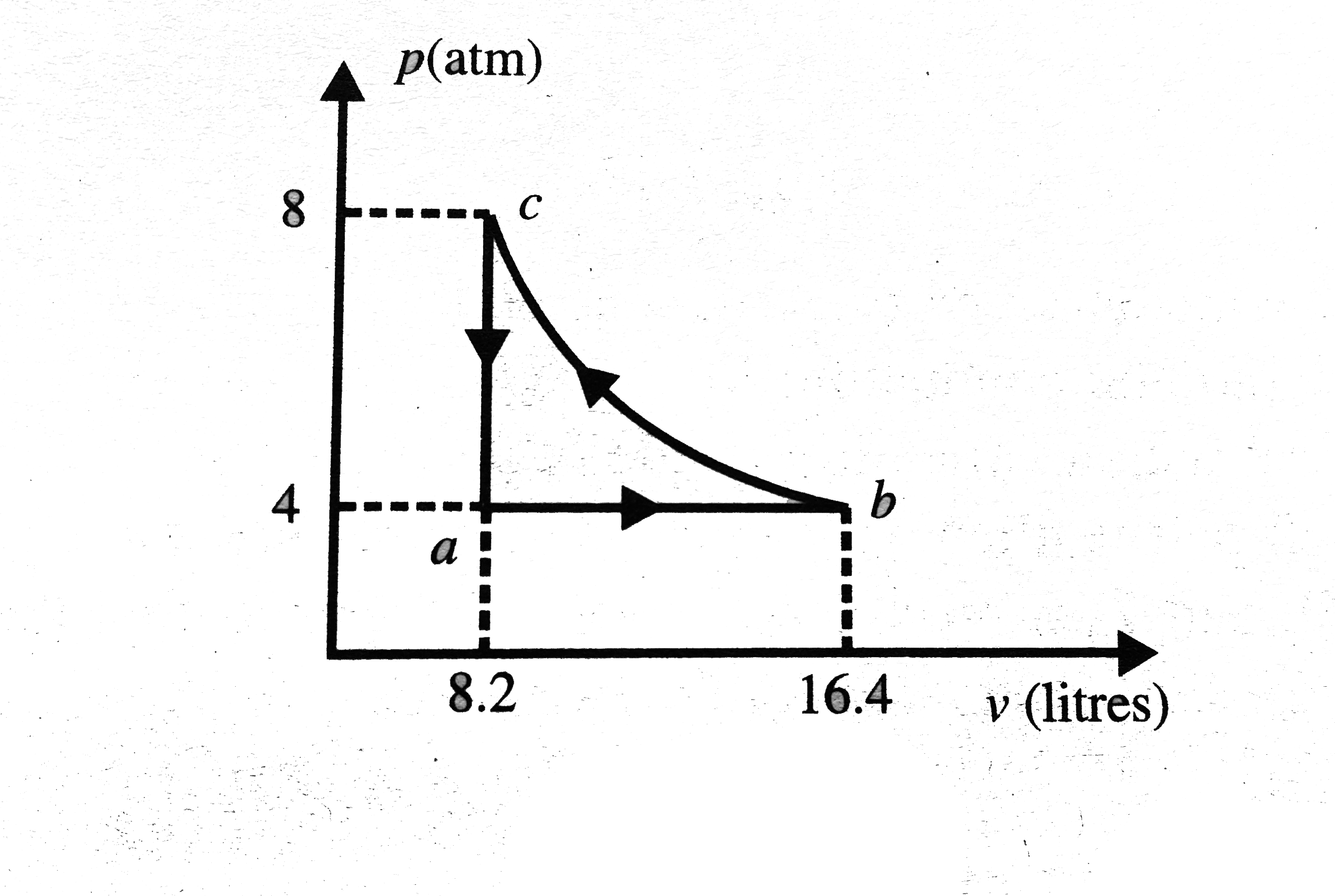
a. Work done , W
process `a rarr b` is clearly isobaric at P = 4 atm.
`W = P (V_(b) - V_(a)) = 4 (16.4 - 82) = 32.8 L atm`
`implies W_(a - b) = 32.8 - 101 = 3313 J`
Process `b rarr c` is isothermal (given)
`W = 2.303 nRT log (V_(c )//V_(b))`
`implies W = 2.303 (P_(b) V_(b)) log (V_(c )//V_(b))`
`W = 2.303 (4 xx 16.4 xx 101) log (8.2//16.4)`
`W_(b rarr c) = - 4592.5 J`
Process `c rarr a` is isochoric (volume is constant)
`W_(c rarr a) = 0 J`
b. change in internal energy `Delta U`
Process `c rarr a : Delta U = nC_(v) Delta T`
`Delta U = nC_(v) ((P_(b) V_(b))/(nR) - (P_(a) V_(a))/(nR))` (since pV = nRT)
`= (C_(v))/(R ) (P_(0) V_(0) - P_(a) V_(a)) = (3)/(0.0821) (4 xx 16.4 - 4 xx 8.2)`
`implies Delta U = 1200` cal
Process `b rarr c` : isothermal, `Delta T = 0`
`implies Delta U = 0`
Process `c rarr Delta U` for complete cyclic process is zero because it depends on initial and final states i.e., temperature difference only.
`(Delta U)_(ab) + (Delta U)_(bc) +(Delta U)_(ca) = 0`
`implies 1200 + 0 + (Delta U)_(ca) = 0`
`implies (Delta U)_(ca) = - 1200` col
Heat supplied : `Delta H`
Using the first law of thermodynamics:
`(Delta H)_(ab) = (Delta U)_(ab) + W_(ab)`
`= (1200 + 3313 // 4.18) cal = 1992.5 "cal"`
`implies (Delta Q)_(ab) = 1992.5 cal`
`implies (Delta H)_(bc) = (Delta U)_(bc) + W_(bc)`
`= (0 - 4592.5 // 4.18) cal = 1098.7 cal`
`implies (Delta H)_(bc) = 1098.7 cal`
`(Delta H)_(ca) = (Delta U)_(ca) + W_(ca) = - 1200 + 0 = - 1200 cal`
`implies Delta H = 1200 cal`
Promotional Banner

Topper's Solved these Questions

  • KINETIC THEORY OF GASES AND FIRST LAW OF THERMODYNAMICS

    CENGAGE PHYSICS|Exercise Exercise 2.1|20 Videos
  • KINETIC THEORY OF GASES AND FIRST LAW OF THERMODYNAMICS

    CENGAGE PHYSICS|Exercise Exercise 2.2|28 Videos
  • KINETIC THEORY OF GASES AND FIRST LAW OF THERMODYNAMICS

    CENGAGE PHYSICS|Exercise Interger|11 Videos
  • KINETIC THEORY OF GASES

    CENGAGE PHYSICS|Exercise Compression|2 Videos
  • LINEAR AND ANGULAR SIMPLE HARMONIC MOTION

    CENGAGE PHYSICS|Exercise Multiple Correct Answer Type|9 Videos

Similar Questions

Explore conceptually related problems

Find work done in the process A rarr B (isothermal) by gas?

Graph for one mole gas is given below Work done in the process C rarr A is

P-V curve of a diatomic gas is shown in the Fig. Find the total heat given to the gas in the process A rarr B rarr C

The enthalpy change for the process C("graphite") rarr C(g) is called

An ideal gas undergoes a series of processes represented by a rarr B rarr C rarr D on the P-V diagram. Answer the following questions. (a) Is the internal energy of the gas at B and D equal? (b) Find work done by the gas in the process A rarr B rarr C rarr D . (c) Is it right to say that point B and D lie on an isotherm? (d) Find the ratio of internal energy of the gas in state A to that in state D.

If work done by the system is 300 joule when 100 cal. Heat is supplied to it. The change in internal energy during the process is :-

Five mole of a gas put through a series of change as shown below graphically in a cyclic process. The processes A rarr B, B rarr C and C rarr A , respectively, are

An ideal gas is taken through a thermodynamic cycle ABCDA. In state A pressure and volume are P_(0) and V_(0) respectively. During the process A rarr B , work done by the gas is zero and its temperature increases two fold. During the process B rarr C , internal energy of the gas remains constant but work done by it is W_(BC) = – P_(0)V_(0) ln2 . In the process C rarr D , the temperature decreases by 50% while the volume does not change. In the process D rarr A the temperature of the gas does not change. (a) Draw pressure – volume (P–V) and pressure – density (P – rho) graph for the cyclic process. (b) Calculate work done on the gas during the cycle.

An ideal gas (gamma = 1.67 ) is taken through the process abc shown in figure . The temperature at the point a is 300 k . Calculate (a) the temperature at b and c, (b) the work done in the process, ( c) the amount of heat supplied in the path ab and in the path bc and (d) the change in the internal energy of the gas in the process.

